The CBD market continues to grow, but advertising remains one of its biggest challenges. Despite rising demand, many brands still face ad disapprovals, limited reach, or account restrictions—even when their products meet legal requirements. The reason is simple: platform policies do not always align with product legality.
A compliant CBD advertising strategy now means knowing exactly what platforms allow, what they block, and how to promote your brand without crossing policy lines. This guide breaks down the key rules, common limits, safer alternatives, and the mistakes that still get brands into trouble.
Why Are CBD Advertising Rules So Restrictive?
CBD advertising is restricted because the rules do not fully line up across regulators, states, and ad platforms. A product may be legal to sell in some form, but that does not mean Google or Meta will allow it in paid ads.
The biggest reason is regulatory uncertainty. The FDA says CBD cannot be marketed as a dietary supplement, and it also bars CBD as an added ingredient in food sold across state lines. That alone makes paid promotion harder.
Another issue is claims. The moment a brand starts talking like CBD can treat, cure, or prevent a health condition, it moves into risky territory fast. FDA warning actions over the years are a big reason platforms stay cautious.
Then comes the platform layer. Google, Facebook, and Instagram apply their own review systems, and those rules are often stricter than what a brand expects.
So even a legally sold product may still get blocked in ads. That is why CBD advertising rules feel so hard to work around.
| Did you know? Epidiolex is the only approved CBD drug product, as per the FDA. That is one reason platforms do not want broad CBD product advertising to look medical or therapeutic. |
Google’s CBD Advertising Policy (Current Status)
Google’s CBD advertising rules fall under its “Dangerous Products and Services” and “Healthcare and Medicines” policies. These allow only limited promotion of certain CBD products.
In 2026, most CBD ads are still restricted.
Right now, Google only permits ads for certain topical hemp-derived CBD products, and even that comes with limits. Advertisers must be certified, THC must stay at 0.3% or less, and targeting is limited to California, Colorado, and Puerto Rico.
So, in simple words, most CBD Google Ads are still off the table.
What does this mean for advertisers?
✔️ Some topical CBD products may be allowed
❌ Oils, gummies, capsules, and drinks are not allowed
✔️ Certification is required
❌ Ads cannot run everywhere
Here, “topical” means products applied to the skin, like creams or balms. Products intended for ingestion do not fall under this category.
Why do ads still get rejected?
Even when brands try to follow the rules, ads can still get disapproved. This usually happens because of small gaps like:
- Landing pages mentioning restricted products
- Health-related wording in the ad
- Mismatch between the ad and the website
Quick example
✔️ A skincare-focused CBD cream ad linking to a compliant page
❌ A CBD oil ad or a page promoting ingestible products
Why is Google this strict?
Because CBD still sits in a sensitive category. Federal limits are not fully settled, state rules vary, and it does not want risky product claims or broad exposure where rules differ. That is the real reason behind most CBD ad compliance issues on the platform.
Meta’s CBD Advertising Policy (Facebook & Instagram)
Apart from Google, Meta platforms such as Facebook and Instagram also have strict rules for CBD advertising.
| Facebook CBD ad rules | Instagram CBD ad rules |
| LegitScript approval is required. | An active LegitScript certification is needed. |
| Meta must grant written permission. | You need direct written approval from Meta. |
| Ads have to match local legal requirements. | Campaigns must comply with the laws of the place where they run. |
| Anyone under 18 cannot be targeted. | The ad audience cannot include users below 18. |
Note: Facebook, Instagram, and Google’s CBD ad policies can change at any time, so always check their latest official guidelines before running a campaign.
This is where most brands hit a wall:
- Using health-focused or medical-style wording.
- Linking to pages that make stronger claims than the ad.
- Assuming hemp legality is enough for approval.
- Reusing the same campaign across platforms without checking the CBD platform policies first.
Where CBD Ads Still (and May) Work?
Since major platforms like Google and Meta remain restrictive, many CBD brands look for other ways to keep campaigns running. Insights shared in PPC discussions on Reddit also point to the same pattern—traditional ad platforms remain limited for CBD, so marketers often test channels like Snapchat, Twitter, and TikTok, as well as influencers and alternative placements.
What CBD Brands CAN Advertise?
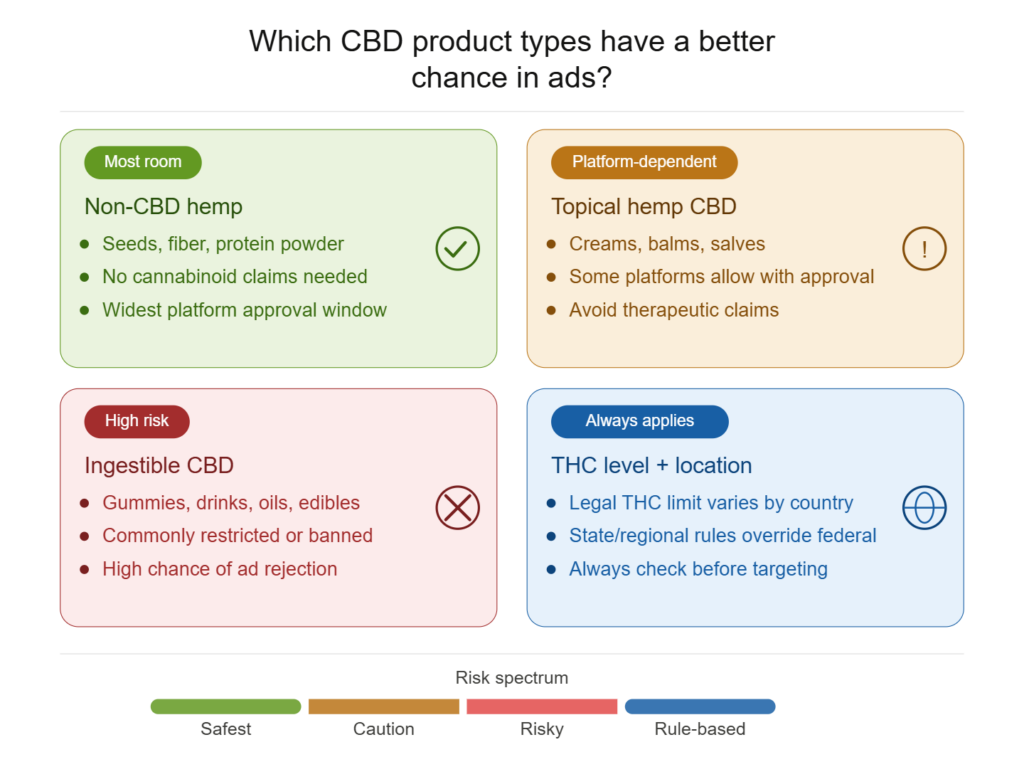
CBD brands usually have a better chance of getting ads approved when they move away from ingestible products and focus on the limited areas platforms still allow.
✔️ Safer to advertise: Hemp products that are not sold as CBD products, some topical CBD products, educational content, and brand-focused campaigns.
⚠️ Harder to advertise: Ingestible CBD, strong product claims, and health-related wording.
❌ Most likely to fail: “Buy now” ads for oils, gummies, drinks, or anything that sounds like a medical promise.
Non-CBD Hemp Products and Topicals
One area where brands usually have more room is hemp products that are not sold as CBD products, as well as certain topical CBD products.
If a brand wants to run paid ads, this is often the safest place to begin. Meta says written permission is not needed for hemp products that do not contain CBD and do not go over 0.3% THC.
Google is more strict. It allows only certain topical CBD products made from hemp, and even then, advertisers must be certified. These ads can only be shown in California, Colorado, and Puerto Rico.
Brand Awareness vs Direct Response
Another safer route is to focus on awareness instead of immediate sales.
Most platforms are more open to brand awareness campaigns than direct response campaigns. In simple terms, it is usually better to promote the brand, its story, or helpful educational content than to run a direct “shop now” ad for CBD products.
Here is the basic difference:
| Brand awareness: Introduces the brand, its values, product type, or educational content. |
| Direct response: Tries to get an immediate sale, usually with stronger sales language. |
Compliant Alternatives To Paid Advertising
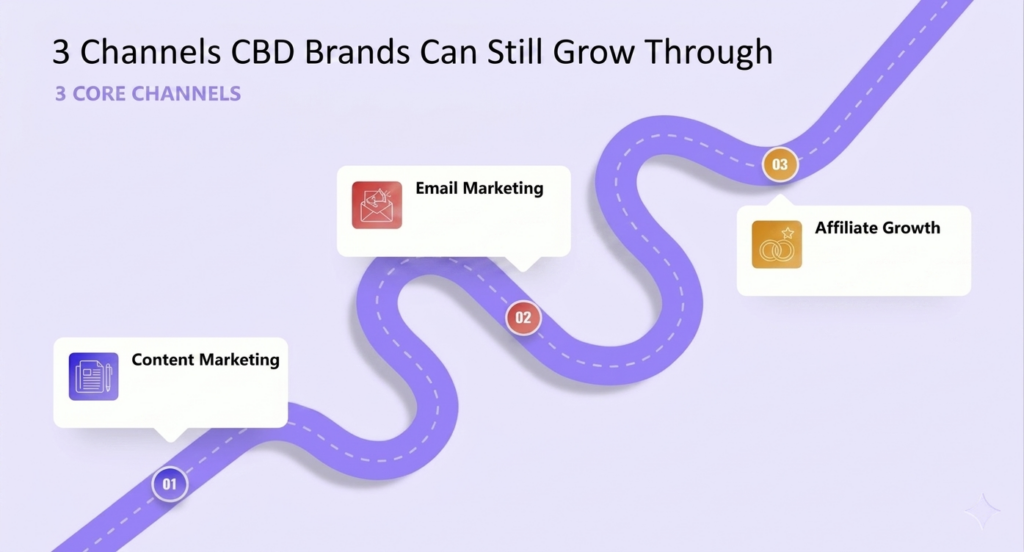
When paid ads stop working well, CBD brands need other ways to get noticed and bring people to their website. That is where SEO, email marketing, and trusted partnerships become useful, especially because of strict CBD marketing restrictions.
These channels are easier to manage, more stable over time, and less likely to face the same ad issues again and again.
1. SEO and Content Marketing
One of the strongest alternatives is SEO and content marketing.
Instead of trying to sell right away, this approach helps a brand show up when people are already searching for answers. It fits well in the CBD space because it puts the focus on education, search intent, and trust.
A smart SEO and content plan usually includes:
- Blog posts that answer real customer questions
- Product education pages written in easy-to-understand language
- Use of long-tail keywords with clearer intent
- Guides, FAQs, and comparison content
- Lab-report pages and other trust-building content
Here’s why this method is effective:
- It builds organic traffic over time
- It gives the brand more control than paid ads
- It supports CBD ad compliance by keeping the focus on helpful content instead of risky ad copy.
| Important Insight: Do not build every article around “buy now” intent. A lot of strong CBD traffic starts higher in the funnel with searches that ask what, how, when, or which. |
👉🏻 Since SEO and content need consistent work to perform well, we handle that at CBD Marketing Solutions through our CBD marketing services, with support across keyword research, on-page SEO, off-page SEO, and blog management.
2. Email Marketing (List-Based)
Email marketing is another useful option for CBD brands because it helps them reach people who have already shown interest. That could be someone who joined the list, visited the site, or bought before. Unlike paid ads, email doesn’t require approval over and over.
It is often used to support things like:
- Welcome emails
- Product education
- New product updates
- Cart reminders
- Repeat purchase messages
To make email more useful, CBD brands can split their list into smaller groups.
For example, they might send different emails to new subscribers, past customers, or people interested in a certain product type. This makes the message feel more relevant and less random.
Email also needs to be handled carefully. The content should be useful, honest, and trustworthy.
A good CBD email strategy usually means:
- Using honest subject lines.
- Avoiding medical claims.
- Making the unsubscribe option easy to find.
- Keeping the tone more helpful than overly salesy.
| Useful insight: Email usually works better when the brand teaches first and sells second. That keeps the message useful, builds trust, and makes offers feel more natural. |
3. Affiliate and Influencer Marketing
Affiliate and influencer marketing is another compliant CBD advertising strategy that can help CBD brands grow without depending only on paid ads. This works by reaching people through creators, publishers, or partners who already have trust with their audience.
| Both terms are different! Influencer marketing helps with reach and brand awareness. Whereas, affiliate marketing is more focused on tracked sales through links or discount codes. |
A good setup usually includes:
Working with micro-influencers in spaces like wellness, skincare, yoga, or pet care.
↓
Giving partners custom links or coupon codes to measure results.
↓
Focusing on educational content instead of direct hard selling.
↓
Choosing partners whose audience matches the product type.
At the same time, this channel still needs to be handled carefully. As per the FTC, influencers should clearly disclose any material connection to a brand, such as payment, free products, or discounts. Those disclosures should be easy to notice and easy to understand.
That is why a safer setup usually includes:
✔️ Using clear labels like #ad or #sponsored.
✔️ Avoiding medical claims.
✔️ Reviewing partner content before and after it goes live.
✔️ Choosing creators who can explain the product in a simple, natural way.
| Pro tip no one will tell you! Do not use influencers only for sales posts. They can also help with product education, how-to content, and simple brand awareness, which often feels more natural and more believable. |
👉🏻 For brands that want to grow this channel in a more organized way, we support affiliate-led growth in the CBD niche by helping brands build the right partnerships and turn them into steady results.
Staying Compliant As Policies Evolve
| The future of CBD marketing may keep changing, but the safer path stays the same:Stay updated → Stay careful → Keep your compliant CBD advertising strategy ready and aligned with current rules. |
CBD marketing rules are unlikely to stay fixed for long. Platforms update their policies, review systems change, and what gets approved today may not work the same way later. That is why a compliant CBD advertising strategy cannot be treated as a one-time setup. It has to keep changing as the rules change.
Looking ahead, brands will likely need to depend less on shortcuts and more on systems they can manage with care.
That usually means:
⭐ Keeping a close eye on platform policy updates.
⭐ Reviewing ad copy, landing pages, and partner content regularly.
⭐ Avoiding claims that sound medical or misleading.
⭐ Building stronger direct customer relationships through channels the brand controls more closely.
| Important! A policy update, account review, or platform restriction can slow growth overnight. |
The Takeaway
CBD advertising in 2026 leaves very little room for guesswork. Brands need to know which products can be promoted, which claims can create problems, and which channels are safer when paid ads are limited. That is why the smartest path is not to push harder, but to build a compliant CBD advertising strategy that stays careful, flexible, and easy to trust.
CBD Marketing Solutions helps CBD brands turn compliance into growth. Take the next step with a strategy built to last—contact us to get started.
FAQs
Can CBD brands advertise on Google in 2026?
Yes, but only in limited cases. On Google Ads, advertising is restricted to certain topical, hemp-derived CBD products with 0.3% THC or less, and advertisers must complete certification. These ads are also limited to specific regions, such as California, Colorado, and Puerto Rico, so most CBD brands cannot run broad campaigns.
Do CBD advertisers need LegitScript certification to run ads?
In many cases, yes. Platforms like Facebook, Instagram, and Google require LegitScript certification for eligible CBD advertising. On Meta platforms, additional approval is also needed before ads can run. Without certification, most CBD ads are unlikely to get approved.
Can you run ads for CBD gummies, oils, or other ingestible products?
In most cases, no. Major platforms like Google, Facebook, and Instagram do not allow ads for ingestible CBD products such as gummies, oils, or drinks. Restrictions are stricter for these products compared to topical CBD items.
What kind of claims can get a CBD ad rejected?
Claims that suggest a product can treat, cure, prevent, or diagnose a health condition are the most likely to cause rejection. Even indirect or exaggerated claims can create issues. In general, anything that sounds like a medical promise should be avoided.
What is the safest way to market CBD if paid ads are limited?
The safest approach is to focus on SEO, educational content, email marketing, and partnerships. These channels give brands more control and require fewer ad approvals, making them more stable for long-term growth.
Can CBD brands use affiliate and influencer marketing legally?
Yes, but certain rules still apply. Influencers and affiliates must clearly disclose any paid or sponsored relationships using simple labels such as #ad or #sponsored. The content should also avoid medical claims and stay honest.
How often should CBD brands review their advertising compliance?
There is no fixed timeline, but regular checks are important. It is best to review compliance before launching campaigns, when updating content, and whenever platform rules change, since policies in this space can shift quickly.
How much does SEO cost as part of a compliant CBD advertising strategy?
SEO pricing varies by site size, competition, and scope.
Are paid ads usually the most expensive part of a compliant CBD advertising strategy?
Often, yes. Paid ads can become expensive faster because you keep paying for clicks, testing, and approvals. SEO usually takes longer to build, but it can keep bringing traffic without paying for every visit.