
A cannabis brand in Colorado tripled its online revenue in eight months without running a single paid ad. No Google campaigns, no Meta spend, no influencer retainers. Just a well-structured cannabis affiliate marketing program that puts the right publishers to work.
This is not an isolated case. Affiliate marketing already drives over 16% of all ecommerce sales in the United States, and yet remarkably few cannabis brands have built structured programs to capture that opportunity.
The right publishers drive targeted traffic to your store, and you pay only when it converts. No upfront spend, no platform rejections.
But execution is where most brands get it wrong. Platform, commission structure, compliance, and recruitment all have to align from day one.
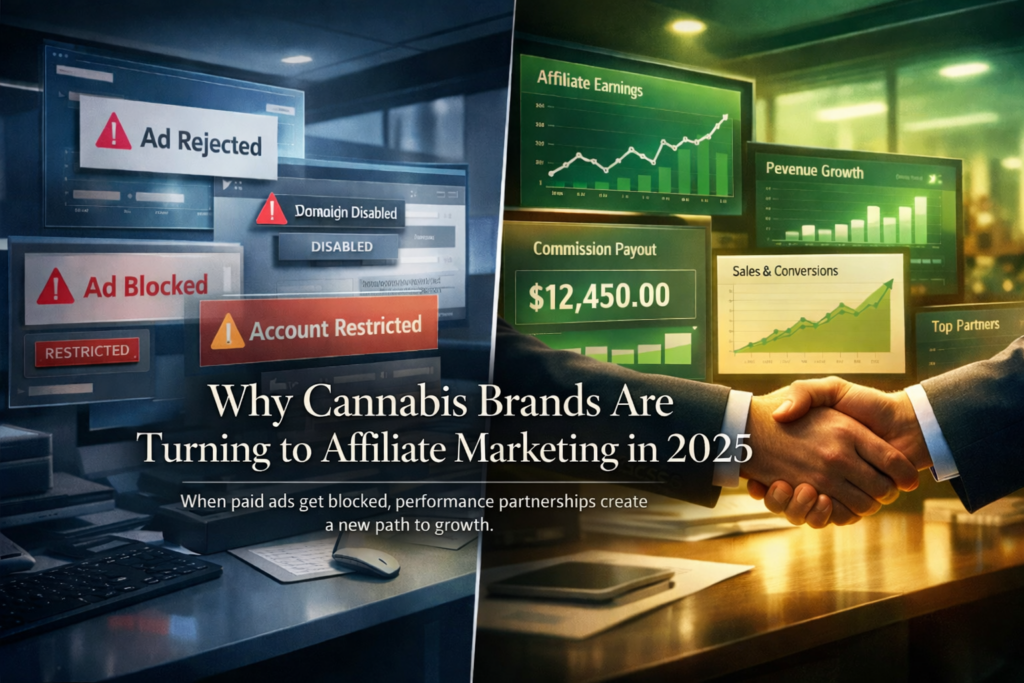
Why Cannabis Brands Need Affiliate Marketing
The cannabis industry operates under advertising restrictions that most other industries simply do not face. Google Ads prohibits cannabis-related advertising under its Dangerous Products policy. Meta bans cannabis ads outright. Even programmatic networks like TradeDesk apply strict category exclusions that most other consumer brands never have to think about.
So the remaining growth channels are narrow. Organic search, email marketing, and performance-based channels are the main channels cannabis brands have to work with. And among those, affiliate marketing stands out for one reason: you only have to pay when you get the results.
Here is how affiliate marketing stacks up against other available channels:
| Channel | Upfront Cost | Pay Per Result | Platform Risk |
| Google SEO | Medium | ❌ | Low |
| Email Marketing | Low | ❌ | Low |
| Influencer Marketing | High | ❌ | Medium |
| Affiliate Marketing | Low | ✅ | Low |
Beyond cost efficiency, affiliate marketing delivers something equally valuable: third-party credibility. Because when a trusted cannabis review site or blogger recommends your brand, it carries significantly more weight than a brand promoting itself.
And for cannabis brands specifically, where consumer trust is still being built at an industry level, that third-party endorsement is not just useful. It is a genuine competitive advantage.
Choosing an Affiliate Platform That Accepts Cannabis
Picking an affiliate platform sounds simple until you realize that most mainstream networks do not accept cannabis programs at all. If you sign up for the wrong one, you might build an entire program on a foundation that can get shut down the moment their compliance team reviews your account.
That’s why the platform you choose needs to do three things well. First, accept cannabis as a product category. Second, provide reliable tracking. And lastly, give you enough control over your affiliate relationships to maintain compliance on your own terms.
Which Networks Allow Cannabis Programs? 🌿
Here is where the major platforms actually stand:
| Platform | Cannabis Friendly | Type | Best For |
| Refersion | ✅ | SaaS | E-commerce brands, Shopify stores |
| Tapfiliate | ✅ | SaaS | Small to mid-size cannabis brands |
| PartnerStack | ✅ | SaaS | Cannabis SaaS and B2B brands |
| Tune (HasOffers) | ✅ | SaaS | Performance marketers, larger programs |
| ShareASale | ⚠️ | Network | Case by case, requires approval |
| CJ Affiliate | ❌ | Network | Does not accept cannabis |
| Rakuten | ❌ | Network | Does not accept cannabis |
Refersion is particularly popular among cannabis ecommerce brands due to its native Shopify and WooCommerce integrations, which make tracking and commission payouts significantly easier to manage.
| ⚠️Never build your program on a mainstream network without first confirming its cannabis policy in writing. Verbal confirmations are not enough because policies change quietly, without warning, and a sudden program shutdown halfway through scaling is a setback that takes months to recover from. |
Setting Up Your Cannabis Affiliate Program
The structure of your cannabis affiliate marketing program will determine the quality of partners it attracts and the results it delivers. A poorly configured program will either attract the wrong affiliates or fail to retain the right ones.
Commission Structure, Cookie Window, Creatives
Commission Structure
Cannabis affiliate commissions typically range from 10% to 30%, depending on the product category and margin. Here is a general benchmark:
| Product Category | Typical Commission Range |
| CBD products | 20% to 30% |
| Cannabis accessories | 10% to 20% |
| Cannabis seeds | 20% to 25% |
| Dispensary referrals | 15% to 25% |
Higher-ticket items with lower margins warrant lower percentages, while consumables with stronger margins can support more generous cannabis commission rates. So you should start competitively, as an underpaying program will struggle to recruit quality affiliates from the start.
Cookie Window
The cookie window is the period during which an affiliate is credited for a sale after a user clicks their link. For cannabis brands, a 30 to 90-day cookie window is considered the industry standard. A shorter window is seen as a penalty by affiliates, particularly when a longer consideration cycle is known to be common in this category, especially among first-time buyers.
Creatives
Your affiliates need ready-to-use assets to promote effectively. Provide:
- Banner ads in standard sizes (300×250, 728×90, 160×600)
- Product images cleared for affiliate use.
- Pre-written copy for emails and blog placements
- Discount codes tied to individual affiliates for easier tracking
The easier you make it for affiliates to promote your brand, the faster your cannabis partner marketing program gains traction.
Creatives
Ready-to-use assets are needed by affiliates to promote effectively. The following should be provided:
- Banner ads in standard sizes (300×250, 728×90, 160×600)
- Product images cleared for affiliate use.
- Pre-written copy for emails and blog placements
- Discount codes tied to individual affiliates for easier tracking
The more accessible these assets are made, the faster your cannabis partner marketing program will gain traction with the right partners.
Compliance Clauses to Include in Your Affiliate Agreement
This section is most commonly skipped by cannabis brands and is later regretted. The affiliate agreement should not be treated as a formality. It is the legal protection that is relied upon if your brand is promoted irresponsibly by an affiliate.
The following clauses should be included at a minimum:
- Age gating requirement: Content must not be directed at or targeted toward users under the legal purchasing age in their region
- No paid advertising clause: Paid ads using your brand name or product keywords must not run without prior written approval. Your SEO is protected, and trademark bidding is prevented as a result.
- Geographic restrictions: Promotion must only be carried out in jurisdictions where cannabis is legally sold
- FTC disclosure requirement: The relationship between the affiliate and your brand must be clearly disclosed on all promotional content, in line with FTC guidelines on endorsements
- Content approval clause: The right to review and reject affiliate content that misrepresents your products or makes unverified health claims must be reserved
- Termination clause: Clear conditions under which an affiliate can be removed from the program immediately and without notice must be defined
A well-drafted affiliate agreement is what separates a professional cannabis affiliate marketing program from one that creates legal exposure. A legal professional familiar with cannabis regulations should be consulted to review it before launch. ⚖️
Recruiting Cannabis Affiliates
A cannabis affiliate marketing program is only as strong as its affiliates. Getting the program live is the straightforward part. But finding partners who actually send converting traffic rather than just inflating your click numbers is an entirely different challenge.
The mistake most brands make is casting too wide a net. A hundred low-quality affiliates will consistently underperform compared to ten highly relevant ones. Relevance and audience trust matter far more than reach alone.
For cannabis brands, that relevance is best found in three specific partner types around which your recruitment strategy should be built.
Review Sites, Cannabis Blogs, and Influencer Affiliates 🌿
Cannabis Review Sites
Review sites are among the highest converting affiliate partners available to cannabis brands. Because their audiences arrive with purchase intent already formed. Sites like Leafly, Weedmaps, and niche product review blogs attract users who are actively researching before buying, making them ideal affiliate partners for cannabis performance marketing.
Cannabis Blogs and Content Publishers
Independent cannabis bloggers and content publishers build deeply loyal audiences over time. They are trusted voices in a space where trust is genuinely hard to earn. When approaching cannabis blogs for your affiliate program, you should prioritize:
- Sites with engaged comment sections are more popular than those with only high traffic.
- Publishers who produce original, well-researched content rather than thin promotional posts.
- Blogs with a clearly defined audience that overlaps with your customer profile.
Influencer Affiliates
Cannabis influencers. They operate primarily on platforms like YouTube and Substack, where content moderation is less restrictive than on Instagram or TikTok. A cannabis influencer with 20,000 genuinely engaged subscribers will outperform one with 200,000 passive followers every single time.
Thus, when recruiting influencer affiliates, look for:
- Consistent posting history of at least six to twelve months.
- Audience demographics that match your target customer.
- Transparent engagement rates rather than vanity follower counts.
Where to Find and Recruit Affiliates
- Post your program on Refersion Marketplace, where affiliates actively search for new programs to join.
- List your program on cannabis specific affiliate directories that connect brands with niche publishers.
- Reach out directly to cannabis bloggers and YouTubers whose content already aligns with your product category.
- Attend cannabis industry events like MJBizCon, where publisher and influencer relationships are built in person.
✨The best affiliate relationships in cannabis are built on genuine product alignment, not just commission rates. Affiliates who believe in what they are promoting will always outperform those who are purely chasing the highest payout.
Managing and Scaling Your Affiliate Program
Launching your cannabis affiliate marketing program is the starting line, not the finish line, and the distance between a program that plateaus and one that becomes a genuine revenue channel comes down to how well it is managed and scaled after that first affiliate signs up.
Tracking Performance, Paying Commissions, Preventing Fraud 📈
Tracking Performance
Every affiliate in your program should be tracked against a clear set of metrics. Vanity numbers like clicks and impressions tell you very little. What actually matters is:
| Metric | What It Tells You |
| Conversion Rate | How well an affiliate’s audience matches your customer profile |
| Average Order Value | Whether affiliates are attracting high intent buyers |
| Revenue Per Click | The true efficiency of each affiliate partner |
| Return Rate | Whether affiliate-driven customers are satisfied with the product |
An affiliate sending 10,000 clicks with a 0.2% conversion rate is significantly less valuable than one sending 1,000 clicks with a 4% conversion rate.
Paying Commissions
Pay your cannabis affiliate commissions on a reliable and predictable schedule. Monthly payouts are the industry standard, and delayed or inconsistent payments will push quality affiliates toward competing programs faster than anything else.
Key considerations for commission payments:
- Set a minimum payout threshold (typically $50-$100) to avoid processing fees on micro payments.
- Offer multiple payment methods, including bank transfer, PayPal, and, where possible, cryptocurrency, as some cannabis affiliates prefer it, given banking restrictions in the industry.
- Clearly define your refund policy and how returned orders affect affiliate commissions in your agreement.
Preventing Fraud
Affiliate fraud is a genuine problem in cannabis performance marketing and should be actively managed rather than reactively addressed. These are the most common fraud types that need to be watched for:
- Cookie stuffing — Affiliates artificially dropping tracking cookies on users who never clicked their link
- Fake leads — Fabricated referrals designed to trigger commission payouts
- Coupon abuse — Affiliates sharing discount codes in unauthorized channels, attracting deal seekers rather than genuine buyers
To protect your program:
- Use platforms like Refersion or Tune that have built-in fraud detection tools.
- Monitor traffic sources for unusual spikes in clicks that do not convert.
- Set conversion windows that reflect realistic buyer behavior to automatically flag suspicious activity.
- Conduct regular manual audits of your top-performing affiliates to verify traffic quality.
Scaling the Program
Once consistent performance is delivered by your core group of affiliates, scaling should be approached as a process of deliberate recruitment rather than aggressive expansion:
- Identify your top five performing affiliates and understand exactly what they are doing differently.
- Offer tiered commission structures that reward affiliates who consistently hit revenue thresholds. For example, a base commission of 15%, scaling to 25% at $5,000 in monthly referred revenue.
- Introduce seasonal promotions and exclusive discount codes to keep affiliates actively engaged rather than passively signed up.
- Run a quarterly affiliate newsletter updating partners on new products, upcoming promotions, and program performance benchmarks to maintain momentum.
Cannabis Affiliate Marketing Compliance
Compliance should not be treated as an afterthought in a cannabis affiliate marketing program. It is the framework within which everything else is operated. Legal exposure that far outweighs whatever revenue was generated can be created by just one non-compliant affiliate.
Compliance for cannabis affiliate marketing is spread across three levels:
Federal Level: Cannabis is still classified as a Schedule I controlled substance under federal law in the United States, meaning affiliate marketing activity must be carefully structured to ensure federally prohibited territory is not crossed.
State Level: Each state has its own advertising regulations that affiliates must abide by. In California, cannabis marketing must not be directed at audiences where more than 28.4% are reasonably expected to be under 21. In Colorado, a similar 30% threshold is applied.
The specific rules of each targeted jurisdiction must be understood and followed by every affiliate promoting your brand.
Platform Level : Individual platform content policies are applied independently of state law. On YouTube, cannabis content is permitted, but direct promotion of cannabis products for sale is prohibited.
Beyond these three levels, four non-negotiable requirements should be enforced across every affiliate in your program:
- Age verification must be applied to all affiliate landing pages.
- No unverified health claims about cannabis products should be made, per FDA guidelines.
- FTC disclosure must be included on every piece of affiliate promotional content.
- Geographic targeting must be restricted to legally permitted jurisdictions only.
Compliance is not something that is set up once and forgotten. Regular audits must be conducted, agreements must be periodically updated, and legal counsel from someone well-versed in both cannabis law and digital marketing must be consistently sought.
Building a Cannabis Affiliate Marketing Program That Actually Lasts
The cannabis affiliate marketing space is still relatively underdeveloped compared to most other industries. The brands that recognize that gap and move deliberately now will be significantly harder to displace twelve months from now.
But the important word here is “deliberately.” The right platform has to be chosen, a competitive commission structure has to be set, compliance has to be built in from day one, and affiliates who genuinely align with your brand have to be recruited and retained.
None of that happens on its own.
A cannabis affiliate marketing program that is built with intention and managed with consistency becomes one of the most durable growth assets a cannabis brand can own. The window to build it the right way is open. The question is whether it will be acted on.
Let CBD Marketing Solutions Take It From Here
Building a compliant, high-performing cannabis affiliate marketing program requires expertise that goes beyond general marketing knowledge. CBD Marketing Solutions works exclusively with brands in niche markets and understands the specific challenges that come with them.
If you want it done right from the start, it is worth a conversation.
👉 Explore CBDMarketing Solutions
📞 +1 209 813 4209 📧 info@cbdmarketingsolutions.com
FAQs
What Types Of Cannabis Products Tend To Perform Best Through Affiliate Marketing?
Consumable products with repeat purchase behavior, like CBD tinctures, edibles, and wellness supplements, tend to generate the strongest long-term affiliate revenue because satisfied customers return and repurchase through the same affiliate links.
How Long Does It Typically Take For A Cannabis Affiliate Program To Generate Meaningful Revenue?
Most programs see their first consistent returns within 3 to 6 months, assuming a solid affiliate base is recruited early. The ramp-up period depends heavily on how quickly you onboard quality publishers and how competitive your commission structure is from the start.
Should Cannabis Brands Disclose Their Affiliate Program Publicly On Their Website?
Having a publicly visible Affiliate Program or Partner With Us page is strongly recommended, as it attracts inbound applications from relevant publishers who are already interested in your niche and actively looking for programs to join.
How Do You Handle Affiliates Who Operate Across Multiple Jurisdictions?
You should clearly define in your affiliate agreement which states or countries are approved for promotion, and provide affiliates with geo-targeting guidance. Platforms like Refersion and Tune also allow you to set geographic restrictions at the tracking level for an added layer of control.
How Do You Keep Affiliates Motivated And Engaged Over The Long Term?
Regular communication through newsletters, exclusive early access to new products, and performance-based commission tiers all play a big role in keeping affiliates actively invested in your program. Affiliates who feel like genuine partners rather than just traffic sources are far more likely to prioritize your brand over competing programs.