SEO is harder for cannabis brands than for most other industries. Ad platforms place limits, publishers often turn away cannabis content, and weak backlinks can do more harm than good. Because of this, every step needs to be handled carefully and kept relevant.
Working with the right cannabis backlinks service provider can help brands earn stronger links without creating new problems. This guide covers proven link opportunities, quality checks, and common mistakes to avoid.
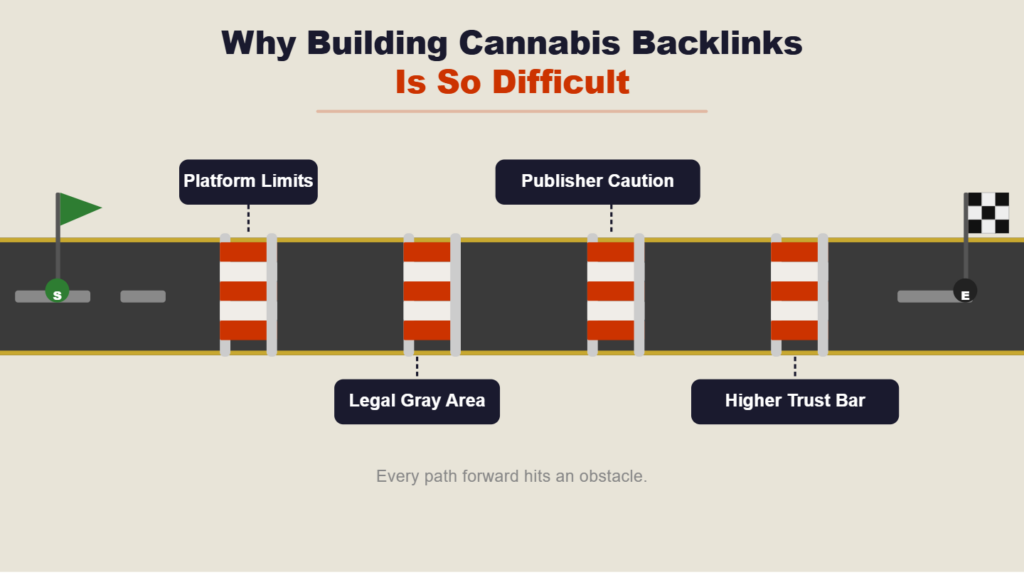
Why Building Cannabis Backlinks Is So Difficult?
Building links in cannabis is difficult because the niche gets pressure from both directions.
On one side, Google puts a higher quality bar on topics tied to health, safety, and public well-being. Its Search Quality Rater Guidelines state that YMYL topics are held to very high page-quality standards.
On the other side, there is still a legal trust gap. In the U.S., the DEA continues to list marijuana as a Schedule I controlled substance.
So even when a cannabis business is legal in its state, many publishers, platforms, and compliance teams still treat it as a higher-risk topic. That makes outreach slower, approvals harder, and cannabis link building much more selective than normal SEO outreach.
Major Sites That Block Cannabis Content
A third big problem is platform access. Many major websites do not fully ban all cannabis discussion, but they do restrict sales language, ads, transactions, or direct product promotion. That makes it much harder to build reach, earn mentions, and turn visibility into backlinks.
The table below shows some of the major platforms that restrict cannabis-related content and the kinds of limitations brands usually encounter.
| Platform | What the policy says? | What it means for cannabis brands? |
| Google Ads | Google does not allow ads for recreational drugs, including marijuana, or for products that facilitate recreational drug use. It allows only narrow CBD exceptions in approved locations. | You cannot depend on paid search the way other niches do. |
| Meta, Facebook and Instagram | Meta says ads cannot promote THC products or cannabis products with psychoactive components. CBD ads require certification, written authorization, legal compliance, and age targeting. | Even when education is allowed, product promotion is tightly controlled. |
| TikTok | TikTok routes advertisers through strict advertising policies, and TikTok Shop explicitly prohibits marijuana and drug paraphernalia. | Great for awareness in theory, difficult for direct cannabis promotion in practice. |
| LinkedIn restricts drug and healthcare ads, and its community policies do not allow content promoting drug abuse. | Fine for B2B thought leadership, not ideal for direct product promotion. |
| Did you know? Reddit allows cannabis discussion, but not buying, selling, gifting, or facilitating transactions involving controlled substances. |
THE Bottom Line:
- Cannabis SEO is not impossible.
- It is just less forgiving.
- Relevance beats volume.
- Getting broader cannabis SEO authority is difficult because the niche has fewer friendly platforms, fewer easy promotion options, and less tolerance for low-quality tactics.
7 Tactics for Getting Cannabis Backlinks That Work
When the niche is this restricted, backlinks have to be built with smarter and safer methods like the ones below.
1. Guest Posts on Cannabis Industry Publications
Guest posting can work well for cannabis SEO, but only when the article brings real value to the site publishing it. The goal is not to force a link. The goal is to contribute something useful, with the backlink fitting in naturally.
How to make this tactic work?
- Target the right sites. A link from a cannabis news site, operator blog, or industry publication usually makes more sense than a random general blog.
- The topic has to stand on its own. Think education, local market trends, compliance changes, store operations, consumer behavior, or product category explainers.
- The link should feel more natural. Anchor text should help both users and Google understand the linked page.
| A better way to pitch: Instead of asking, “Can you publish my article with a backlink?” lead with a useful idea. |
The table below shows the difference between a strong guest post and a weak one.
| Strong guest post ✔️ | Weak guest post ❌ |
| Published on a niche-relevant website | Published on a random general site |
| Covers a topic readers care about | Written only to place a link |
| Adds a natural, relevant backlink | Forces a keyword-heavy anchor |
| Feels like editorial content | Feels like an SEO placement |
👉🏻 Done right, cannabis guest posts can build both visibility and authority. Done poorly, they look forced and do little to help you earn real cannabis authority links.
2. Get Listed on Leafly and Weedmaps
Leafly and Weedmaps are often among the first platforms people visit to find a cannabis business, compare options, or check whether a brand looks trustworthy. That is why links from these listings are highly relevant and easier to secure than other dispensary backlinks out there.
How does it work?
Directories help in two ways.
Number 1: Search engines use them to confirm that your business is real and consistently listed online.
Number 2: Customers use them to check contact details, reviews, and website links before making a decision.
The Process:
- Claim your profiles first: Start with Leafly, Weedmaps, and Google Business Profile.
- Fill in the key details: Add the correct business name, address, phone number, website, hours, and category.
- Link to the right page: Use your main location page, store page, or homepage, whichever makes more sense.
| Important! Your Name, Address, and Phone number, along with your website, should stay exactly the same across all listings. |
The table below shows what matters most when setting up or reviewing these profiles.
| Listing element | Reason to check it |
| NAP details | Helps keep business information consistent |
| Website link | Sends users to the right page |
| Business category | Improves relevance |
| Hours and contact details | Makes the listing more useful |
| Photos and reviews | Builds trust and activity signals |
3. PR and Local News Coverage
PR and local coverage can lead to some of the strongest backlinks in cannabis because these mentions are usually earned through real stories, not placed just for SEO. That makes them more credible, more relevant, and often harder for competitors to copy.
The goal is not just to send out a press release. It is to give reporters, editors, and local publications something genuinely worth covering.
Inside the Process:
- Lead with something newsworthy like events, updates, insights, or industry recognition.
- Keep the story simple and usable with one angle, quote, and link.
- Pitch relevant outlets like local media, niche blogs, and trade publications.
- Focus on earned coverage, where publishers create original stories and link naturally.
These are the kinds of story angles that usually have a better shot at earning coverage. You can target them.
| Story angle:Rule or law update | Ideation: A new state rule, licensing change, packaging rule, delivery update, or local compliance shift. |
| Usefulness: Feels timely, relevant, and easier for cannabis readers or reporters to care about. |
| Story angle:Education campaign | Ideation: Consumer awareness drive, beginner-focused cannabis content, or myth-busting content. |
| Usefulness: Sounds more helpful and editorial than sales-driven. |
| Story angle:New store or expansion | Ideation: Store launch, new delivery zone, or second location opening. |
| Usefulness: Gives local media a major reason to mention your business. |
4. Cannabis Business Association Memberships
Cannabis business associations can be a good cannabis backlinks service source because many of them publish public member directories, member profiles, or organization pages. It can also place your website on a real industry page that people and search engines can find.
Here is where this backlink-building tactic becomes useful in a restricted niche:
✔️ The link is niche-relevant because it comes from a cannabis-focused organization, not a random website.
✔️ It helps build trust by placing your brand alongside other operators, service providers, and known businesses in the space.
| Important! Not every membership is worth paying for, though. A strong one should give your business a visible placement and real industry value. |
Ask yourself this before joining:
- Is there a public member directory? If the listing is hidden behind a login, the SEO value will become limited.
- Does the profile include a clickable website link? A profile without a live website link is much less useful.
- Is the group active? Look for current news, events, advocacy work, or member updates. That usually shows the association is alive and worth being part of.
- Does it fit your business type? A national group may help with broader industry visibility, while a state association may help more with local trust.
| Did you know? NCI, founded in 2010, is considered the oldest and largest national trade association serving the cannabis industry. |
5. Appearing on Podcast Guest Spots in the Cannabis Space
Podcast guest spots can be surprisingly useful in this niche. They may not always be the highest-DA links in the article, but they can still earn a backlink from an episode page, guest bio, show notes, or transcript.
They also put your brand in front of a targeted audience, which can lead to later mentions on blogs, newsletters, or trade sites.
Here’s something worthy that you can discuss over the podcast:
⭐ “What changed in cannabis retail this year?”
⭐ “How local rules affect dispensary operations?”
⭐ “What customers are asking for now?”
⭐ “Mistakes cannabis brands make in marketing or compliance.”
⭐ “How do we, as a cannabis backlinks service provider, help you?”
| Do not treat the interview like an ad. The backlink is stronger when the episode feels useful, with your site linked. |
6. Resource Page Placements
Resource pages are curated pages that collect useful links on one topic. In cannabis, it is another good source of backlinks when your page truly helps the reader.
The strongest placements usually happen when you already have something worth referencing, not when you ask someone to link to a sales page. Links also work better when the linked page and anchor text make sense in context.
However, understand that not every resource page is worth chasing. A good one usually has these signs:
✔️ The page is clearly about cannabis or something close to your page.
✔️ The links look hand-picked, not dumped onto the page in bulk.
✔️ The page is not full of casino, pills, adult, or unrelated junk.
✔️ The page is still active and not abandoned.
Watch out for poor resource pages!
❌ Be careful with pages that accept almost every submission.
❌ Old pages with no recent updates are another warning sign.
❌ Unrelated outbound links across the page usually point to poor quality.
❌ Some pages are built only to swap links, and those are best avoided.
How To Qualify A Cannabis Backlink Opportunity?
In cannabis SEO, not every backlink is worth taking. A good link should make sense to a real reader, not just to an SEO tool. If the site looks off, the page feels forced, or the link only exists to push rankings, it is usually not a great fit.
Here’s a practical way to review the opportunity before saying yes:
| Qualifying factor | What to look for? | Why it matters? |
| Relevance | The site covers cannabis, CBD, local business, health education, policy, retail, or something close. | Relevant links make more sense and look more natural. |
| Editorial control | A real person appears to review and publish content. | Pages with human review are usually stronger than open submission pages. |
| Placement | The link sits inside useful content, not in a random footer or thin author box. | Better placement usually means better context. |
| Anchor text | Brand name, page title, or plain words that fit the sentence. | Anchor text should help people understand the page being linked to. |
| Page match | The linked page clearly supports the topic on the page where the link appears. | A mismatch makes the link feel forced. |
| Site quality | The site looks active & readable. | Weak, messy sites usually give weak links. |
| Local value | For dispensaries, the site has local relevance or local audience value. | Local links and mentions can support prominence in local search. |
Dangerous Tactics To Avoid
Once you know what a good opportunity looks like, the bad ones get easier to spot. In a restricted niche like cannabis, shortcuts can stand out faster because the link pool is already smaller and more sensitive.
Here’s a clear breakdown of the main tactics to stay away from:
| The Tactic | Reason to avoid it |
| Paying for a backlink that is not marked properly. | Paid links that pass ranking credit can violate spam rules. |
| Publishing lots of guest posts mainly to drop links. | This often turns into low-value, keyword-heavy link building. |
| “You link to me, I link to you” done over and over. | Heavy link exchange patterns can look manipulative. |
| Buying an old domain to borrow its past authority. | Google added a spam policy against expired domain abuse in March 2024. |
| Publishing lots of thin pages to rank. | This includes bulk low-value pages, no matter how they are made. |
| Publishing third-party pages on strong sites mainly to ride their authority. | This is what many people call parasite SEO. |
| Dropping links in comments, forums, or user profiles with no real value. | These links are weak and can make the profile look sloppy. |
👉🏻 For brands that want an exceptional cannabis backlinks service without relying on shortcuts, we at CBD Marketing Solutions offer SEO and high-authority link building for restricted niches like cannabis, CBD, Delta 8, vape, and Kratom.
Conclusion
The best cannabis backlinks do not come from shortcuts. They come from relevant placements, smart outreach, careful vetting, and a clear understanding of what to avoid. That is what we covered throughout this blog. But a reliable cannabis backlinks service works best when it supports a bigger visibility plan.
At CBD Marketing Solutions, we include link building as part of a broader cannabis growth strategy for restricted industries. Learn more about our cannabis marketing approach and contact us today.
FAQs
How long does cannabis link building take to show results?
Do not expect instant movement. In most cases, SEO starts showing noticeable results in about 3 to 6 months. Note that meaningful changes can take time to be crawled, reprocessed, and reflected in search. Some links may go live sooner, but rankings usually move more slowly than placements do.
What budget should I expect from a cannabis backlinks service provider?
The cost of a cannabis backlinks service depends on your niche, competition, goals, and the amount of manual outreach required. A local campaign usually needs a different budget than a broader authority-building plan. Focus on link quality and relevance, not just volume. That is also why we do not force every brand into the same plan. We shape the strategy around your goals.
How many backlinks does a cannabis website actually need?
There is no fixed number. What matters more is whether the links are relevant, editorial, and natural. A smaller group of strong links can outperform a large batch of weak ones.
What proof should a cannabis backlinks service provider be able to show?
They should be able to show real placements, live URLs, sample target sites, case studies, and reporting that ties links to rankings, traffic, or visibility gains. Be careful with anyone promising guaranteed rankings.
What makes a cannabis backlink high-quality?
A high-quality backlink comes from a relevant, trustworthy site that is clearly edited by a real person. The link should sit inside useful content, point to a page that truly matches the topic, and use anchor text that helps readers understand what they will find after clicking.
How does backlink strategy change for dispensaries, CBD ecommerce brands, and ancillary cannabis businesses?
Dispensaries usually need more local links, such as maps-related signals, local news, and nearby business listings. CBD ecommerce brands need stronger content and category-focused links that support broader organic growth. Ancillary cannabis brands often have the most flexible outreach because they can earn links from both cannabis sites and broader business publications.
Can bad backlinks hurt a cannabis website’s rankings?
Yes. Spammy, irrelevant, or overly forced backlinks can weaken your site’s trust and hold back rankings. A few low-value links may do little harm, but repeated patterns such as paid links, random guest posts, or heavy link swapping can create real problems.