If your CBD website is not getting the traffic or visibility you expected, the problem may not be your products; it could be your SEO. Small issues like slow-loading pages, missing metadata, broken links, or poorly optimized content can quietly affect how search engines view your site. The good news is that many of these problems can be uncovered in less than 30 minutes with a structured audit process.
As CBD SEO strategies 2026 continue to evolve, regular audits are becoming essential for identifying hidden issues before they impact rankings. This guide walks through the key areas to review, from technical SEO and on-page optimization to backlinks, and content gaps — and you may be surprised by how many hidden SEO issues are affecting your rankings without you even realizing it.
Quick CBD SEO Audit Snapshot: What To Check First?
| Page/Area Checked | Issue Found | Tool Used | Priority | Next Fix |
| Example: CBD service page | Title tag is too generic | Manual review | Medium | Rewrite title with page intent |
| Example: Blog page | Not indexed | Google Search Console | High | Review indexing reason |
| Example: Business profile | Old phone number listed | Manual check | High | Update contact details |
A Simple 3-Step CBD SEO Audit You Can Complete In 30 Minutes
Before checking random pages or opening too many tools, divide the audit into three areas: technical SEO, on-page SEO, and off-page SEO. This keeps the process focused and helps you spot the issues that most often affect CBD website visibility.
Start with the technical side first because if search engines struggle to crawl, load, or understand your site, your content and backlinks may not perform as well as they should.
Step 1: Run A CBD Technical SEO Check (Minutes 1–10)
- Technical SEO is the foundation of your CBD website audit.
- It helps you find the behind-the-scenes issues that can quietly hold your website back, even when your content looks good to visitors.
- For this step, focus on whether Google can find your pages, load them properly, and understand what each page is about.
⭐Check Your Website’s Overall Health
Open Google Search Console and look for any major warnings that may affect your website’s visibility. This gives you a quick look at how Google sees your site.
| ✔️ Check for:Sitemap errorsCrawl issuesPages blocked by robots.txtRedirect problemsImportant CBD pages missing from search resultsSudden drops in clicks or impressions |
If your homepage, category pages, service pages, blogs, or contact page show errors here, fix those before moving to smaller SEO tasks.
⭐Check Site Indexing
Indexing tells you whether Google has added your pages to search results. A CBD page cannot rank if Google has not indexed it.
| Do a quick Google search using:site:yourdomain.com |
Then check whether your most important pages appear. After that, go to Google Search Console and review the indexing report. Look for pages marked as discovered, crawled but not indexed, or excluded.
| ✔️ Focus on pages that matter most, such as:HomepageMain CBD service pagesProduct or category pagesBlog posts targeting important keywordsLocation pagesContact page |
If Google skips important pages, the issue may come from weak content, crawl blocks, duplicate pages, or technical errors.
⭐Review Core Web Vitals And Page Speed
A slow CBD website can frustrate visitors before they even read your content. This can also make it difficult for search engines to view your site as user-friendly.
| ✔️ Open PageSpeed Insights and test your main pages. Pay attention to:Loading speedMobile speedLarge imagesHeavy scriptsLayout shiftsSlow server responseDelayed button or form response |
You do not need to fix every warning at once. Start with pages that bring traffic, leads, or sales. If your homepage or top CBD pages load slowly, they deserve attention first.
Test Mobile Friendliness
Many visitors will land on your CBD website from a phone, so the mobile version cannot feel like an afterthought. Open your website on your own phone and move through it like a real visitor.
| ✔️ Check whether:The menu opens smoothlyText feels easy to readButtons have enough spaceForms work without glitchesImages fit the screenPopups do not block important contentCheckout or contact steps work properly |
If a visitor has to pinch, zoom, wait, or tap several times to complete one action, your mobile experience needs work.
Validate Schema And Crawl The Site
A schema helps search engines better understand your website’s details. For a CBD website, you can check schema for pages such as blogs, FAQs, local business details, organization information, and product-related pages, where suitable. Then run a crawl with Screaming Frog or a similar tool to catch issues that are hard to find manually.
| ✔️ Look for:Missing title tagsDuplicate meta descriptionsMissing H1 tagsBroken internal linksRedirect chains404 pagesPages with very little contentCanonical tag issuesMissing image alt text |
Step 2: Review CBD On-Page SEO, URLs, Keywords, and Content (Minutes 11–20)
Once the technical side looks good, move to the pages visitors actually read. This part of the audit checks whether each CBD page explains the right topic, targets the right search intent, and gives users enough reason to stay, click, or take action.
Review Metadata And On-Page Basics
Start your CBD on-page audit by checking the elements that show up first in search results and on the page itself.
| ✔️ Check for:Unique title tags on every important pageMeta descriptions that explain the page value naturallyOne H1 that matches the main topicH2s and H3s that organize the page properlyInternal links to related CBD pages or blogsImage alt text where images support the topicNatural keyword placement without stuffingCTA placement that matches the page intent |
For example, a CBD service page should not have a generic title like “Home” or “Services.” It should tell both users and search engines what the page covers.
Analyze URL Structure
URLs should look simple, readable, and relevant to the page topic. A messy URL can make the page harder to understand and less user-friendly.
✔️ Check for:
- Short URLs with relevant words
- Hyphens between words
- No random numbers, symbols, or long strings
- No duplicate URLs targeting the same keyword
- No unnecessary folders
- URLs that match the page topic
| Better URL example:/cbd-seo-audit/Weak URL example:/page?id=4387-cbd-random-main/ |
During your audit, make a note of URLs that look outdated, too long, or disconnected from the page topic.
Audit Keywords And Search Intent
Keywords should match what users expect to find on the page. This matters even more for CBD SEO strategies 2026, where content needs to serve real search intent instead of just repeating keywords.
| ✔️ Check these areas:Which keywords bring impressions in Google Search ConsoleWhich pages get clicks but low engagementWhich pages rank but do not bring leadsWhether the page answers the keyword properlyWhether the keyword matches the right page typeWhether the content sounds useful or overly promotional |
Identify Content Gaps
Content gaps show where your CBD website fails to answer important user questions. These gaps can make users leave and give search engines fewer reasons to rank the page.
| ✔️ Look for missing or weak sections like:FAQsBuying or service guidanceLocation-specific contentTrust signalsShipping or return detailsLab report explanation pagesInternal links to related topicsUpdated information for current SEO practicesBlog topics that answer real customer questions |
A quick content gap review helps you spot pages that need stronger answers, better structure, or additional supporting sections. Once this step is complete, your CBD SEO checklist should show which pages need better metadata, cleaner URLs, improved keyword targeting, and stronger content.
💡 Know more about ranking your CBD website:
- CBD Marketing : A Complete Guide
- How To Rank Your CBD Website On Google In 2026: A Step-by-Step SEO Guide?
Step 3: Check Off-Page SEO, Backlinks And Local Signals (Minutes 21–30)
After reviewing your website pages, the next step in CBD SEO strategies 2026 is to look at how your CBD brand appears outside your own site. Off-page SEO includes backlinks, business profiles, reviews, citations, and local signals that can influence trust and visibility in search results.
Run A Quick Backlink Check
Backlinks show which websites are pointing to your CBD website. A strong CBD backlink profile can support authority, while weak or spammy links can create SEO concerns.
✔️ Check for:
- Total referring domains
- Links from relevant websites
- Spammy or low-quality backlinks
- Lost backlinks
- Over-optimized anchor text
- Links from unrelated websites
- Backlinks pointing to important CBD pages
| 💡 Tools you can use:Google Search ConsoleAhrefs Free Backlink CheckerSemrushMoz Link Explorer |
Focus on quality over quantity. A few relevant links from trusted websites matter more than many random links from unrelated sources.
Review Broken Backlink Profile
Broken backlinks happen when another website links to a page on your site that no longer works. This can waste link value and create a poor user experience.
| ✔️ Check for:Backlinks pointing to 404 pagesOld blog URLs with incoming linksDeleted CBD service or category pagesChanged URLs without redirectsRedirects are going to unrelated pagesLost backlinks from important sources |
Fix these by redirecting broken URLs to the closest relevant live page. For example, if an old CBD blog has backlinks but no longer exists, redirect it to an updated blog or related service page instead of the homepage.
Check Google My Business / Google Business Profile
Many users still say Google My Business, but the current profile is managed through Google Business Profile. This is important for CBD brands that want to appear in local searches and map results.
| ✔️ Check these details:Business nameAddress or service areaPhone numberWebsite linkBusiness hoursMain business categoryPhotosReviewsBusiness descriptionService details |
Make sure the profile uses accurate, CBD-compliant wording. Avoid exaggerated claims and keep the description focused on what the business offers, where it operates, and how customers can contact the brand.
Run A Citation Analysis
Citations are mentions of your business details across online directories, maps, review platforms, and local websites. Search engines use these signals to understand whether your business information is consistent.
| ✔️ Check for:Same business name across platformsCorrect address or service areaMatching phone numberAccurate website URLUpdated business hoursDuplicate profilesWrong categoriesOutdated contact details |
If your phone number, address, or website URL appears differently across platforms, fix it. Even small mismatches can create confusion for search engines and users. Once this step is complete, your off-page audit should show whether your CBD website has relevant backlinks, working link paths, an optimized Google Business Profile, and consistent local citations.
💡Read more:
Free 30-Minute CBD SEO Checklist
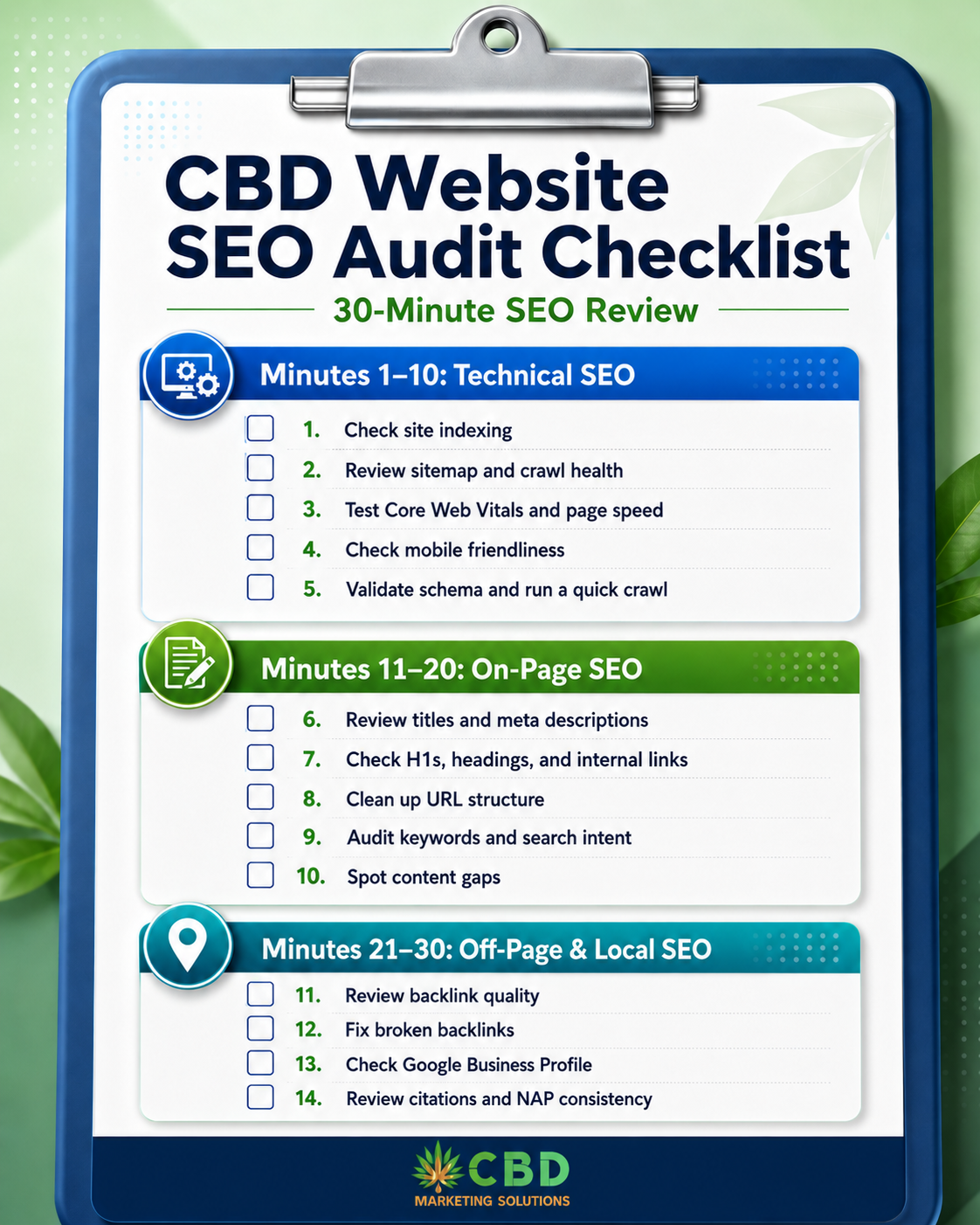
Now that you have reviewed the three main audit areas, the last step in CBD SEO strategies 2026 is to use this checklist to record what actually needs work:
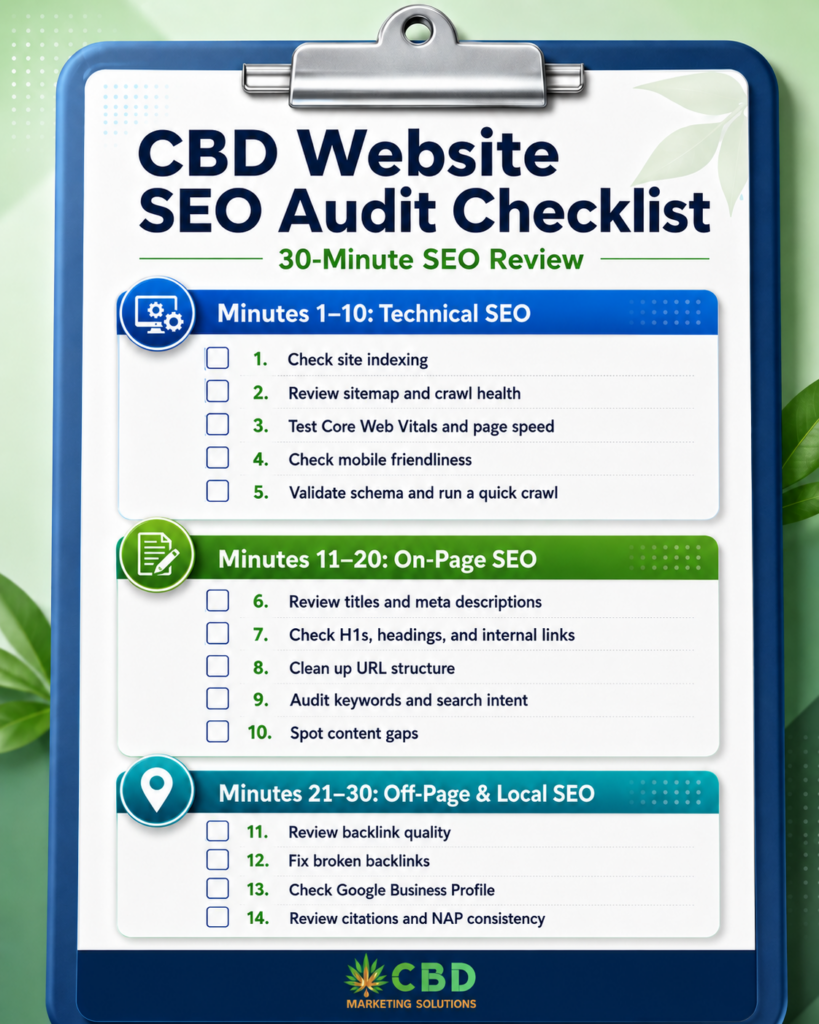
This keeps your CBD site audit free, focused, and easy to act on. Once the checklist is filled, fix high-priority issues first, then use the notes to shape stronger CBD SEO strategies 2026 without repeating the same audit work every week.
Ready To Find And Fix What’s Holding Your CBD Website Back?
A 30-minute audit can show where your CBD website needs attention, but the next step is turning those findings into real improvements. CBD Marketing Solutions can help with technical fixes, on-page updates, content planning, local SEO, and backlink support, all aligned with what strong CBD SEO strategies 2026 require.
Our team works with CBD brands that want more than quick checks and need better CBD marketing services. We help create SEO plans that support better visibility, stronger website performance, and a smoother path for users searching for your products or services. To discuss your website’s next move, contact us at 📩 info@cbdmarketingsolutions.com.
⭐ Read next:
Frequently Asked Questions About CBD SEO Audits
1. Which Free Tools Can Help With A CBD Site Audit?
Free tools like Google Search Console, PageSpeed Insights, Google Business Profile, and Screaming Frog’s free version can help identify indexing issues, speed problems, broken links, and other common SEO concerns on a CBD website.
2. How Often Should You Audit A CBD Website’s SEO?
A basic SEO audit should ideally be done every few months, especially after major website updates, content changes, or ranking drops. Regular checks help catch technical and content issues before they affect visibility.
3. Why Is Page Speed Important For CBD SEO?
A slow website can frustrate visitors and increase bounce rates, especially on mobile devices. Faster pages improve user experience and remain an important part of effective CBD SEO strategies 2026.
4. What Are The Most Common SEO Issues Found On CBD Websites?
Common problems include slow-loading pages, missing metadata, weak internal linking, indexing issues, duplicate content, and outdated SEO practices that no longer match current search intent.
5. Can Broken Backlinks Affect CBD Search Rankings?
Yes, broken backlinks can waste valuable link authority and lead users to error pages. Fixing or redirecting broken URLs helps preserve SEO value and improves the overall website experience.