Ranking a CBD site is tougher than ranking many other websites because ad restrictions, content checks, and strong competition all limit visibility. If you are searching for ‘how to rank CBD website on Google’, this blog will cover the key steps that matter most. It is for CBD brand owners, ecommerce teams, and marketers who want better rankings, stronger visibility, and more organic traffic from the right searches.
Why Is CBD SEO Different From Standard SEO?
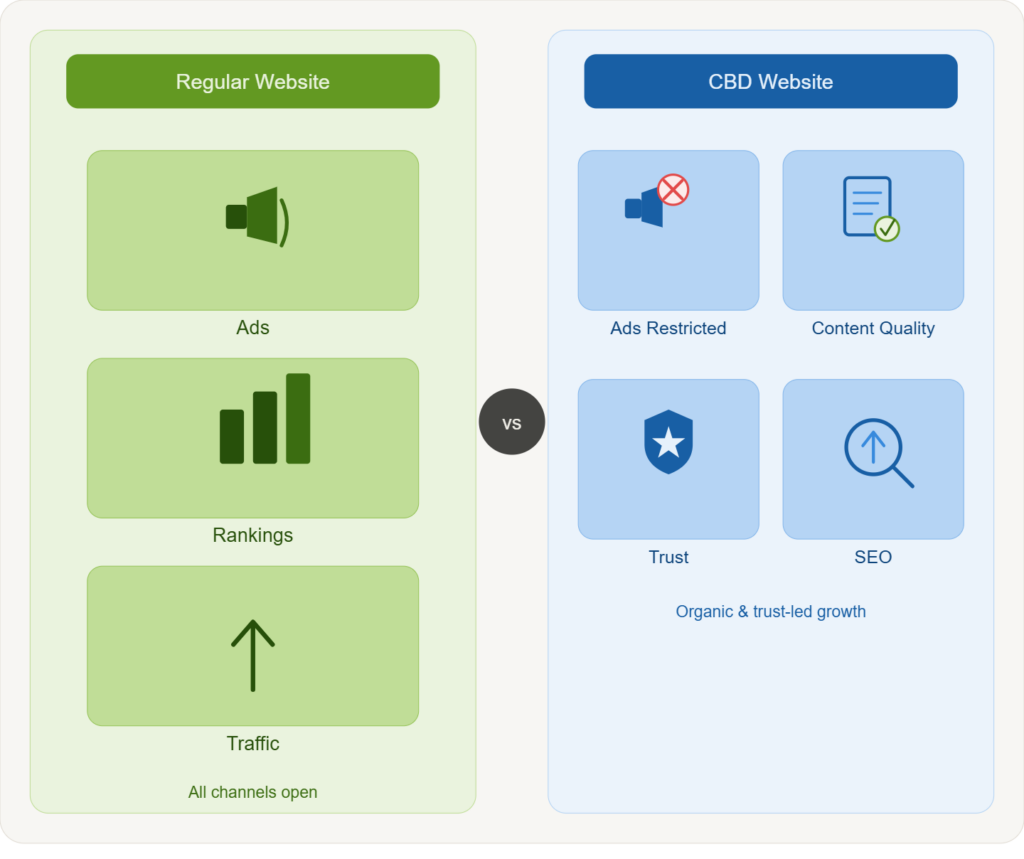
CBD SEO is not the same as standard SEO. The basic SEO rules still apply, but this niche comes with extra limits that many other industries do not face. CBD brands often face stricter ad rules, closer content review, and a greater need to build trust.
That is why CBD SEO strategies usually focus more on compliance, authority, and long-term organic growth rather than quick wins.
Platform Restrictions That Make Organic Search Essential
CBD brands cannot rely on paid promotion the way many other businesses do. Meta, TikTok, and X all impose limits on CBD advertising, with approvals, certifications, product-type rules, and format restrictions varying by platform.
When paid search is limited like this, organic search becomes one of the most dependable ways to grow visibility.
| To put it simply, SEO carries more weight in this niche. |
Google’s Current Stance on CBD Content
Google does not automatically block CBD pages from search. What matters more is whether the page is helpful, original, clear, and written for people. Google’s guidance around helpful content makes that clear, while its broader CBD-related ad rules also show that this is still a carefully watched category.
At the same time, CBD content sits within a compliance-sensitive space. In the United States, regulatory bodies such as the FDA and FTC monitor how CBD products are described, especially regarding health-related claims. Statements that suggest a diagnosis, treatment, or prevention of diseases can pose a risk, even if the content is otherwise well-optimized.
In addition, state-level rules can differ. Some states have stricter requirements around THC limits, product formats, labeling, or availability. This can influence how CBD brands structure local pages, product descriptions, and location-based content.
For CBD sites, this means they need to:
- Be careful with the claims
- Keep product descriptions factual and clearly worded
- Make product and business details easy to find
- Reflect accurate availability where location matters
- Publish useful content instead of filler
- Build stronger signals of experience, expertise, authority, and trust, often referred to as the EEAT approach
| CBD website optimization needs to be more careful, more consistent, and more trust-focused than standard SEO in many other niches. |
How To Rank CBD Website On Google: The ‘5-Step’ Roadmap
The following steps answer the most searched query, ‘how to rank CBD website on Google’ using a clear, practical SEO approach.
Step 1 — Keyword Research for CBD Websites
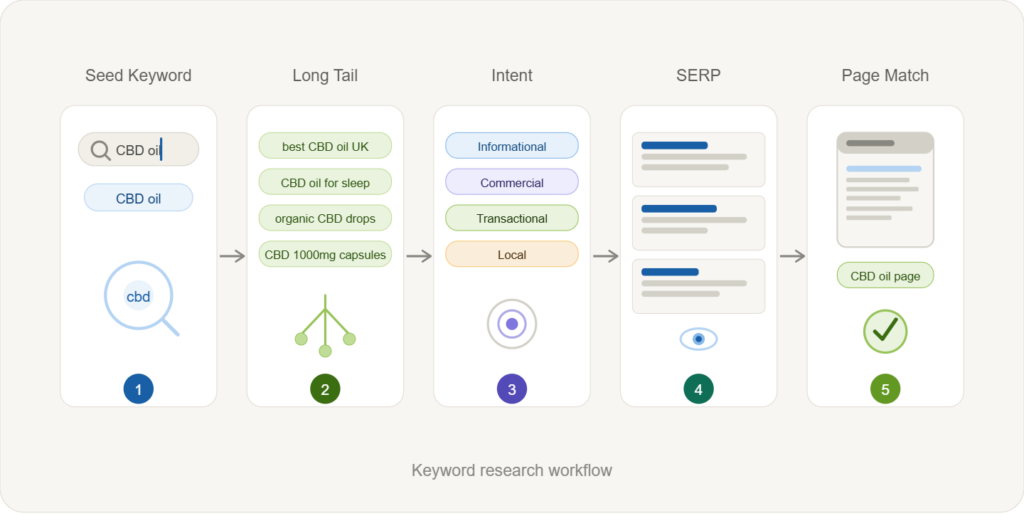
Keyword research decides whether your CBD site attracts the right searches or ends up chasing terms that are too broad, too competitive, or too vague to convert. It is the starting point for building strong CBD organic traffic and achieving better long-term rankings.
In this niche:
✔️ The goal is to find the phrases your audience is already using, match them to the right page type, and build from there.
❌ Do not rank for every big keyword.
| Keyword Types At A Glance! | ||
| Keyword type | What it tells you? | Example |
| Informational | The user wants to learn | ‘what is broad spectrum CBD’ |
| Commercial | The user is comparing options | ‘best THC free CBD gummies’ |
| Transactional | The user is close to buying | ‘buy CBD balm online’ |
| Local | The user wants a nearby option | ‘CBD store in Austin’ |
| Branded | The user already knows the brand | ‘Brand name CBD gummies’ |
| A good CBD keyword list usually includes a mix of all these types. |
How To Find Low Competition CBD Keywords?
The easiest mistake here is starting with head terms like CBD oil or CBD gummies and expecting fast results. Those terms are broad, crowded, and often dominated by stronger domains. A smarter move is to begin with specific phrases that show clear intent and are easier to compete for.
Here is a simple way to approach it:
1. Start with your niche first
Think beyond “CBD.” Start with the exact product, format, audience, or use case your business focuses on.
| Example: | ‘CBD skincare for dry skin’ is easier to work with than ‘CBD skincare’. |
2. Prefer longer, clearer phrases
Longer keywords usually reveal stronger intent. They also help you avoid wasting effort on broad searches that bring low-quality traffic.
| Example: | ‘best THC-free CBD gummies for beginners’ is more useful than ‘CBD gummies’. |
3. Match the keyword to the page type
Not every keyword belongs on a product page. Some are better for blogs, some for collections, and some for location pages.
| Questions go to blogs, comparison terms go to guides, and buying phrases go to commercial pages. |
4. Look for gaps that smaller brands can win
If bigger CBD sites are focused on broad commercial terms, that often leaves room in more specific searches, especially educational and product comparison topics.
5. Do a manual SERP check before choosing a keyword
This step matters. Even if a tool says a phrase looks manageable, search it manually. If page one is full of giant health publishers, national brands, or heavily optimized pages, it may not be a good early target. If you see weaker niche blogs, forum threads, or thin content, that is often a better opening.
Tools To Use: Ahrefs, GSC, Google Autocomplete
You do not need ten tools to do this well. For most CBD sites, these three are enough to build a strong keyword system.
⭐ Ahrefs (for market and competitor research)
Use Ahrefs to expand seed terms, review keyword difficulty, and spot what competitors rank for. It is especially useful when you want to move past obvious phrases and uncover keywords other CBD sites are already getting traffic from. The competitor angle matters here because it helps you find terms that are proven, relevant, and still open to improvement.
What to do inside Ahrefs?
- Enter a broad seed term such as CBD balm.
- Filter for lower difficulty and longer phrases.
- Check Questions to uncover blog opportunities.
- Review competitor keywords to find terms they rank for, but have not covered well enough.
⭐ Google Search Console (for hidden wins)
GSC shows what your site is already getting impressions for. This is one of the best places to find near-miss keywords you can improve without starting from zero. If a page is already showing up for a query, Google has already connected your site to that topic. That is a strong signal worth using.
What to look for in GSC?
- Queries sitting on page 2.
- Keywords getting impressions, but weak clicks.
- Pages ranking for phrases that are not clearly mentioned in the copy.
- Blog posts that could be updated to target a more specific variation.
⭐ Google Autocomplete (for real search behavior)
Autocomplete is useful because it reflects how people actually search. It helps uncover the wording, modifiers, and question patterns that may not stand out right away in paid tools. This is especially helpful for CBD on page SEO optimization, because the exact language people use can shape better headings, FAQs, and supporting sections.
Try this:
Type a seed term and let Google finish it
- Add a word before or after the seed term
- Test variations like best CBD, CBD for, or CBD gummies vs
- Note repeated modifiers such as ‘best’, ‘THC-free’, ‘for beginners’, ‘near me’, or ‘how to choose’.
A simple workflow to follow:
- Start with a seed keyword list based on your products, category pages, and buyer questions.
- Expand that list with long tail, local, branded, and question-based variations.
- Use Ahrefs to check difficulty, related terms, and competitor overlap.
- Use GSC to find queries where your site already has visibility.
- Search the term manually and judge whether page one looks beatable.
- Group final keywords by intent and assign each group to the right page.
👉🏻 If keyword research is not your forte, getting the right support can make a big difference. CBD Marketing Solutions helps brands go beyond keywords with a full-scale CBD marketing service backed by experience across 200+ CBD projects in the US and UK.
| Did you know?A lot of CBD sites lose momentum not because they publish too little content, but because they target the wrong keywords first. |
Step 2: On Page SEO Fundamentals For CBD
Once the right keywords are selected, the next job is to place them on the page in a way that feels organized and useful.
Good CBD on-page SEO helps Google understand what the page is about, and it also makes the page easier for people to scan, trust, and act on.
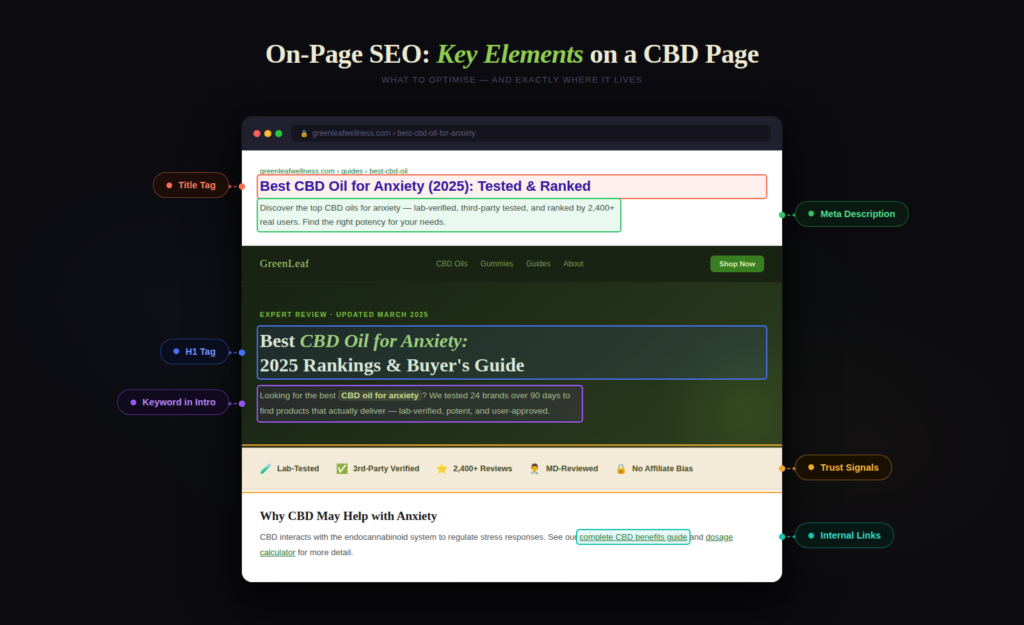
Title Tags, Meta Descriptions, and H1 Structure
These are some of the first on-page signals that Google and users notice. If they are vague, repetitive, or poorly structured, the page becomes harder to rank and less likely to earn clicks.
➡️ Title Tags
The title tag is the main line people see in search results. It should tell the topic clearly and make the page feel worth clicking.
Best practices:
- Keep it clear and specific.
- Aim for around 50 to 60 characters.
- Place the primary keyword naturally.
- Match the search intent.
- Make each title different from the rest of the site.
If the page targets a buying term, the title should sound commercial.
If it targets a question, the title should sound informational.
➡️ Meta description
The meta description does not directly improve rankings, but it can improve click-through rate. Think of it as the short line that tells the user why your page is worth opening.
Best practices:
- Keep it around 150-160 characters.
- Mention the page topic early.
- Reflect what the user is actually looking for.
- Avoid repeating the same wording sitewide.
- Give a genuine reason to click.
➡️ H1 structure
The H1 is the main heading on the page. It should tell both Google and the reader what the page is mainly about.
Best practices:
- Use one H1 per page.
- Include the main keyword once.
- Keep it close to the page topic.
- Do not make it very different from the title tag.
- Then use H2s and H3s to break the content into logical sections. This improves readability and helps search engines understand the page structure better.
Content Length and Keyword Placement Best Practices
There is no fixed word count that guarantees rankings. What matters more is whether the page covers the topic well enough for its purpose. A product page does not need the depth of a blog post, and a category page should do more than just list products.
| Content Length Guide! | ||
| Page type | Suggested range | Focus on |
| Product pages | 300 to 800 words | Product detailsIngredientsUsage infoTrust signals |
| Category pages | 400 to 1,000 words | About the collectionSuitabilityComparison options |
| Educational blog posts | 1,500 to 2,500+ words | Detailed answersTopical depthSupporting context |
Where Should Keywords Go?
Place your main and related keywords in these important spots:
- H1
- First paragraph
- One or two subheadings
- URL slug
- Meta description
- Image alt text, where relevant
What Strong CBD Pages Usually Include?
- Internal links to related blogs, products, or categories
- Clear product details and easy-to-find business information
- Expert or brand credibility signals
- COA access or testing references where relevant
- Related terms like hemp-derived, third-party testing, cannabinoids, or terpenes
Step 3: Technical SEO Checklist For CBD Sites
Technical SEO gives your CBD website a structure that search engines can crawl, understand, and trust. You may have strong content and the right keywords, but if the site is slow, confusing, or sending mixed signals, rankings can still struggle.
Site Speed, Canonicals, and Schema Markup
Site speed, canonicals, and schema markup affect how well your site performs, how clearly Google reads your pages, and how confidently it can show your content in search results.
1. Site speed
A slow CBD site creates two problems at once. It gives users a poor experience and makes it harder for search engines to crawl your pages efficiently. That is why site speed is one of the first technical areas worth fixing.
Do this to improve site speed:
- Compress large images so pages load faster.
- Use a mobile-friendly layout that works cleanly on smaller screens.
- Reduce heavy scripts, popups, or design elements that delay loading.
- Check key pages in tools like PageSpeed Insights and review Core Web Vitals.
- Make sure the page does not shift around while loading.
2. Canonical tags
Canonical tags help Google understand which version of a page should be treated as the main version. This matters a lot on CBD ecommerce sites, where product variants, filtered collections, and repeated URLs can create duplication.
Canonical best practices:
- Set one preferred URL for each main page.
- Use canonicals on product variants where the content overlaps too much.
- Keep filtered or parameter-based URLs from competing with the main page.
- Review category pages to make sure similar versions are not fighting each other.
| If Google sees multiple versions of the same or very similar pages, it may split ranking signals between them. |
3. Schema markup
Schema markup gives search engines extra context about your content. It helps them understand what a page is, what the business does, and what details belong to a product or article.
The most useful schema types here are:
- Product schema for price, availability, and product details
- FAQ schema for common questions on blogs or product pages
- Organization schema for brand and business identity
- Review schema where valid and properly implemented
| Schema does not guarantee rich results, but it provides Google with clearer signals. |
| A Technical Checklist Every CBD Site Should Review! | |
| Area | What to check? |
| Security | ✔️ Site runs fully on HTTPS |
| Mobile | ✔️ Pages are easy to use on phones |
| Speed | ✔️ Images, Scripts, and Page load performance are optimized |
| Indexation | ✔️ Important pages are crawlable and included in the sitemap |
| Canonical setup | ✔️ Duplicate or variant URLs point to the main version |
| Schema | ✔️ Key pages use relevant structured data |
| URL structure | ✔️ Readable, and consistent URLs |
| Site health | ✔️ Broken links, Redirect issues, and Crawl errors are fixed |
| Did you know?Many CBD sites lose ranking potential due to small technical issues that quietly weaken CBD Google ranking performance over time. |
Step 4: Building Backlinks in a Restricted Niche
Backlinks matter because they help Google see your site as more credible and worth ranking. But for CBD websites, link building needs a more careful approach. This is not a niche where every backlink helps.
| A big NO NO: Low-quality placements, forced anchor text, and random directories can do more harm than good. |
In short, building backlinks is about earning the right links from the right places in a way that looks natural and safe.
Here are the main ways to do that:
➤ Guest posts
Publish useful, topic-relevant articles on websites that already cover CBD, hemp, cannabis, wellness, or health.
➤ Trusted directories
Good directories can help build a basic trust layer around your brand. They are useful for brand visibility, citations, and local relevance, but only when the site is reputable and relevant.
➤ Niche placements
These include roundups, product comparisons, resource pages, expert mentions, interviews, and curated industry features. They often feel more natural than forced guest posting.
➤ Linkable assets
Some of the best CBD backlinks come from content people genuinely want to reference. This could be an original guide, a data-backed blog, a consumer trend piece, or a useful educational page.
➤ Digital PR
Journalists and publishers often need expert input on CBD, hemp, regulation, and product trends. Getting quoted in these pieces can earn stronger editorial links than standard outreach.
➤ Broken link building
This means finding outdated or broken links on relevant sites and offering your page as a better replacement. It is a quieter tactic, but it can work well when your content is actually useful.
➤ Podcast and interview features
A mention or feature on a relevant podcast, brand interview, or industry conversation can bring both exposure and a solid backlink.
| Judge A Backlink Opportunity: Here’s How | |
| Check | Raise questions! |
| Relevance | Does the site cover CBD, hemp, wellness, health, or a related topic? |
| Traffic | Does it have real visitors, not just inflated metrics? |
| Content quality | Does the site publish actual content people would read? |
| Link pattern | Does it look selective, or does every post exist to sell links? |
| Anchor text | Can the link be placed naturally without forcing keywords? |
👉🏻 Avoid!
❌ Spammy CBD directories
❌ Private blog networks
❌ Exact match anchors used too often
❌ Unrelated paid placements
❌ Websites built only for selling links
👉🏻 Since backlink building is only one part of off-page growth, we also support brands through CBD affiliate marketing, which can help CBD businesses strengthen reach beyond search alone. Get in touch with us today to see how we can support your next stage of growth.
Step 5: Tracking and Iterating With GSC + GA4
SEO should not be treated like a one-time setup. Once your pages are live, you need to track what is gaining visibility, what is bringing the right visitors, and what is not turning into results.
That is where Google Search Console and GA4 become essential.
Together, they help turn CBD website optimization from guesswork into a process you can improve month after month.
What Each Tool Is For?
👉🏻 GSC shows what is happening in Google Search before someone lands on your site. It tracks impressions, clicks, and the queries people use to find you.
👉🏻 GA4 shows what happens after they land. It helps you review sessions, landing pages, engagement, and conversion events.
| Metrics To Track in GSC | ||
| SEO metric | What to analyze? | What it tells you? |
| Impressions | Are more pages appearing in search? | Shows visibility growth |
| Clicks | Are users clicking your results? | Reflects title + intent match |
| Queries | Which searches drive clicks vs just impressions? | Helps refine targeting |
| Avg. Position | Are keywords moving up over time? | Indicates SEO progress |
| Indexing | Are important pages indexed properly? | Flags technical issues |
| Metrics to Track in GA4 | ||
| SEO metric | What to analyze? | What it tells you? |
| Landing Pages | Which pages bring organic traffic? | Identifies top performers |
| Engagement Rate | Are users interacting or leaving quickly? | Shows content relevance |
| Conversions | Are key actions happening? | Measures real outcomes |
| User Flow | Are users exploring beyond one page? | Indicates traffic quality |
👉🏻 Tracking is one thing, but getting actual results is another, and that is exactly where we come in as a reliable CBD marketing agency focused on turning insights into meaningful growth.
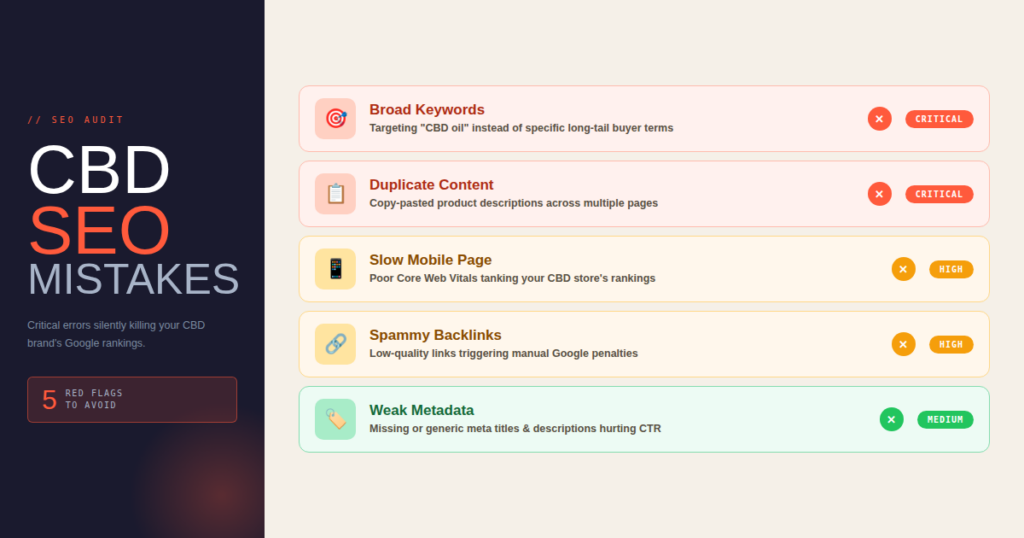
Common CBD SEO Mistakes To Avoid
If you want to understand how to rank CBD website on Google for maximum conversions & traffic, avoiding the wrong moves matters just as much as following the right steps.
In the CBD space, small SEO mistakes can slow growth faster because the niche already faces tighter scrutiny, stronger competition, and a bigger trust barrier.
Here are some of the most common mistakes to stay away from:
Targeting broad keywords too early ❌
Going after wide terms can drain time and effort without bringing the right traffic. Long-tail, specific, and intent-based keywords usually make more sense in a niche like CBD.
Publishing thin, copied, or weak content ❌
CBD pages need to feel useful, original, and trustworthy. Generic content does not just weaken rankings; it is just making your brand look less credible.
Ignoring mobile experience ❌
If the site is slow to load or awkward to use on a phone, it can hurt both rankings and conversions.
Using duplicate or unhelpful titles and meta descriptions ❌
Repeating the same page titles across the site, stuffing them with keywords, or leaving meta descriptions weak can hold back clicks and make pages harder for search engines to understand properly.
Building the wrong kinds of backlinks ❌
Random directories, spammy link schemes, and low-quality link placements can create more risk than value.
| Relevance and trust usually matter more than volume in the CBD space. |
Skipping technical cleanup ❌
Slow pages, broken links, incorrect redirects, missing schema, and duplicate URLs can quietly weaken performance even when the content is trustworthy, original, and organized.
Treating SEO like random posting ❌
Publishing without a defined strategy often leads to scattered pages, missed keyword opportunities, and weak internal alignment between content and business goals.
Not tracking what is working ❌
Without reviewing search visibility, clicks, rankings, and on-page behavior, it becomes much harder to improve what is already starting to gain traction.
Turn Your CBD SEO Into Measurable Growth
Knowing “how to rank CBD website on Google” is not guesswork. It requires the right keyword strategy, compliant messaging, strong technical foundations, and consistent execution. CBD Marketing Solutions turns these elements into measurable growth—helping brands improve visibility, attract qualified traffic, and compete effectively in an increasingly competitive CBD search landscape.
FAQs
Should a CBD brand handle SEO internally or work with an outside agency?
That depends on the team, the time available, and the expertise available. In-house SEO offers greater direct control, but it can take longer if the team is still learning the CBD niche. Outsourcing can make more sense when a brand wants faster execution, stronger strategy, and support from people who already understand CBD content, backlinks, compliance concerns, and search trends.
How do I get started with CBD SEO services?
Getting started is simple. Just fill in a few basic details like your name, contact number, the service you need, whether that is CBD keyword research, backlinking, on-page optimization, or something else, and share your website URL. Once that is done, our team will review the details and get in touch with you shortly.
How long does it realistically take a CBD website to rank on Google?
There is no fixed timeline. Performance post-SEO may take several weeks or months to be affected, and broader site-quality improvements can take several months to be recognized. For a new CBD site, it is more realistic to expect gradual movement than fast rankings.
What pages should a new CBD site build first: homepage, collections, PDPs, or blogs?
Start with the homepage, core collection pages, and your main product pages first. Once this foundation is in place, create a blog page to publish content consistently.
How should CBD product pages be written to avoid risky medical-claim language while still converting?
Lead with what the product is, key ingredients or specs, price, availability, shipping or return information, and straightforward buying details. Keep the copy helpful and specific, avoid exaggerated or misleading claims, and use trust-building details instead of hype.
How do you recover if a CBD site loses traffic after a core update?
Start by checking whether the drop is due to a core update, a technical problem, or a normal demand shift. Then review the site as a whole, not just a few pages, for helpful, reliable, people-first content. Fix indexing issues, improve weak or overlapping pages, strengthen trust and clarity across the site, and give the changes time to take effect. Remember that recovery can take days to months, and sometimes longer if systems need to reassess the site as a whole.