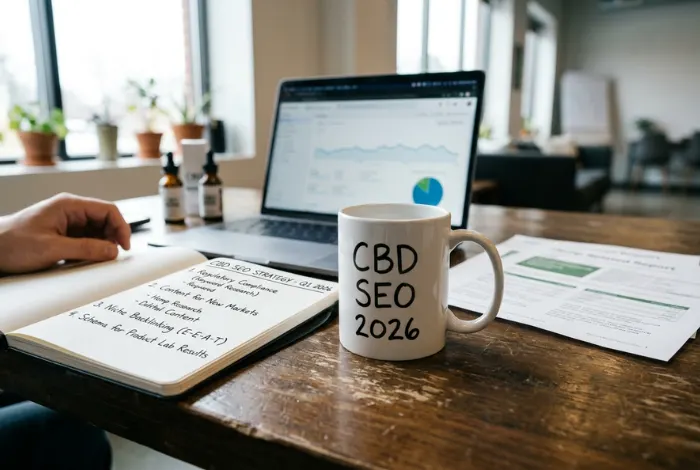
Growing a CBD brand becomes difficult when ad platforms keep imposing limits on scale. In such a restricted space, organic search becomes one of the few reliable ways to grow. If you are searching for “CBD SEO strategies 2026,” chances are you need a practical, effective roadmap.
This guide is for brands that want clearer direction on keywords, content, technical SEO, and link building to grow with consistency. Read to the end to see how each part fits together into a growth plan that is easier to follow and apply.
What Makes CBD Search Engine Optimization Different In 2026?
CBD SEO in 2026 is different because brands are no longer competing only for rankings. They also need visibility in AI-led answer experiences, where Google pulls direct responses from pages it considers clear and trustworthy. That makes a strong CBD SEO strategy less about chasing more links and more about:
⭐ Topical authority
⭐ Compliance-aware content
⭐ Technical health
⭐ Local trust signals
Refer to the table below to know what has changed for CBD brands.
| Changes | Why it matters for CBD brands |
| Answer engines are growing | Content now needs to be easy for Google to understand, extract, and cite in AI experiences. |
| E-E-A-T matters more | Helpful, reliable, people-first content has a better chance of earning trust and visibility. |
| Topical authority beats weak link volume | A strong content network around CBD topics is more useful than collecting random low-value links. This is an inference from Google’s emphasis on helpful, reliable content and spam-compliant publishing. |
| Technical SEO still matters | Slow, poorly indexed, or thinly structured sites make it harder for search systems to trust and surface pages. |
| Local SEO still matters | Google’s local rankings still depend on relevance, distance, and prominence. |
| Note:CBD brands cannot rely on generic e-commerce SEO advice. In this niche, content has to be useful enough to rank and careful enough to stay within policy boundaries. | |
Ad Restrictions, Trust Barriers, and Why Organic Still Leads
CBD brands do not have the same paid-growth freedom as most e-commerce businesses. Ad access exists in some cases, but is limited, which is why organic search remains the most dependable growth channel.
CBD Ad Platform Rules (2026 Snapshot)
| Platform | Allowed? | Allowed Regions | Restrictions | Approval Needed? |
| Google Ads | ✔️ Yes (limited) | CA, CO, Puerto Rico | Most CBD ads outside topical hemp ≤0.3% THC | ✔️ Yes (certification) |
| Meta (FB/IG) | ✔️ Yes (restricted) | United States only | No medical/health claims, no under-18 targeting | ✔️ Yes (product approval) |
| TikTok | ⚠️ Very limited | Select markets only | No ingestibles, no self-serve hemp ads | ✔️Yes (rep + LegitScript in cases) |
| AdRoll | ❌ Mostly no | Limited beta only | Most CBD/hemp ads + dynamic ads blocked | ✔️ Strict compliance review |
It is this regulatory patchwork that makes CBD SEO an important and, in fact, the most reliable strategy for growth.
| An Extra Angle Most CBD Brands Miss!Google’s local system still leans on relevance, distance, and prominence. So even in a niche where brands think only SEO matters, local pages, reviews, and a complete Business Profile can improve visibility, where buying intent is often strongest. |
What Is CBD SEO, and How Is It Different From CBD Marketing?
CBD SEO is the work done to help a CBD website appear in search results when people are already looking for related products, topics, or answers. It is built around search intent, site structure, and content that can keep bringing traffic over time.
CBD SEO, in simple words
- Helps the website show up on Google.
- Focuses on search-driven traffic.
- Brings in people with clearer intent.
- Builds visibility that can last longer.
| Did You Know?CBD falls under YMYL (Your Money or Your Life), so Google only ranks content that shows strong E-E-A-T: experience, expertise, authority, and trust. That means SEO in CBD isn’t just about keywords—it’s about proving real credibility. |
How Does It Differ From CBD Marketing?
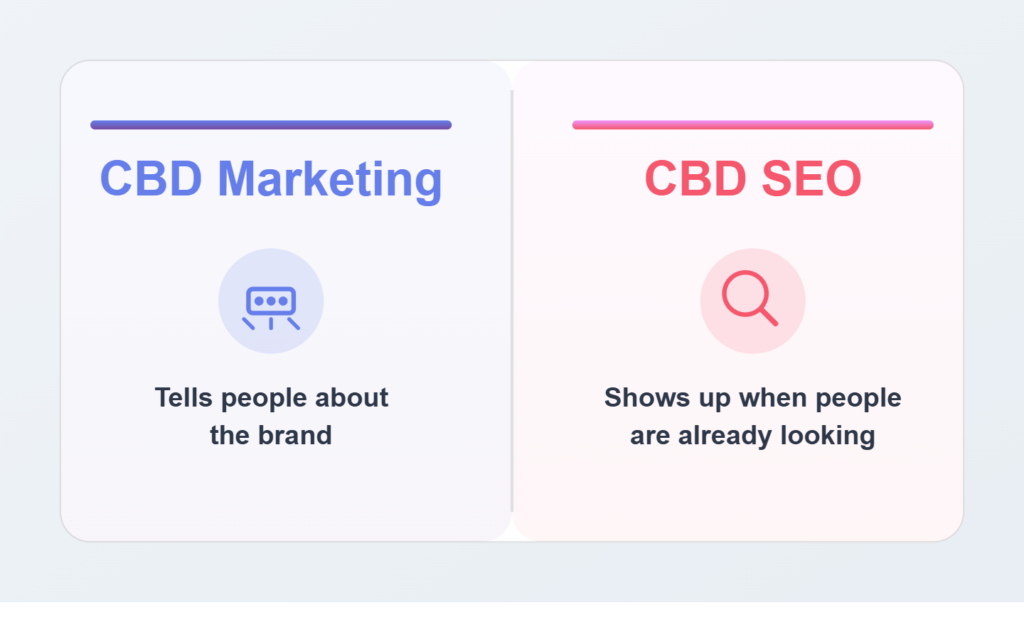
CBD marketing is the bigger picture. It includes brand promotion across channels like social media, email, creator campaigns, and content distribution. CBD SEO is one part of that bigger effort, but its job is more specific: to capture demand that already exists in search.
CBD SEO Strategies 2026 Roadmap
Building The Right CBD Site Architecture
A strong CBD site structure should make two things easy:
Number 1: Users should find the right page fast
Number 2: Search engines should understand how every page connects.
Here’s what you need to ensure/do:
✔️ Keep the site clean, layered, and easy to follow.
✔️ Make key pages reachable within a few clicks.
✔️ Connect related pages through descriptive internal links.
✔️ Help Google discover important URLs through good linking and a sitemap.
| Think in this order: Homepage → Category → Subcategory or Guide → Product or Article.(The cleaner this path is, the easier it is to scale new content later.) |
💡 Micro Insight:
Many CBD brands struggle with SEO, not because they lack content, but because their site structure is unclear. Important pages often sit too deep in the site or remain poorly connected, making it harder for search engines to understand what should rank.
Pillar & Cluster Architecture For CBD Websites
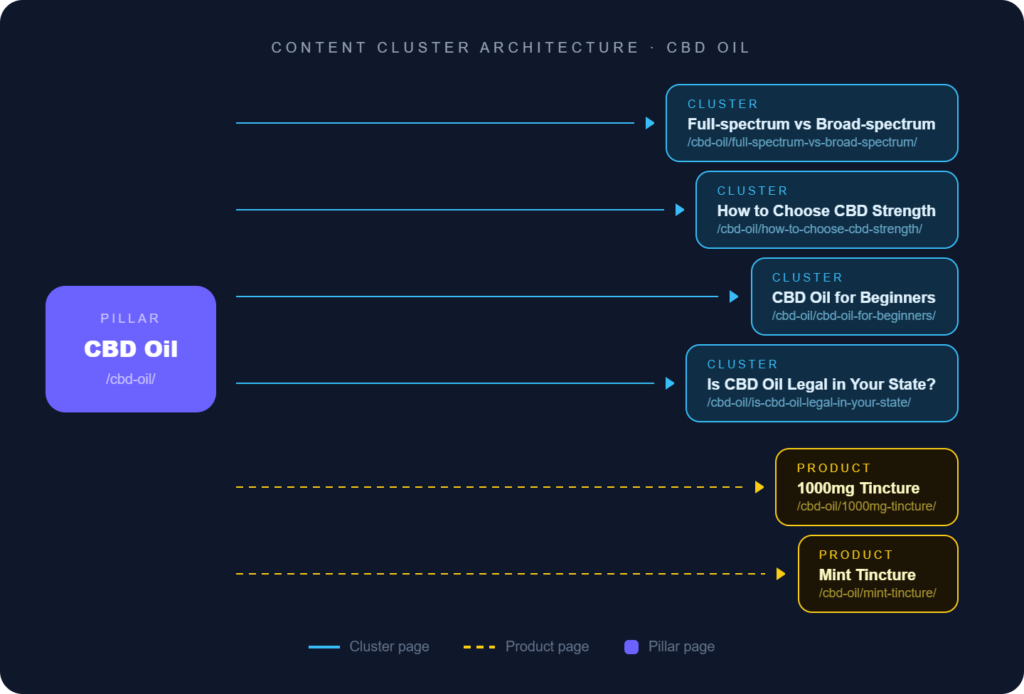
A pillar-and-cluster setup helps a CBD site avoid scattered publishing.
| THE Pillar Page | Cluster Pages |
| Should cover the broad topic. | Should support the ‘pillar page’ by answering narrower questions and linking back to the main page. |
A simple way to build it:
- Use a main category page or core guide as the pillar.
- Add supporting articles for specific questions, comparisons, or use cases.
- Link cluster pages back to the pillar with clear anchor text.
- Link sideways between related cluster pages where it helps the reader.
How To Build Topic Authority In The CBD Niche?
Topical authority comes from covering a subject with depth, order, and relevance, not from publishing random articles whenever a keyword looks promising. Google’s AI features documentation says the same core SEO basics still matter, which makes connected, well-structured topic coverage even more useful.
Here’s how you can build authority brick-by-brick:
| Start with your main topic groups, such as oils, gummies, topicals, dosage basics, legality, and product comparisons.↓Create one strong core page for each major topic.↓Add cluster content for specific questions and long-tail searches.↓Use expert-reviewed, carefully sourced content where the topic becomes sensitive.↓Add real product details, original photos, or real usage context where relevant.↓Keep clusters tightly linked so both users and crawlers can move through the topic easily. |
| What actually builds authority?In CBD, authority is rarely built by one page alone. It comes from a network of related pages that answer. |
👉🏻 We, at CBD Marketing Solutions, manage your blog end-to-end—from planning and writing to publishing—ensuring engaging CBD content that stays consistent and keeps your audience coming back.
Example: What a High-Ranking CBD Page Looks Like
A strong CBD page is not just optimized—it is built around clear intent, structure, and trust.
Here’s what it typically includes:
✔️ Targets a specific keyword with clear intent (not broad terms)
✔️ Uses a clean heading structure (H1 → H2 → H3) for easy scanning
✔️ Answers the main query early, then expands with supporting sections
✔️ Adds internal links to related guides, categories, or products
✔️ Includes trust signals like product details, testing references, or brand info
✔️ Keeps language clear, factual, and compliance-aware
✔️ Loads fast and works smoothly on mobile
👉 Many CBD pages underperform because they try to rank without fully matching search intent or building trust.
Bad vs Good CBD Page: What Actually Makes the Difference
Not all CBD pages compete equally in search. Small differences in structure, clarity, and compliance can decide whether a page ranks or gets ignored.
Here’s a side-by-side comparison to make that difference clearer:
| Area | ❌ Weak CBD Page | ✅ High-Performing CBD Page |
| Search Intent | Targets broad keywords without a clear purpose | Matches a specific query like “best CBD gummies for beginners.” |
| Content Depth | Thin, repetitive, or surface-level content | Covers the topic in detail with comparisons, FAQs, and supporting sections |
| Structure | Poor formatting, large text blocks, no clear hierarchy | Clean H1–H3 structure with scannable sections |
| Product Integration | Pushes products aggressively without context | Introduces products naturally within helpful content |
| Compliance | Includes exaggerated or risky claims | Uses clear, factual, and compliance-aware language |
| Trust Signals | Little to no brand or product transparency | Includes product details, testing references (COA), and clear business info |
| Internal Linking | Few or random links | Strategic links to guides, categories, and related pages |
| User Experience | Slow, cluttered, or hard to navigate | Fast-loading, mobile-friendly, and easy to explore |
| SEO Readiness | Weak titles, missing metadata, no schema | Optimized titles, structured data, and clear on-page signals |
How To Map Keywords To Categories, Products, Blogs, & Guides?
Keyword mapping means assigning each page a single, clear search goal. It is the process of assigning keywords to specific URLs so that the page best matches the searcher’s intent. Done well, it helps prevent keyword cannibalization and reveals content gaps.
The Process:
| Category pages: broad, commercial termsExample: CBD gummies, CBD topicals, CBD oil |
| Product pages: specific, transactional termsExample: 1000mg CBD oil tincture, mint CBD gummies |
| Blog posts: question-led informational termsExample: how to choose CBD strength, what is full-spectrum CBD |
| Guides: broad educational topics that need more depthExample: complete guide to CBD oil, CBD beginner guide |
Beware!
- Assign one primary keyword to each page.
- Add 3-5 secondary terms that support the same intent.
- Track everything in one sheet: URL, page type, intent, primary keyword, secondary keywords, status.
- If two pages target the same thing, merge, reposition, or differentiate.
- If an important keyword group has no page, create one.
❌ Common mistake that will backfire – Sending every valuable keyword to a product page.
CBD Keyword Research — Full Framework
Good CBD keyword research is not about picking the biggest term and hoping it ranks. It is about finding the right search intent, choosing keywords that fit the right page type, and building a plan that can grow over time.
- Find terms that match real buyer or reader intent.
- Separate broad terms from specific opportunities.
- Avoid sending every keyword to the same kind of page.
- Reduce keyword cannibalization by giving each page one clear job.
OR
| Do It With REDDIT! |
| As seen in the Reddit CBD Keyword Research Discussion, users note that Google Keyword Planner often shows limited or unreliable CBD keyword data due to platform restrictions. Some suggest using tools like Ahrefs, while others focus on simple intent-based searches like “CBD oil for anxiety” when volume data is unclear. |
👉 In CBD SEO, success depends more on search intent than perfect keyword volume data.
Commercial vs Informational vs Local Keywords
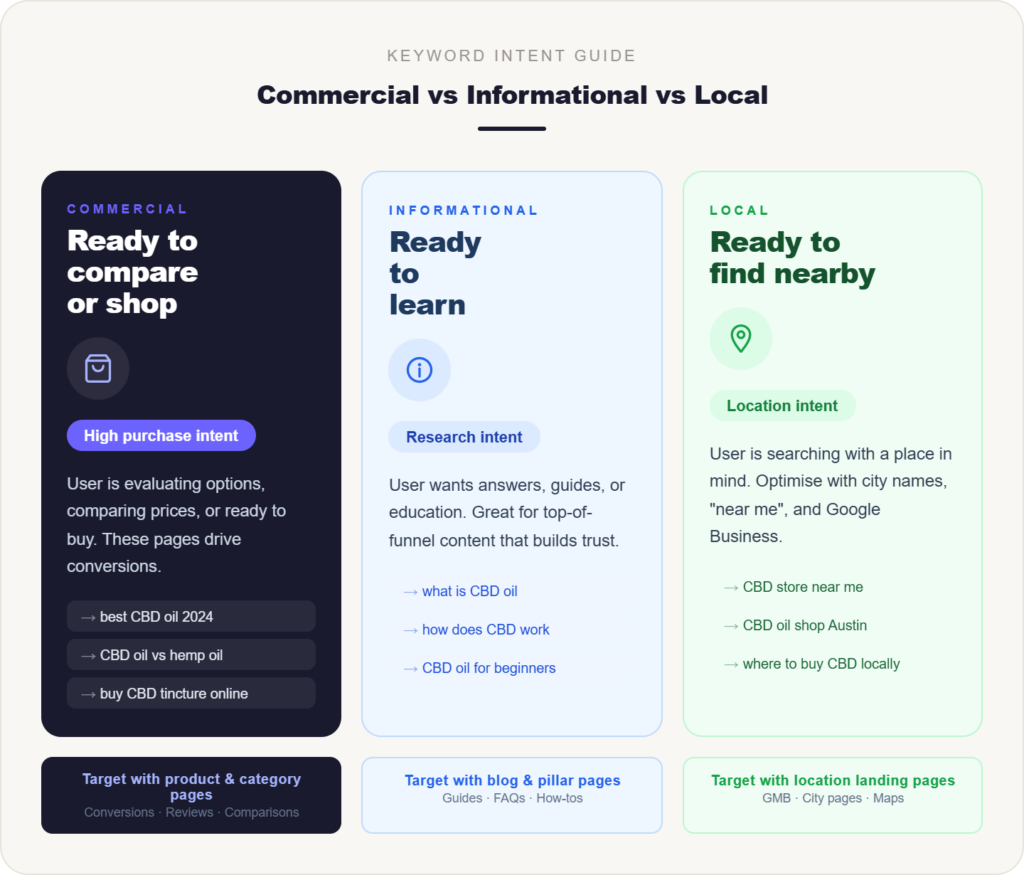
CBD keywords do not all serve the same purpose. Some bring in people who are ready to compare or buy, while others attract users who are still learning or searching within a specific area. The table below makes that difference easier to understand.
| Keyword Type | Meaning | How to find it? | Examples | Best Page Type |
| Commercial | Searches made by people comparing products, exploring options, or getting close to a purchase | 👉🏻 Look for words like best, buy, top, for sale, vs, review | ‘best CBD gummies’ ‘buy CBD oil’ ‘CBD gummies vs tincture’ | Category pages ↓ Comparison pages ↓ Product collections |
| Informational | Searches made by people who want to learn, understand, or solve a question | 👉🏻 Look for words like what is, how to, guide, benefits, difference between | ‘what is broad-spectrum CBD’ ‘how to choose CBD strength’ ‘CBD oil guide’ | Blogs↓Guides↓FAQ pages |
| Local | Searches made by people looking for CBD products or stores in a specific area | 👉🏻 Look for place names or phrases like near me, in [city], nearby, local | ‘CBD store near me’, ‘buy CBD oil in Miami’ ‘CBD gummies nearby’ | Location pages↓Store pages↓Local landing pages |
| Do not judge a keyword only by volume. A lower-volume keyword with clearer intent can be more valuable than a broad term. |
Long-Tail CBD Keywords: Your Set of Easier To Rank Keywords
Some of the best opportunities come from long-tail CBD keywords, which are more specific searches with clearer intent. They usually bring in more focused users and are often easier to rank for than short, high-volume terms.
Why do they matter?
- Less competition than broad head terms.
- Clearer intent, which makes page matching easier.
- Better content ideas for blogs, guides, and collections.
- Stronger chance to rank faster with the right page structure.
Examples:
- ‘best CBD oil for beginners’
- ‘how to choose CBD gummies strength’
- ‘CBD tincture vs gummies for first-time users’
- ‘where to buy CBD oil near me?’
- ‘full-spectrum CBD guide for beginners’
| A strong CBD keyword plan should include all these keywords (types), because they target users at different stages of the journey. |
Content Strategy for CBD Brands
A strong CBD content strategy should do more than fill the blog with new posts. It should help the site become more useful, more trusted, and easier to understand for both users and search engines.
📌 Cover topics with a clear purpose.
📌 Publish pages that add new value, not reworded summaries.
📌 Keep important pages fresh and accurate.
📌 Make each piece fit a real search intent.
| Google wants to see original content that is not just “content written from scratch.” It should also be useful, accurate, and worth visiting instead of another page on the same topic. |
How Original, Trustworthy Content Improves Rankings?
Original, trustworthy content helps rankings by giving users a reason to stay on the page, trust the site, and keep exploring related content.
- Use clear explanations.
- Fact-check before writing.
- Do consistent internal linking.
- Follow a CBD content marketing plan built around useful topics, not just keyword volume.
Avoid This (Otherwise Expect WEAKER Performance Overtime)
❌ Publishing pages that say the same thing in slightly different words.
❌ Writing for rankings first and readers second.
❌ Letting important pages go stale.
❌ Using AI or templates without adding real editorial value.
Best Content Types For CBD SEO
- Guides for broad educational topics.
- Comparisons for decision-stage searches.
- FAQs for short, intent-driven questions.
- Educational assets for supporting trust and topic depth.
| Content is one part of CBD content marketing, which can also include videos, case studies, webinars, newsletters, infographics, and other educational assets used to attract, engage, and retain the right audience. |
On-Page CBD SEO Strategies In 2026: Complete Checklist
On-page SEO is where keywords, content, UX, and compliance come together on the actual page. Google analyzes the text, images, and other page elements it can crawl and index, so the way a CBD page is titled, structured, linked, and marked up directly affects how well it can be understood in search.
Use this as the core on-page checklist for CBD pages:
- Title tag: Keep it unique, clear, and specific to the page.
- Meta description: Wrote a short summary that matches the page, but do not treat it like a guaranteed snippet.
- Headings: Use one clear H1, then break sections with H2s and H3s.
- Internal links: Connect related pages with crawlable HTML links and descriptive anchor text.
- Images and alt text: Use images near relevant copy, and write alt text that describes the image naturally.
- Structured data: Add markup that matches the page type.
Structured Data Toolkit: Put It To Use
- CMS platforms (like WordPress) → Use SEO plugins (like RankMath, Yoast) → they add it automatically.
- Shopify / eCommerce sites → Many themes already include product schema or added via apps.
- Custom websites → Developers manually add JSON-LD code to each page type.
How To Optimize Product Pages, Collection Pages, And Blog Posts Differently?
Do not make the mistake of optimizing every page the same way. The best setup is to match the on-page elements to the job of the page.
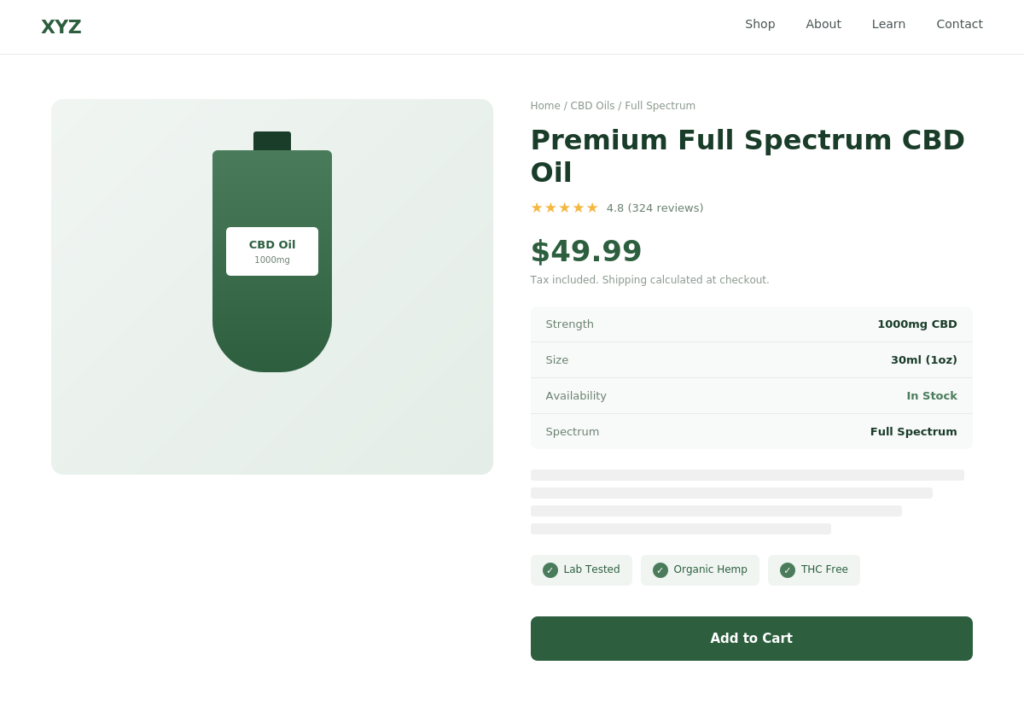
1️⃣ For Product pages:
- Lead with the exact product name.
- Keep pricing, availability, size, or strength, and key product details easy to find.
- Add Product markup where appropriate.
- Use high-resolution product images with descriptive alt text.
- Avoid heavy claims and fact-check.
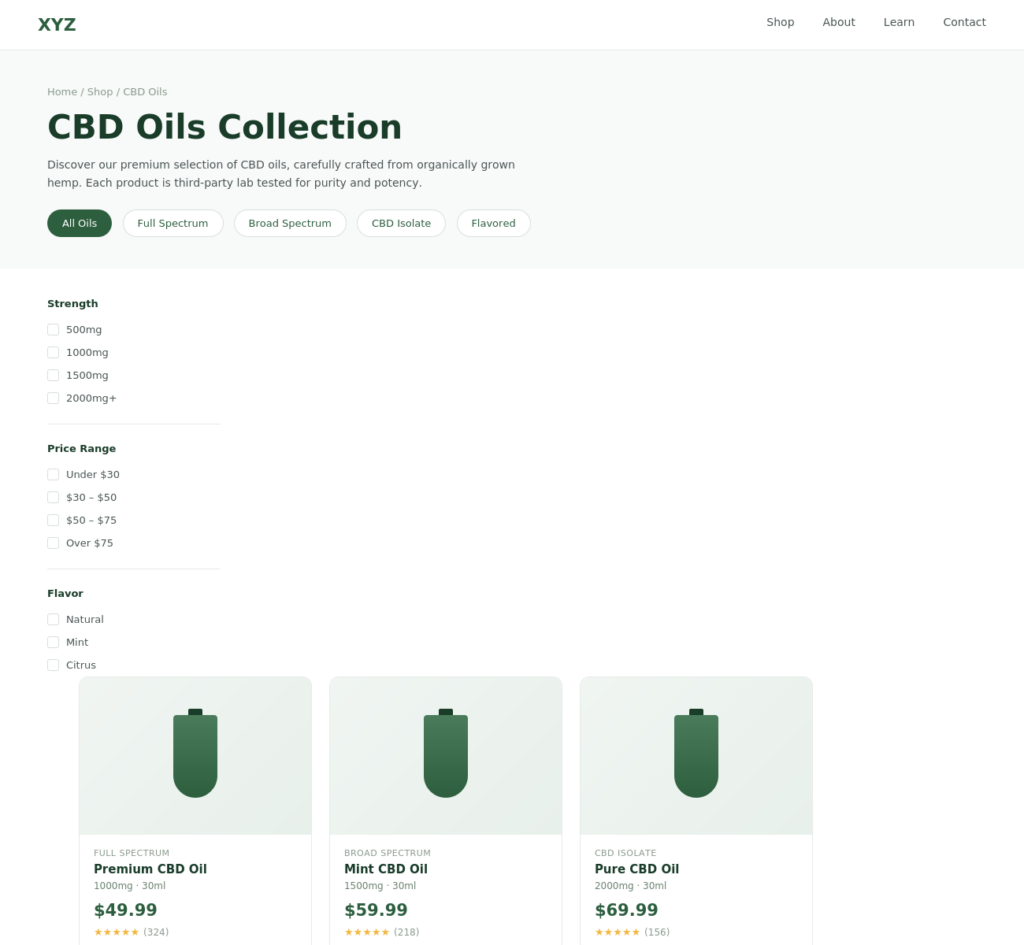
2️⃣ For Collection pages:
- Add a short introduction (sometimes referred to as “A hero section”) that explains what the category covers.
- Link clearly to subcategories and products.
- Use internal links that help users move deeper into the store.
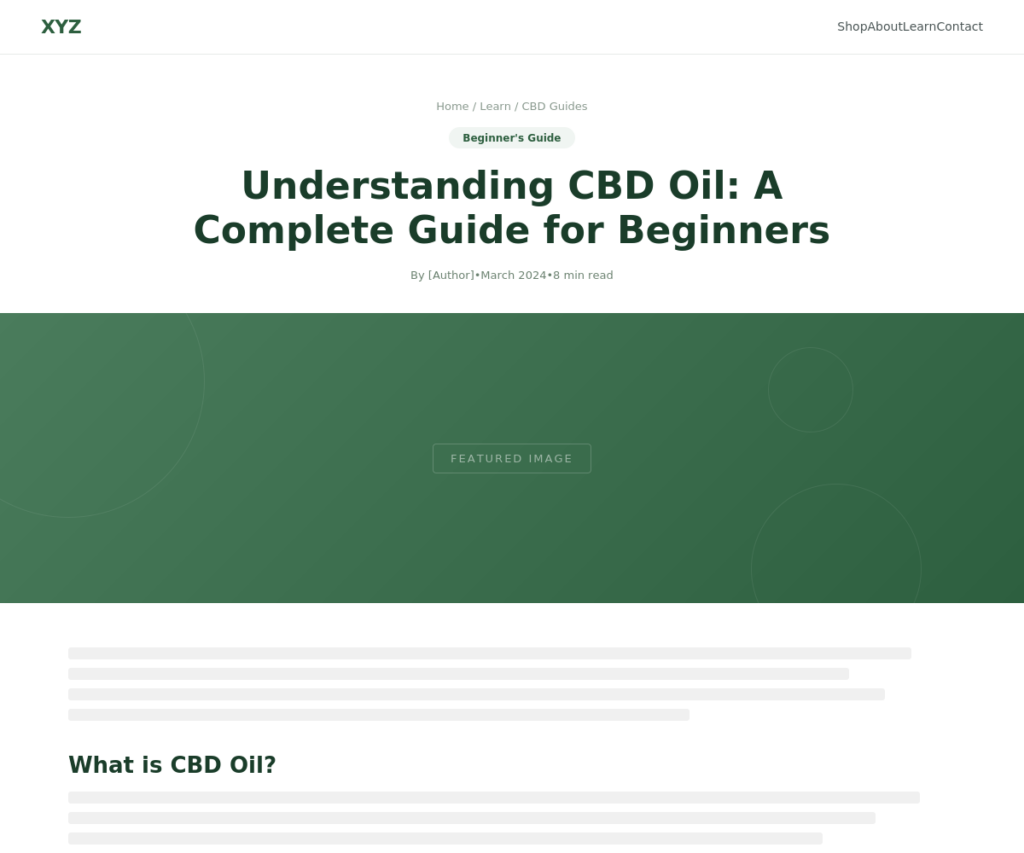
3️⃣ For Blog posts and guides:
- Match the page to a specific question or topic.
- Use a proper heading structure.
- Add helpful internal links to related guides, categories, or products.
- Use Article markup where it fits the page type.
Technical CBD SEO Strategies In 2026
Technical SEO is what helps a CBD site stay fast, accessible, secure, and easy for Google to process. Even strong content can struggle if important pages load slowly, are hard to crawl, or send mixed signals about which URL should rank.
Why Is Technical SEO Important For CBD Sites?
👉🏻 Slow pages can hurt user experience and make product browsing feel frustrating.
👉🏻 If a page is blocked, orphaned, or not properly indexed, it will not do much for SEO, no matter how good the copy is.
| A page can be published and still remain weak from an SEO angle if Google cannot reach it through normal crawlable links. |
Core Web Vitals, Crawlability, and Indexation
This is the part that decides whether Google can reach your pages, understand them, and serve a smooth experience once users land there.
Know these terms before you start:
- Largest Contentful Paint (LCP) → Checks how quickly the main content appears.
- Interaction to Next Paint (INP) → Shows how responsive the page feels when users tap, click, or interact.
- Cumulative Layout Shift (CLS) → Tracks unexpected layout movement while the page loads.
HTTPS, Canonicals, XML Sitemaps, and Site Hygiene
These are the quieter technical settings that keep a CBD site organized behind the scenes. They do not always stand out visually, but they help reduce confusion for both users and search engines.
A practical checklist for you to follow!
- Use HTTPS across the full site.
- Set canonicals where similar URLs exist.
- Keep the XML sitemap up to date with important pages.
- Make URLs short, readable, and crawlable.
- Check that internal links point to the right canonical versions.
CBD Link Building Strategy
For CBD brands, link building should focus on trust, relevance, and editorial value, not just numbers.
Link building works as one of the best CBD SEO strategies in 2026 because it:
🔹 Helps important pages gain more trust and visibility.
🔹 Supports category pages, guides, and product discovery.
🔹 Gives CBD brands a growth channel beyond restricted paid promotion.
🔹 Works best when links come from real, relevant sites.
A good CBD backlink plan usually works best when it combines a few high-quality acquisition paths rather than relying on a single tactic. Refer to the table below for several link-building tactics.
| Technique | Best use |
| Guest posting | Get placed on relevant wellness, retail, ecommerce, or niche sites |
| HARO / journalist outreach | Earn editorial mentions through expert quotes |
| Digital PR | Win links through data, trends, expert commentary, or useful stories |
| Niche directories | Build foundational links from curated, relevant listings |
| Unlinked brand reclamation | Turn existing brand mentions into links |
| Testimonial link building | Earn links from tools, services, or partners you genuinely use |
| Unlinked brand reclamation is often easier than cold outreach because the site already knows your brand. You are asking them to complete an existing mention, not create a brand-new one. |
The DR sweet spot
DR should be treated as a screening metric, not a Google metric.
That said, as a practical vetting rule, a DR 30–60 range is often a strong sweet spot:
🔴 Below DR 20 can be risky
🟡 DR 30–60 is often the most workable range
🟢 DR 70+ can be excellent
| Do not choose a site only because the DR is high. Relevance, editorial quality, and real traffic matter more. |
How To Vet A Placement Yourself?
Use this quick check before saying yes to any placement:
- Read the site like a normal user: Does it look real, current, and trustworthy?
- Check topic relevance: Would a CBD brand naturally belong on this site?
- Review existing articles: Are they well-written, or do they look mass-produced for SEO only?
- Look at outbound links: If every article links out to unrelated industries, that is a bad sign.
- Check whether the site gets real visibility: Use tools to review organic traffic, referring domains, anchor patterns, and link quality signals.
- Avoid obvious footprint signals: Too many casino, pharma, adult, or gambling links nearby usually mean poor quality.
Red Flags You Should Not Ignore
🚩 Thin content that adds little value and does not support long-term CBD organic traffic
🚩 No clear editorial quality
🚩 Unrelated outbound links everywhere
🚩 Obvious paid-link footprints
🚩 Guest posts published at scale with no topical fit
CBD SEO Strategies In 2026: How To Measure Them?
Once a CBD SEO strategy is live, the work does not stop at publishing and optimization. SEO needs regular tracking because rankings alone do not show whether the strategy is actually bringing the right visitors, stronger engagement, and revenue impact.
What is the actual ‘success’ for a CBD brand?
- More qualified CBD organic traffic
- Better keyword visibility
- Stronger engagement on key pages
- More conversions from search
KPIs To Track In GSC & GA4
Focus on a small set of metrics that actually show real movement.
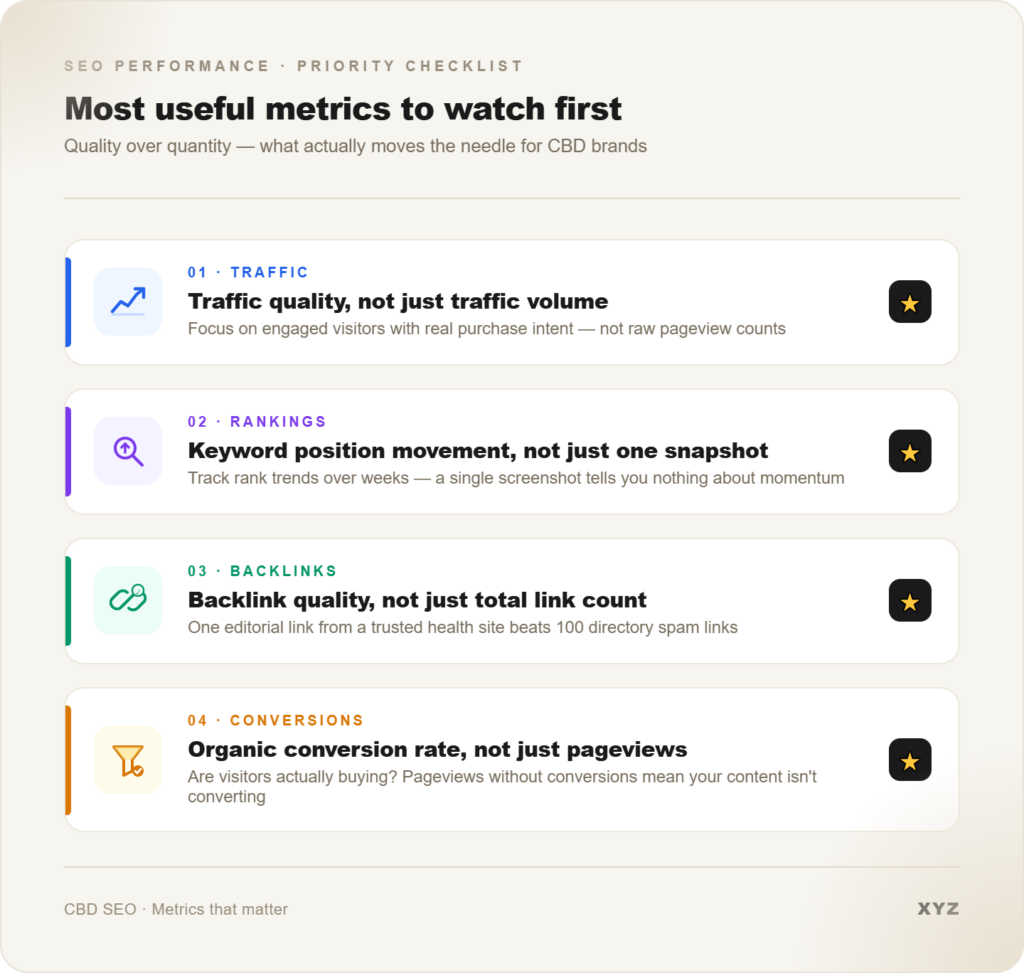
Most useful metrics to watch first:
⭐ Traffic quality, not just traffic volume.
⭐ Keyword position movement, not just one ranking snapshot.
⭐ Backlink quality, not just total link count.
⭐ Organic conversion rate, not just pageviews.
To make things easier, here are the key metrics you should track in each tool.
| Tool | What to track with it? |
| Google Search Console (GSC) | Clicks, impressions, CTR, average position, top queries, and indexing issues. It shows how your site is performing in Google Search. |
| Google Analytics 4 (GA4) | Organic sessions, users, engagement rate, traffic acquisition, and conversions. It helps you understand where users come from and how they behave on the site. |
Take The Next Step
By now, you understand how CBD SEO works in 2026—what matters next is execution. Strategy, structure, and consistency are what separate slow progress from real growth.
CBD Marketing Solutions helps brands turn these insights into a focused, results-driven SEO system.
👉🏻 Contact us today to start building a CBD SEO strategy that delivers.
FAQs
1. How long does it take for CBD SEO strategies in 2026 to show results?
Most CBD SEO strategies in 2026 need a few months before they show strong traction. Some pages may start gaining impressions and clicks earlier, but steady traffic growth usually comes after consistent work on content, technical SEO, internal linking, and backlinks.
2. Is CBD SEO still worth it if the brand is new?
Yes, but a new brand should start with realistic expectations. New CBD sites often need time to build trust, cover core topics properly, and earn enough authority before they can compete for stronger terms.
3. Can AI-generated content work for CBD SEO?
It can help with drafting, but it should not be published without strong editing. In the CBD niche, content needs to be accurate, useful, compliant, and clearly better than thin AI-written pages.
4. Do CBD brands need separate pages for different states or cities
Only when there is a real SEO reason to create them. If a brand serves different locations, pages should offer unique local value instead of repeating the same content with swapped place names.
5. Should CBD product descriptions be unique on every page?
Yes. Reusing the same copy across multiple products or category pages weakens relevance and makes the site feel thin. Each page should have its own clear purpose and original information.
6. Is blogging enough to grow a CBD website?
No. Blogs can boost visibility, but they work best when integrated with category pages, product pages, internal links, and a broader SEO structure.
7. Do CBD brands need medically reviewed content
Not every page needs it, but it can be helpful for sensitive educational topics. When content touches on areas where trust matters more, stronger review signals can make the page more credible.
8. What is the biggest mistake brands make with CBD SEO strategies in 2026?
One of the biggest mistakes with CBD SEO strategies in 2026 is treating them like generic e-commerce SEO. Many brands either target the wrong keywords, publish repetitive content, or ignore compliance and trust signals that matter much more in the CBD space.
9. How often should a CBD website update its SEO content?
Important pages should be reviewed regularly, especially if rankings drop, information becomes outdated, or search intent changes. Updates should improve the page, not just change a few words for the sake of freshness.
10. Is it better to hire a CBD SEO agency or do it in-house?
In-house SEO offers more control, while a specialist agency like ours delivers guaranteed results because we already understand CBD search behavior, compliance concerns, and content strategy.