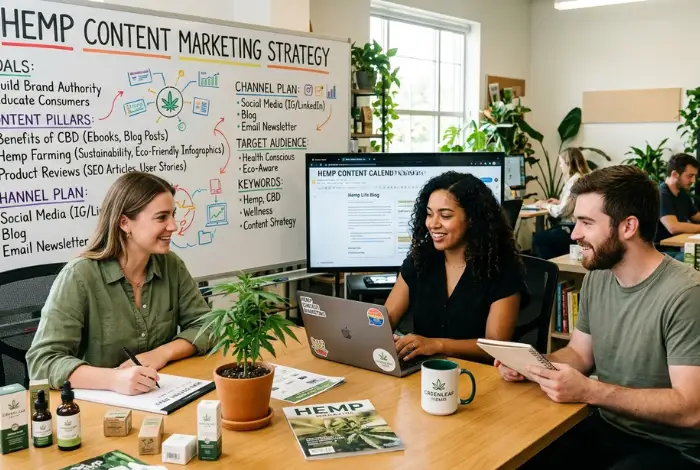
Paid ads often create roadblocks for hemp brands, and the industry still carries too many myths that need better answers. That makes hemp content marketing one of the strongest promotion channels for building visibility, earning trust, and bringing in sales through search. But content marketing is not just about publishing blogs to keep the website active.
A pillar-and-cluster strategy gives your content a proper direction. You create one main pillar page around a broad hemp topic, then support it with cluster articles that answer specific search questions.
This blog explains:
- How does this strategy work for hemp websites?
- How to choose the right pillars?
- How to write supporting cluster articles?
- How to use internal links so every blog supports a larger SEO goal?
What Is The Pillar-And-Cluster Content Model?
The pillar-and-cluster content model helps you decide which topics need a main page and which related questions need their own supporting blog posts.
For your hemp brand, this matters because of these 3 reasons:
- Better topic coverage: You can cover broad and specific searches without stuffing everything into one blog.
- Stronger internal links: Pillars and clusters pass readers to the next useful page.
- Less content overlap: Each cluster targets one search intent, so fewer blogs compete for the same keyword.
Let’s understand this with an example.
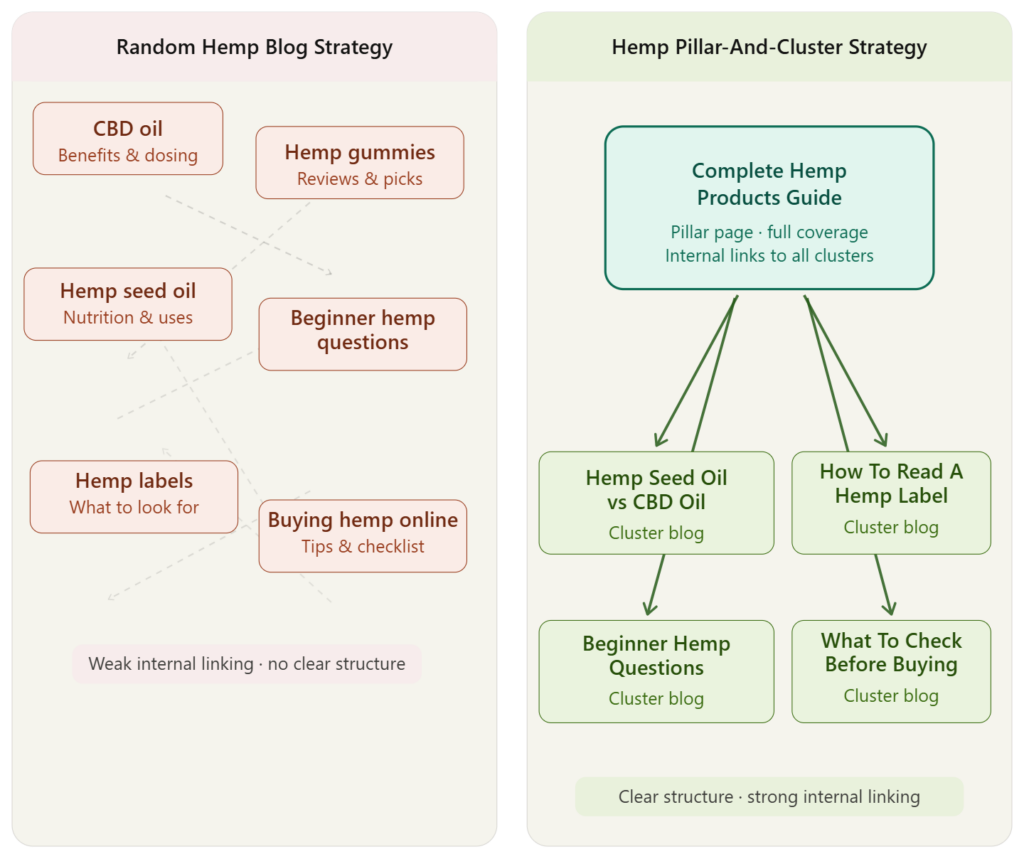
Say a hemp brand sells multiple product formats. Instead of writing separate blogs without a clear direction, the brand could create one main guide around hemp products and support it with focused blogs, such as:
- How to read a hemp product label?
- Hemp seed oil Vs CBD oil
- What to check before buying hemp products online?
- 7 beginner questions about hemp product formats
Here, hemp products serve as the main guide topic because they have enough depth for a full page. The supporting blogs answer specific questions people may search for before comparing products or making a buying decision.
👉🏻 Before adding new blogs, review what your website already has. You may find repeated topics, weak internal links, or pillar pages that need stronger support. Our hemp SEO services are built around fixing that gap with strategy, SEO content planning, and content optimization.
How To Build A Hemp Content Plan Around Pillars And Clusters?
A hemp content plan should not begin with “we need more blogs.” That usually leads to scattered topics, repeated points, and articles that don’t support your broader SEO goals.
Start with topic mapping instead.
Look at the main areas your hemp brand wants to be known for, then decide which topics qualify as pillars and which questions should become supporting cluster blogs.
| Worth knowing: Before adding new blog ideas, check what is already published on your website. Some old posts may support a pillar page, some may need SEO updates, and some may need to be merged because they answer almost the same question. |
Step 1: Choose strong hemp content pillars
Your pillar topics should connect with what your audience searches for and what your business actually offers. A good pillar has enough depth to support several related blogs.
Some hemp pillar topics to get you started:
- Hemp Wellness
- Hemp Marketing
- Hemp SEO
- Hemp Wholesale
- Hemp Product Education
- Hemp Farming Basics
Step 2: Add cluster topics under each pillar
Once you pick a pillar, map the smaller questions around it.
If Hemp Wellness is one pillar, the cluster blogs can focus on:
- Beginner questions about hemp products
- Ingredient comparisons
- Label reading tips
- Buying guidance
If Hemp Wholesale becomes your other pillar, the cluster blogs can focus on:
- What retailers should check before placing an order?
- How to compare hemp vendors online?
- Why do buyers order hemp products in bulk?
The point is simple: do not choose a pillar just because the keyword looks broad. Choose it because it can help you cover multiple useful cluster articles without losing direction.
Avoid a pillar like “hemp” because it is too wide. Also, avoid a tiny topic that can only support one blog.
Step 3: Decide which cluster blogs to write first
Once you have a list of cluster blog ideas, do not start writing randomly. Some topics can bring better traffic, leads, or sales than others.
Start with the topics your buyers are most likely to search for before they take action.
| Blog priority | Topic example |
| Questions buyers already ask | ‘What Should I Check Before Buying Hemp Products Online?’ |
| Comparison topics | ‘Hemp Seed Oil Vs CBD Oil’ |
| Topics linked to your services or products | ‘How Hemp Brands Can Plan Blogs For SEO’ |
| Basic education topics | ‘What Is Hemp Extract?’ |
| Old blogs that need updates | Use words like 2026 updated, trending, latest. |
Such a hemp blog strategy will help you choose & write blogs that answer real questions, support your main pages, and deliver better results for your hemp content marketing.
Hemp Pillar Page Template: What To Add, Skip, And Check?
A hemp pillar page should provide the main topic with enough depth without becoming a long, tiring page. Keep it organized, useful, and easy to move through.
What to add?
- Short opening: Explain the topic and who it helps.
- Simple sections: Break the page into education, product/service details, comparisons, trust points, FAQs, and next steps.
- Cluster links: Add links to supporting blogs where deeper answers are needed.
- Helpful FAQs: Answer questions that don’t require a full blog post.
- Next step: Guide users toward a product, service, consultation, or contact page.
What to avoid?
❌ Repeating the same points already explained in cluster blogs.
❌ Making unsupported benefit claims.
❌ Adding too many internal links in one section.
❌ Turning the page into a keyword-heavy SEO dump.
❌ Covering tiny questions that deserve separate cluster blogs.
Hemp-specific checks:
✔️ Review claims before publishing.
✔️ Keep product details accurate.
✔️ Add age checks where your product category requires them.
✔️ Update hemp cluster articles or the pillar page when laws, products, or buyer questions change.
✔️ Keep internal links natural and useful.
Many hemp brands publish content that looks complete but misses the SEO and claims-review layer. The result: weak keywords, repeated topics, random internal links, or wording that needs a closer look.
At CBD Marketing Solutions, we focus on keyword research, blog writing, blog management, SEO optimization, and claim-conscious content review so your hemp content stays accurate, useful, and search-focused.
Internal Linking For Hemp Pillar-Cluster Content
Internal links should help your content move from one useful answer to the next. The goal is not to add links everywhere. The goal is to place the right link where the next question naturally comes up.
Before deciding where links should go, check your sitemap, blog archive, product pages, category pages, and legal pages. This helps you use the pages already on your website instead of creating links solely for SEO.
For example, if you have a pillar page on hemp products, you can link to:
- Related guides already published on your website.
- Product or category pages, when the intent moves closer to buying.
- A legality page that explains the legal stance of hemp in one place.
- Comparison blogs that help users choose between product types.
- FAQs or educational pages that answer common pre-purchase questions.
| Note: The link should match the section. When doing hemp content marketing, each topic should point to the next relevant page on your website. |
⭐ If two cluster blogs support the same decision, link them to each other.
Mistakes That Can Weaken Your Hemp Pillar-Cluster Strategy
- Writing cluster blogs before deciding which pillar they support.
- Sending every internal link to the homepage instead of the most relevant page.
- Repeating the same anchor text across several blogs.
- Creating two cluster blogs that answer almost the same question.
- Adding internal links after writing instead of planning them with the outline.
- Ignoring pages that already exist in your sitemap, blog archive, product pages, category pages, or legality pages.
An effective hemp content marketing plan works best when you follow this order:
| Choose the pillar first → Map the cluster blogs next → Decide the internal links before writing. |
One more thing. Do not leave your pillar and cluster pages untouched after publishing. Review them when products change, laws shift, or new buyer questions start showing up.
What To Expect From A Successful Pillar-Cluster Hemp Blog Strategy?
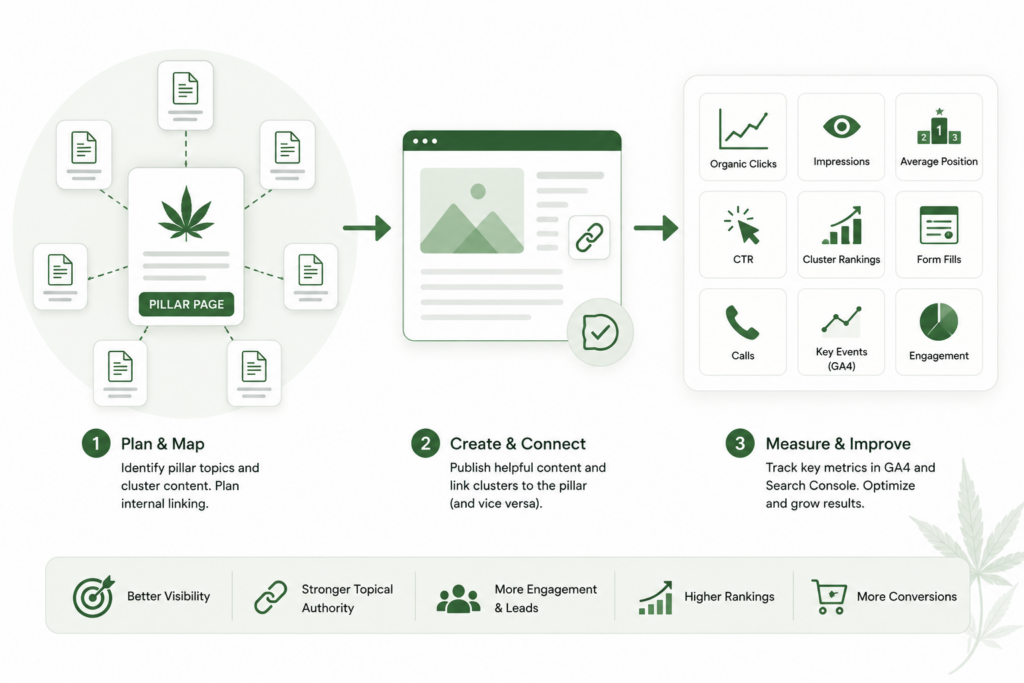
A pillar-cluster strategy works best when it becomes part of your larger hemp content marketing plan, not just a blog-formatting idea. You know which topics need pillar pages, which cluster blogs deserve priority, and where internal links should go before the writing starts.
Track progress through organic clicks, impressions, average position, CTR, cluster blog rankings, form fills, calls, and key events in GA4.
If SEO tools, content tracking, and website checks feel like too much to handle, let us take it from there. We review your website and share a website audit report within one day for just $11.95.
FAQs
What keywords should hemp brands target first?
There is no fixed keyword list every hemp brand should follow. Keywords with low competition and a long-tail nature can make ranking easier, especially for newer websites. Aim for keywords targeting buyer questions, product comparison, local search keywords, wholesale-related searches, and service-focused topics to bring conversions.
What should a 90-day hemp content plan include?
A 90-day hemp content plan should start with keyword research, a content audit, and pillar topic selection. After that, plan core cluster blogs, improve older content, and add internal links. By the third month, review rankings, traffic, form submissions, and which blogs need updates.
How often should you update old Hemp SEO content?
There is no fixed update schedule. Based on a Reddit discussion on updating old blog content, sites often refresh old posts regularly, while smaller sites may update less often. A practical target is reviewing key pillar pages and high-traffic blogs every 2 to 3 months.
Can AI-written hemp content create accuracy problems?
Yes. AI-written hemp content can create major accuracy issues because hemp and cannabis topics involve science, product details, state laws, and claim-sensitive language. AI may mix up legal boundaries, invent facts, or explain regulations incorrectly. Use tools only for support, then review every blog for factual accuracy, legal relevance, and claim safety before publishing.
Should hemp brands hire a content marketing agency?
Yes, if your blog schedule is inconsistent, your team lacks hemp SEO experience, or your staff does not have enough time to plan, write, optimize, and update content regularly. An agency like ours can help with keyword research, blog planning, writing, internal linking, and ongoing optimization.
How much can hemp content marketing services cost?
Hemp content marketing service costs can vary from agency to agency. Pricing depends on the service package a brand chooses, such as a basic content plan, a growth-focused plan, or a full SEO management plan. The final cost can also change based on the number of blogs required each month, whether the content needs to be written from scratch, or whether existing blogs only need SEO optimization.