Psilocybin businesses cannot market themselves like regular wellness brands, cannabis companies, or functional mushroom sellers. In 2026, the rules around psilocybin remain complex, with federal restrictions, state-level programs, platform policies, and advertising limits shaping what brands can say online.
That is why psilocybin marketing services are not just about visibility. They are about building trust, educating the right audience, and avoiding claims that can create legal or compliance issues.
This guide breaks down what’s allowed, what’s risky, and which marketing channels make the most sense for psilocybin brands today.
What Are Psilocybin Marketing Services?
Psilocybin marketing services help clinics, facilitators, retreats, and mushroom-focused brands improve visibility while keeping content careful, clear, and legally aware.
Since psilocybin is still listed as a Schedule I substance under the Controlled Substances Act, marketing cannot rely on the same language used for regular wellness campaigns.
A complete strategy often brings together:
- SEO and local SEO for location-based visibility
- Website content that explains services without overpromising
- Educational blogs around legality, access, and preparation
- Email marketing for updates and lead nurturing
- PR and brand messaging to build credibility
- Compliance-aware content planning before publishing
Did you know? Oregon’s psilocybin advertising rules do not allow ads that are deceptive, false, misleading, aimed at people under 21, or built around unsupported curative or therapeutic claims. That is why strong psilocybin marketing starts with education first and promotion second.
Psilocybin Legal Status In The USA In 2026
Psilocybin is getting more attention in 2026, but businesses still cannot market it freely. At the federal level, psilocybin is still a Schedule I controlled substance, so brands need to be careful with ads, website copy, claims, and sales-focused wording.
Here is the easiest way to understand the psilocybin legal status in the U.S.:
- Federal law still limits psilocybin.
- Some states allow regulated access.
- Some cities have decriminalized personal use.
- Decriminalization does not mean it is legal to sell.
- Marketing should educate people, not promise results.
So, is 2026 just another year, or is the situation changing? The answer is: things are moving, but not wide open yet.
The DEA released its 2026 production quotas for Schedule I and II substances to support medical, scientific, research, and industrial needs. This shows more formal activity around controlled substances, but it does not mean psilocybin is open for regular business promotion.
Before creating SEO pages, website copy, or psilocybin advertising content, brands should first understand what is allowed in their location.
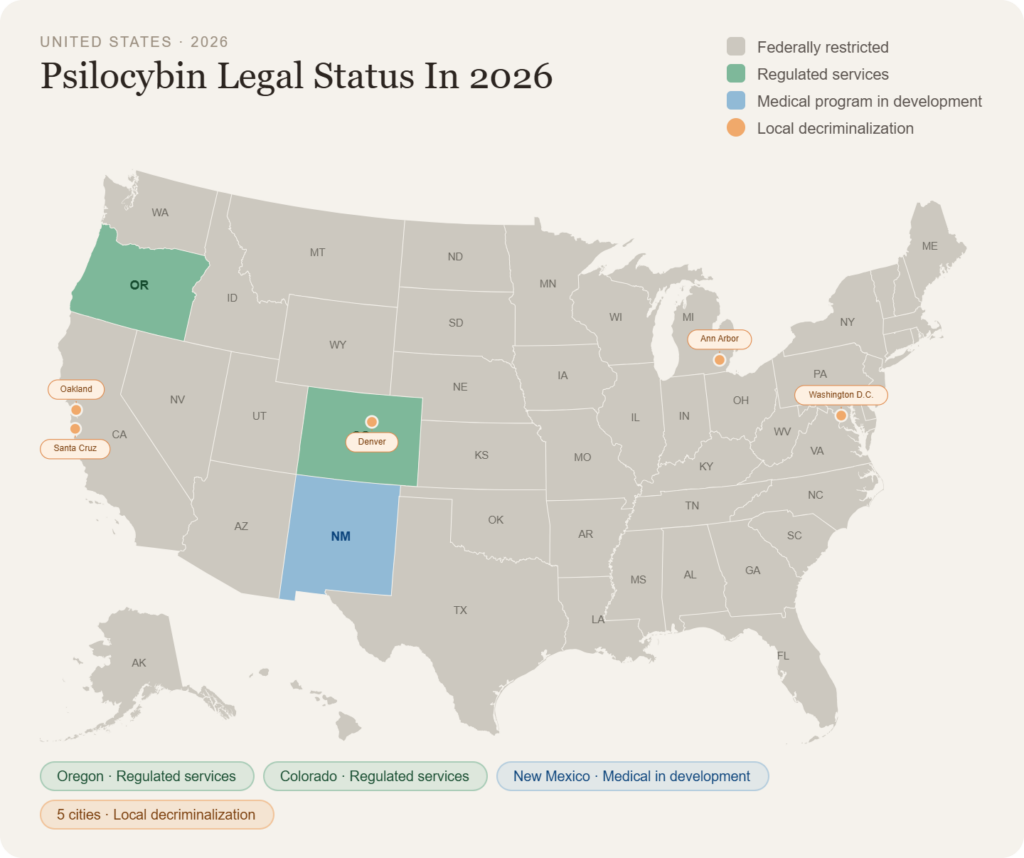
To make this easier, here’s a table showing where psilocybin stands in 2026 and what brands should avoid saying in their marketing.
| Where Psilocybin Access Is Legal Or Regulated? | ||
| Place | Can Psilocybin be sold freely? | Point to be noted: |
| Federal Level | No | Avoid phrases like “buy psilocybin online,” “ships nationwide,” or “available across the U.S.” |
| Oregon | No, but licensed services are allowed | Businesses can market legal services, but ads cannot be false, misleading, aimed at people under 21. |
| Colorado | No, but regulated access exists | Brands can talk about licensed services and legal access, but not retail-style mushroom sales. Denver notes that buying or selling psilocybin mushrooms or products is still against the law. (Denver Government) |
| New Mexico | Not yet for open public access | A medical psilocybin program is being developed, with full implementation set for December 31, 2027. |
| Decriminalized Cities: DenverOaklandSanta CruzWashingtonD.C., and Ann Arbor | No | Lower penalties for personal use do not mean brands can sell, advertise, or run mushroom dispensary marketing like a legal retail business. |
Psilocybin Therapy Marketing vs Mushroom Dispensary vs Functional Mushroom Marketing
Not every psilocybin business should be marketed the same way.
Psilocybin therapy marketing
Usually built around licensed care, guided sessions, preparation, integration, and educational support. The message should help people understand the process, the legal setting, and the next step without making big claims.
Mushroom dispensary marketing
More complicated. This model often sits in a legal grey area because it copies the cannabis retail format, where customers can walk in and buy dried mushrooms, edibles, capsules, or similar products over the counter. That creates a higher marketing risk.
Functional mushroom marketing
Different from both. Functional mushrooms like lion’s mane, reishi, chaga, and cordyceps are usually marketed as wellness products. Brands can talk about ingredients, product formats, blends, and general wellness positioning, but they still need to avoid disease-related claims like “cures anxiety” or “treats depression.”
What Can Psilocybin Businesses Market And What Should They Avoid?
A psilocybin brand can still use psilocybin marketing services to build visibility online, but the message needs to stay within safer boundaries.
The content should focus on:
✔️ Legal access in states where regulated programs exist.
✔️ Licensed services and what the process looks like.
✔️ Facilitator experience and professional background.
✔️ Preparation and integration support.
✔️ Educational blogs about laws, safety, and expectations.
✔️ FAQs, webinars, and community learning resources.
✔️ Contact or screening steps where allowed.
| The content should not make psilocybin sound like a casual purchase. |
Avoid:
❌ Direct sales phrases
❌ Medical promises
❌ Retail product language
❌ Recreational-use messaging
❌ Aggressive CTAs
❌ Unsupported claims
❌ Before-and-after result claims
❌ Influencer claims that sounds universal
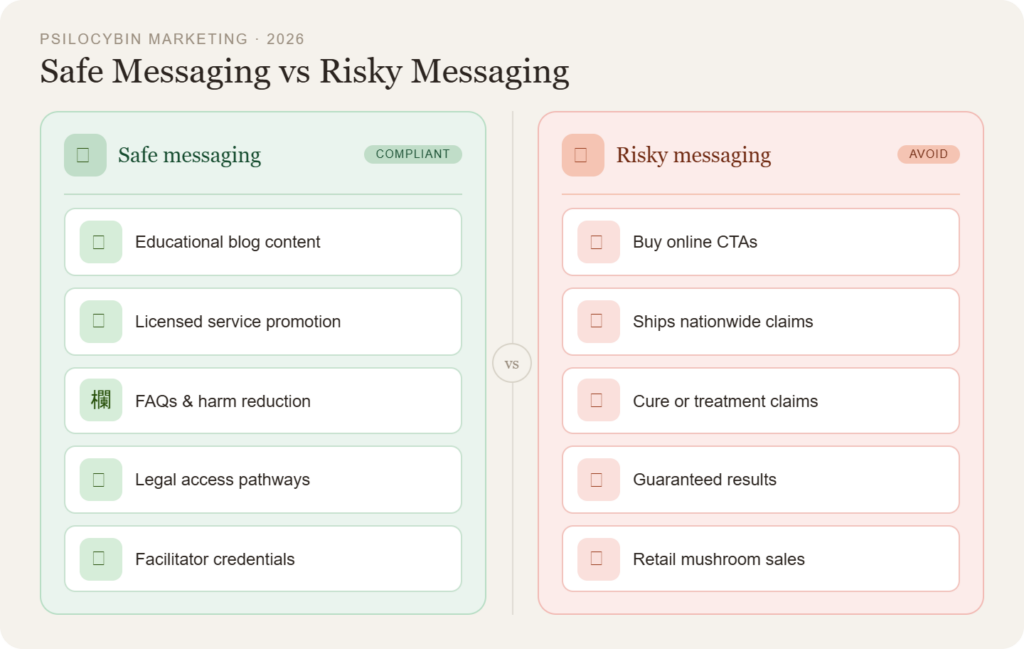
| For example, “book a consultation to understand legal options” is safer than “buy magic mushrooms today.” |
Best Marketing Channels For Psilocybin Brands In 2026
Psilocybin brands should choose channels that help people learn first. The goal is to explain what is legal, what is available, and what the brand can responsibly offer.
Organic SEO As The Primary Channel
SEO is one of the safest starting points for magic mushroom marketing because it brings people to helpful content instead of pushing direct sales.
Focus on:
- Location pages for areas with legal or regulated access.
- Educational blogs that answer common questions.
- Service pages that explain what the brand can offer.
- Local SEO for clinics, facilitators, and service providers.
👉🏻 For brands that need help with search visibility, content, and growth, our shrooms marketing services can support a more focused online strategy.
Content, Email, And PR
These channels help build trust without sounding too sales-heavy.
Use them for:
- Newsletters with updates and educational content.
- Guides and FAQs that explain complex topics simply.
- Podcast features and expert interviews.
- PR mentions in trusted publications.
Paid Ads (but with caution)
Paid ads are harder because platforms have strict rules. Google restricts ads for substances that alter mental state for recreational purposes. Meta does not allow ads that promote the sale or use of illicit or recreational drugs. TikTok also blocks ad content and landing pages that promote or provide access to illegal or controlled drugs.
For psilocybin advertising, keep paid campaigns simple:
- Promote education, not product sales.
- Use calm, professional visuals.
- Feature qualified professionals or clinical settings.
- Avoid mushroom product photos or trippy graphics.
- Send users to educational pages, not “buy now” pages.
- Target only places where the service is legally allowed.
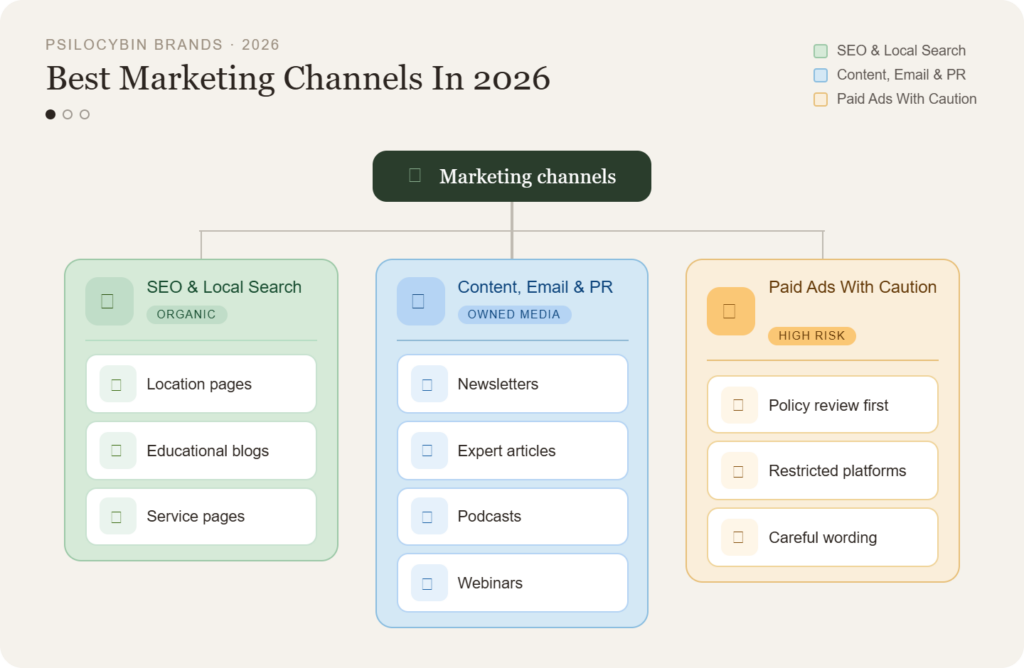
| Paid ads should help people understand their options, not make psilocybin look like something they can casually order online. |
Quick Compliance Checklist Before Publishing
Before publishing any psilocybin page, ad, blog, or email, run a quick final check:
- Does the content match the rules in that location?
- Are “buy now” or retail-style phrases removed?
- Are cure claims and guaranteed results avoided?
- Is the CTA educational instead of pushy?
- Are paid ads linked to helpful pages, not sales-heavy pages?
- Are visuals professional instead of product-heavy or “trippy”?
- Is the audience clearly adult-focused?
| A simple final test works well: if the copy sounds like a product sale, a cure, or a promise, rewrite it. |
👉🏻 Brands that want expert help can also start with a website audit. At CBD Marketing Solutions, we offer a detailed website audit report within a day for just $11.96. From there, we can help research, plan, and build a compliance-aware content strategy that supports visibility without relying on risky claims.
The Takeaway
Psilocybin marketing in 2026 needs more than visibility. It needs clear messaging, legal awareness, and trust-first content. Brands should avoid retail-style selling, cure claims, exaggerated promises, and language that makes psilocybin sound widely available. The stronger route is to focus on education, licensed services, local access, professional credibility, and compliant content across SEO, email, PR, and paid ads.
The right psilocybin marketing services can help brands grow without crossing risky lines. Partner with us to create a compliance-aware strategy built for long-term search visibility and stronger brand trust.
FAQs
What is the safest marketing channel for psilocybin brands?
Organic SEO is usually the safest starting point. It lets brands publish educational pages, legal access guides, FAQs, and location-specific content without pushing direct product sales. Paid ads can work in some cases, but they need stricter review because platform rules are more restrictive.
Where can I market psilocybin legally?
You can market educational content broadly, but service promotion should stay limited to places where your business is legally allowed to operate. Oregon allows licensed psilocybin services with advertising limits, Colorado has a regulated natural medicine model, and New Mexico is building a medical psilocybin program for full implementation by December 31, 2027.
Are there active psilocybin legalization bills this year?
Yes. In 2026, several states have psilocybin-related bills or programs moving forward, including New Jersey, Iowa, Missouri, New York, and New Hampshire. New Jersey has already enacted a psilocybin behavioral health access and therapy pilot program, while other states are considering medical or regulated-access models.
Should I hire an agency for psilocybin marketing services?
Psilocybin marketing services are worth considering if you want to avoid risky claims, weak SEO, or platform issues. A specialized agency can help with keyword planning, compliant content, local SEO, website structure, claim review, and safer campaign strategy without making your brand sound like it is promoting open product sales.
Can a psilocybin clinic make therapy claims?
Only with extreme care. Clinics should avoid claims like “cures depression,” “heals trauma,” or “guaranteed results.” Advertising claims should be accurate, not misleading, and supported by strong evidence where health claims are involved. Oregon’s psilocybin advertising rule is a useful example of how strict this can be.