Hemp brands do not have the same level of open playing field as regular e-commerce businesses. Google Ads allows only certain topical hemp-derived CBD products with 0.3% THC or less, and only under specific certification and location rules. The FDA has also sent warning letters to companies selling cannabis-derived products, especially where the content includes risky product claims. That makes SEO one of the most practical long-term growth channels for hemp brands.
A skilled hemp SEO agency can help build visibility through safer content, stronger website structure, keyword planning, and organic traffic growth. This blog explains how hemp SEO works and how an agency can help you build organic traffic.
Why Do Hemp Brands Need A Specialized SEO Strategy?
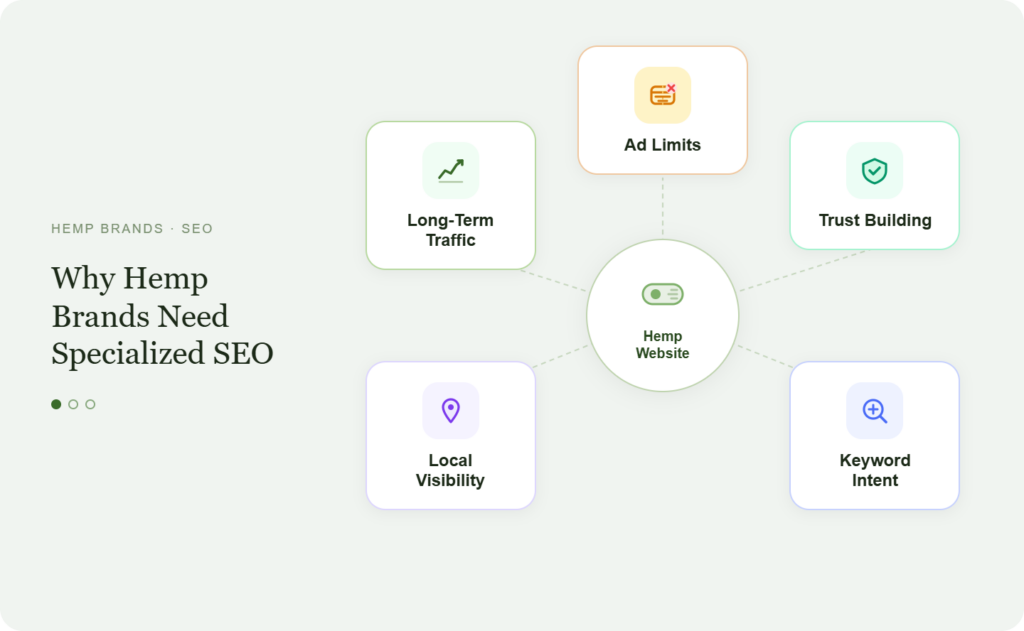
Hemp brands need a specialized SEO strategy because paid ads are limited, search intent is complex, competition is high, and trust matters more in this category.
Here is how a hemp SEO agency helps:
1. Paid ads are not always dependable: Google allows ads only for certain topical hemp-derived CBD products with 0.3% THC or less, and with certification and location limits. So, hemp organic traffic becomes a stronger long-term channel.
2. Trust has to be built carefully: Hemp content should educate, clarify, and answer real buyer questions. Google also encourages helpful, reliable, people-first content, which makes expert-led hemp brand SEO more important.
3. Keywords need sharper intent: A hemp brand should not target broad terms only. A better hemp search engine optimization plan separates B2B, B2C, local, educational, and buying-intent keywords.
4. Local visibility matters: Stores and regional hemp businesses need pages that support “near me” searches and location-based buyer intent.
5. SEO keeps working longer than ads: A strong hemp website SEO can keep attracting qualified visitors even when ad campaigns pause.
👉🏻 At CBD Marketing Solutions, we help CBD, hemp, vape, kratom, cannabis, and similar brands build search strategies that focus on long-term visibility and qualified traffic.
Hemp SEO And CBD SEO Are Not The Same
Hemp SEO and CBD SEO are related, but they target different products, search intent, and content needs. A hemp SEO agency should keep both strategies separate to avoid confusing readers and search engines.
The table below explains the main difference:
| Point | Hemp SEO | CBD SEO |
| ✔️ Main focus | Hemp clothing, hemp seed oil, hemp fiber, hemp suppliers, and industrial hemp products. | CBD oils, gummies, tinctures, topicals, and cannabinoid-based products. |
| ✔️ Search intent | Industrial, nutritional, product-based, and educational. | Wellness-focused, product-focused, and trust-heavy. |
| ✔️ Content style | Educational and product-focused. | More detailed, careful, and compliance-aware. |
| ✔️ Trust needs | Important for hemp brand SEO. | Even stronger because CBD is more regulated. |
A Practical SEO Roadmap For Hemp Brand Growth
Search traffic grows when hemp brands target the right keywords, build useful pages, and turn website visibility into qualified buyer interest.
Refer to the following sections to see how a hemp SEO agency builds that growth step by step.
Hemp Keyword Strategy: Start With Search Intent
In hemp SEO, intent matters because the same keyword can attract very different readers. A buyer searching for bulk hemp products is not looking for the same page as someone searching for what hemp is. A hemp SEO agency should separate these searches before creating content.
Here are the main keyword types to plan for:
Informational keywords:
- These answer basic questions and educate new visitors.
- Example: (What is hemp? Hemp vs. CBD)
Commercial keywords:
- These help people compare products, brands, or options before making a decision.
- Example: (best hemp products, hemp oil brands)
Transactional keywords:
- These show stronger buying intent and should lead to product, category, or service pages.
- Example: (buy hemp oil online, wholesale hemp products)
Local keywords:
- These connect nearby buyers with stores, service areas, or location pages.
- Example: (hemp store near me, hemp products near me)
B2B keywords:
- These work well for suppliers, retailers, distributors, and wholesale-focused hemp brands.
- Example: (bulk hemp suppliers, private label hemp products)
For better hemp organic traffic, start with keywords closest to revenue: service, product, local, and B2B buying-intent keywords. Then build blogs around educational searches to support those high-value pages.
| A strong hemp search engine optimization plan should map every keyword to the right page, whether that is a product page, category page, service page, blog, or location page. |
On-Page SEO For Hemp Websites
On-page SEO helps each hemp page match the right keyword, answer the right intent, and guide visitors toward the next step.
A hemp SEO agency should plan hemp website SEO around three key page types: product pages, category pages, and blogs.
Product Pages
Product pages should help ready buyers make a confident decision.
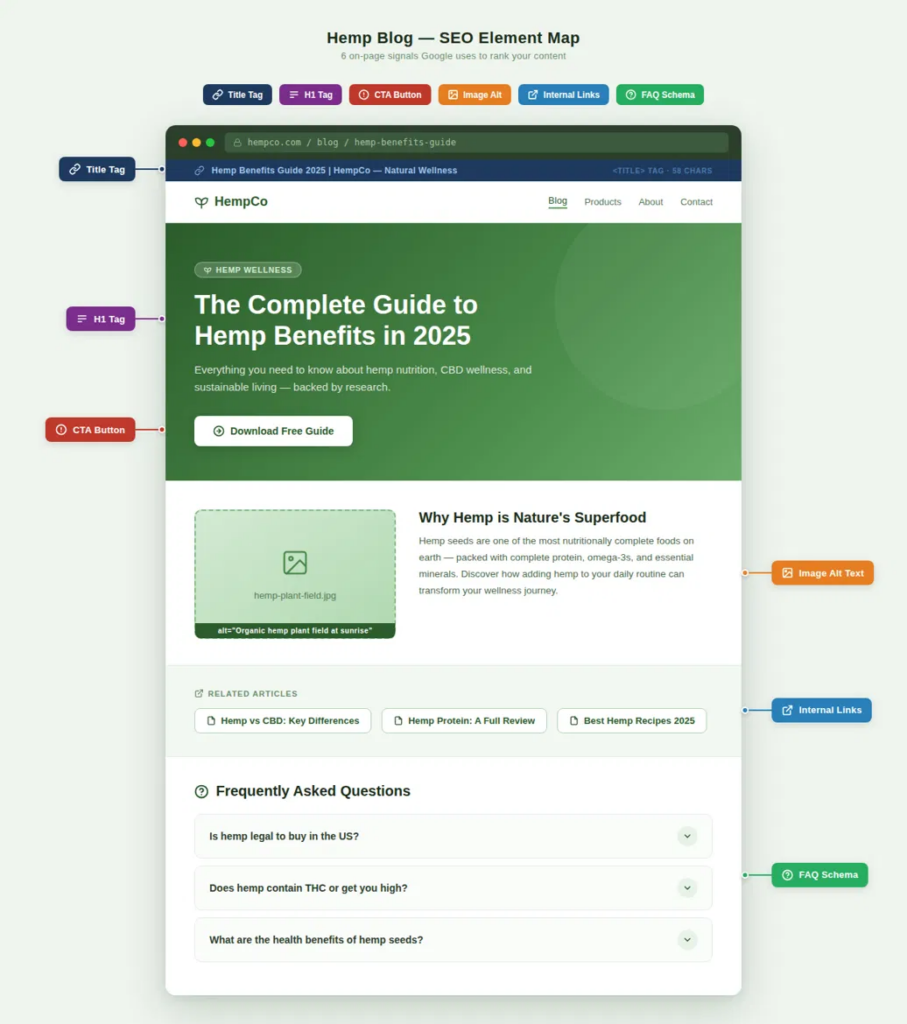
- Add the main product keyword in the title tag, product name, and copy naturally.
- Keep copy clear, specific, and easy to scan.
- Answer buyer doubts with short FAQs.
- Add descriptive image alt text.
- Use trust signals like reviews, COAs, testing details, or clear product information where available.
- Link to related products, categories, or buying guides.
Category Pages
Category pages should target broader buying searches.
- Use a keyword-focused H1 that matches category intent.
- Add a short intro explaining what buyers can find.
- Keep URLs short and clean.
- Group products clearly.
- Link to subcategories, product pages, and helpful blogs.
- Add FAQs for common buying questions.
| Category pages often rank well because they target broader commercial keywords. |
Blog Pages
Blog pages should answer educational or comparison searches.
- Match the title to the search question.
- Use clear H2s for quick scanning.
- Add keywords naturally.
- Use examples where they help.
- Cite credible sources for factual points.
- Link each blog to a relevant service, category, or product page.
Technical SEO For Hemp Brands
Technical SEO makes sure search engines can find, crawl, understand, and index the right hemp website pages.
A hemp SEO agency should check the site foundation before scaling content. If the technical setup is weak, even helpful pages may struggle to rank.
Focus on these essentials:
- Core Web Vitals: Improve loading speed, mobile response, and layout stability.
- Crawlability: Keep the XML sitemap up to date, check the robots.txt file, and make important pages easy to access.
- Indexing: Use Google Search Console to identify pages that are blocked, missing, or incorrectly indexed.
- Duplicate pages: Use canonical tags for similar products, filters, or tag pages.
- Site structure: Keep key pages within a few clicks of the homepage.
- Internal links: Connect blogs, categories, products, and service pages logically.
- Schema markup: Use Product, FAQ, and Local Business schema where relevant.
- Secure browsing: Keep HTTPS active across the website.
👉🏻 If your hemp website needs a quick starting point, our $11.95 website audit report gives you a clear view of key SEO issues within one day.
Content Marketing For Hemp Brands
Content marketing gives hemp brands a way to reach buyers before they are ready to purchase. It also helps build organic hemp traffic around questions, comparisons, and buying concerns that product pages cannot address on their own.
Use the table below as a quick guide to match each content type with the right reader stage.
| Content Piece | Main Role | Reader Stage |
| Educational Blogs | Answer hemp questions | Learning |
| Comparison Posts | Compare options clearly | Deciding |
| Buying Guides | Explain what to check | Ready to act |
| Local Pages | Support “near me” searches | Nearby buyer |
| B2B Resources | Target wholesale needs | Business buyer |
| Note: Keep industrial hemp and hemp-derived CBD content separate because the difference starts with legal classification, the 0.3% THC threshold, production purpose, and processing methods. | ||
| Did you know? Google recommends creating helpful, reliable, people-first content, which makes thin, keyword-only blogs a weak long-term strategy. |
Link Building For Hemp Websites
Backlinks help hemp websites build authority, but only when the links are relevant and trustworthy.
For hemp brands, useful link opportunities may include:
- Get featured on hemp, cannabis, wellness, or retail industry websites.
- Find websites that list useful resources for hemp, CBD, wellness, or e-commerce.
- Add the brand to relevant hemp supplier, wholesale, or business directories.
- Earn mentions from retailers, vendors, manufacturers, or collaborators.
- Share the brand story on niche blogs, podcasts, or industry platforms.
- Publish useful data, surveys, or guides that other websites may cite.
- Contribute expert articles to relevant websites with real audiences.
❌ The goal is not to collect as many links as possible
✔️ The goal is to earn links from websites that make sense for your niche, audience, and content.
| ⚠️ Avoid random placements, spammy domains, and link sources that have no connection to hemp, CBD, ecommerce, wellness, retail, or your buyers. |
👉🏻 For outreach-heavy campaigns, GrowLinks can help organize prospect scraping, contact enrichment, outreach workflows, and AI-led negotiation rules. Use it to support link-building operations, while keeping final quality checks human-led.
Measuring Hemp SEO Success
Good SEO reporting should show what is improving, what is stuck, and what needs to happen next.
For hemp search engine optimization, track more than keyword rankings. Rankings are useful, but they do not tell the full story.
Important metrics include:
- Organic traffic: Are more people finding the site through search?
- Keyword movement: Are priority terms moving up?
- Click-through rate: Are titles and descriptions earning clicks?
- Indexed pages: Are important pages appearing in Google?
- Leads and calls: Are visitors taking action?
- Sales or revenue: Are organic visitors becoming buyers?
- Local visibility: Are location-based searches improving?
- Content performance: Which blogs support money pages?
How A Hemp SEO Agency Builds Organic Traffic?
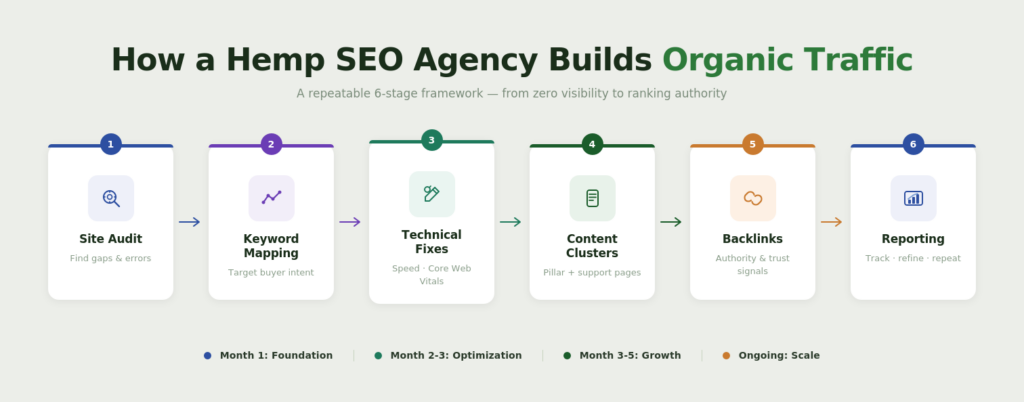
The work usually starts with a website audit. From there, the agency can:
- Research hemp keywords by search intent and buyer stage.
- Map keywords to pages so blogs, product pages, category pages, and service pages do not compete.
- Fix technical issues affecting crawling, indexing, speed, or mobile performance.
- Improve existing pages before creating too much new content.
- Build content clusters around revenue-focused topics.
- Earn relevant backlinks from niche and authority sources.
- Track performance through rankings, traffic, leads, calls, sales, and conversions.
👉🏻 At CBD Marketing Solutions, our hemp marketing services bring SEO, content, and branding together for hemp businesses that need a focused growth plan. The service page is positioned around SEO, content, branding, revenue growth, and compliant hemp marketing support.
Build Hemp SEO Around Intent, Trust, And Long-Term Growth
Hemp SEO works best when every page has a clear purpose. The keywords should match the buyer journey, the website should be easy for search engines to crawl, and the content should help readers understand what they need next.
A hemp SEO agency brings these pieces together through technical fixes, content planning, link building, and regular performance tracking. That is how hemp brands move from random traffic to qualified organic visitors.
If your hemp website needs a clear starting point, we can help you review what is working, what is missing, and where search growth can begin.
FAQs
1. Which hemp SEO agency should I hire?
There is no universal “best” hemp SEO agency for every brand. Look for a team with hemp/CBD industry experience, clear reporting, technical SEO skills, content planning, and ethical link-building methods. Also, check whether they understand restricted-category marketing and buyer intent, like CBD Marketing Solutions, where hemp SEO, content, and digital strategy are handled together.
2. How can hemp brands find quality backlinks?
Hemp brands can find quality backlinks through guest posts, trade publications, wellness sites, local media, podcast features, unlinked brand mentions, and data-led content. Prioritize relevant links, use quality filters like DR 45+, and avoid spammy placements. Tools like GrowLinks can support outreach, but final link checks should stay human-led.
3. Why work with a hemp SEO agency instead of doing SEO alone?
Because hemp SEO needs niche judgment, not just basic optimization. A hemp SEO agency knows how to plan keywords, separate hemp and CBD intent, fix website issues, create useful content, and build relevant links as part of a broader hemp digital marketing strategy, without wasting effort on pages or tactics that do not support organic growth.
4. How much do hemp SEO services cost?
Most hemp or cannabis monthly SEO plans fall somewhere between $1,000 and $10,000+ per month. For many single-location brands, a practical range is closer to $2,000–$5,000 per month. Pricing depends on the agency, market competition, website condition, number of pages, content needs, local SEO goals, and backlink work.
5. How long does hemp SEO take to show results?
Hemp SEO does not have a fixed timeline. Some early ranking movement may appear within 8–12 weeks, but meaningful growth often takes around 4–8 months. In competitive hemp, CBD, or cannabis markets, stronger organic traffic gains may take 12+ months of consistent technical SEO, content, and link-building work.
6. How does SEO compare with paid advertising for hemp and CBD brands?
Paid ads can bring faster traffic, but they are limited for many hemp and CBD products. Google only allows certain topical hemp-derived CBD ads with 0.3% THC or less under specific rules. SEO takes longer, but it builds organic visibility, search trust, and traffic that doesn’t stop when ad spend pauses.