
Learning how to market Delta 8 products legally starts with one rule: every campaign should be built around compliance before promotion.
Delta 8 brands can still use SEO, educational content, cannabis-friendly ad platforms, email marketing, influencer partnerships, affiliate campaigns, and backlinks.
This guide discusses how to use these channels safely, with platform-aware messaging, state-specific planning, and clear labeling practices.
Additionally, marketing for this category must avoid risky claims, follow platform rules, respect state restrictions, and speak only to adult buyers. At CBD Marketing Solutions, we approach Delta 8 growth with this careful balance in mind.
Why Delta 8 Marketing Compliance Comes First?
Delta 8 marketing needs extra care because it is not just another e-commerce product. The product can have intoxicating effects, state rules differ, and major platforms review cannabinoid content closely.
- The FDA has warned companies about Delta-8 products sold in food-like forms, such as gummies, candies, cookies, chips, and snacks, especially when they look similar to regular food products. It has also been said that Delta-8 products have not been evaluated or approved for safe use in any context, so brands should avoid terms like “safe,” “risk-free,” or medical-use language.
- Marketing also needs to stay away from anything that could attract minors. That includes playful packaging, cartoon-style visuals, candy-like product names, and influencer content aimed at younger audiences.
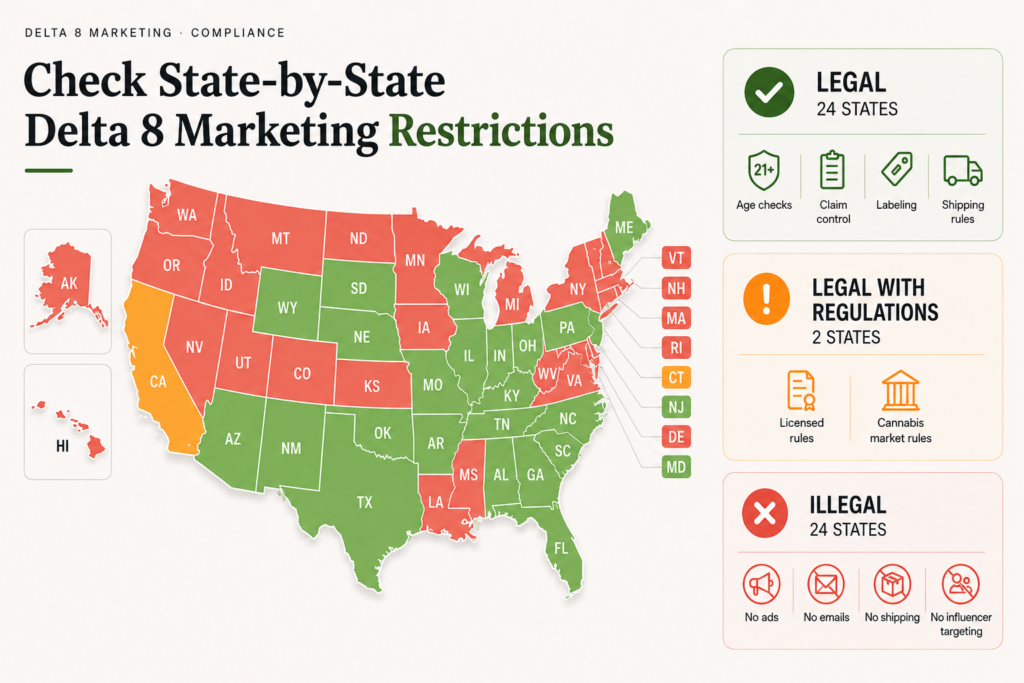
- Another factor is location. One legal-status tracker lists 24 states where Delta 8 THC is illegal, so campaigns should be planned around where the brand can actually sell.
👉🏻 For brands that need a compliance-first growth plan, our Delta 8 marketing services are built around practical marketing methods while keeping compliance concerns in view.
What Claims Can Delta 8 Brands Make?
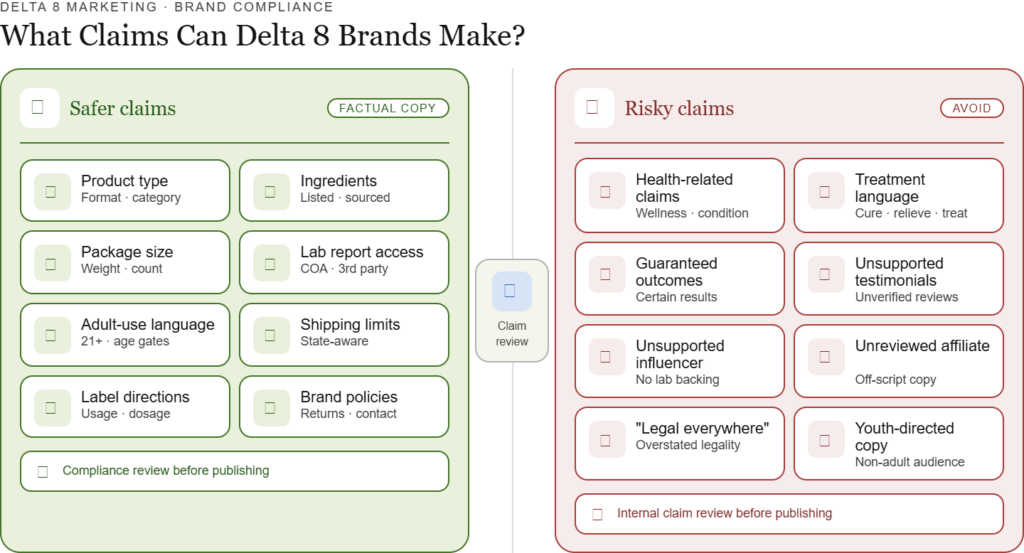
Delta 8 brands should keep claims narrow, factual, and easy to support. Some general wellness-style language may be possible, but it should not be treated as a free pass.
For Delta 8, even soft wording can create risk if it sounds like a health claim, effect promise, or treatment claim.
Let’s now have a look at what the FDA and FTC expect from brands before they publish product copy, ads, reviews, or influencer content.
| FDA’s Position On Health Claims | Avoid medical, treatment, cure, or disease-related claims. Product copy should not suggest that Delta 8 can help with anxiety, pain, sleep disorders, stress, or any medical condition. |
So, what brands can talk about instead?
Brands should stay on safer ground by focusing on product type, ingredients, package size, access to lab reports, adult-use language, label directions, and state shipping limits.
| FTC’s Rules On Testimonials And Endorsements | Delta 8 FTC guidelines matter as well because claims can also come from reviews, affiliates, influencers, and testimonials. |
What influencers & affiliates should avoid?
Influencers should not make claims that the brand itself cannot make. Affiliates should not exaggerate effects to drive clicks. Reviews should not be edited in a way that changes their original meaning.
Where Can Delta 8 Brands Advertise Legally?
Advertising is one of the hardest parts of Delta 8 legal marketing because many mainstream platforms do not openly support direct Delta 8 promotion.
Google allows limited promotion of topical hemp-derived CBD products under strict rules, but that does not mean Delta 8 ads are broadly allowed. Meta, TikTok, and similar platforms can also be risky for direct product ads.
Cannabis-friendly ad platforms may be a better fit for:
- Display ads
- Sponsored content
- Contextual placements
- Retargeting campaigns
- Hemp and cannabis-related audiences
Still, compliant Delta 8 advertising should be reviewed before launch. These platforms also have two clear limits:
❌ Higher cost: Niche ad networks can cost more than broader ad platforms.
❌ Lower reach: Their audience size is usually smaller than Google, Facebook, or Instagram.
So, paid ads can support visibility, but they should not carry the full strategy. For many brands, SEO is by far one of the strongest long-term ways to market Delta 8 products legally.
How To Market Delta 8 Products Legally With SEO And Content?
SEO does not need to take over the entire marketing plan, but it can provide Delta 8 brands with a safer, long-term path to visibility. It helps product pages, blogs, and local pages appear when adult shoppers search for legality questions, product comparisons, lab reports, buying tips, or nearby options.
If a brand does not have an in-house SEO team, this is where agency support can help. The right partner should do more than write blogs. It should connect keyword research, content planning, on-page SEO, blog optimization, internal linking, and compliance-aware copy guidance into one plan.
Our Delta 8 SEO and content marketing support is built around these areas, helping brands searching how to market Delta 8 products legally.
The following table shows how different keyword types can match the right page as part of a Delta 8 content marketing and keyword strategy.
| Keyword type | Keyword example | Best page type |
| Educational | What is Delta 8? | Blog guide |
| Legal | Is Delta 8 legal in Texas? | State guide |
| Comparison | Delta 8 vs Delta 9 | Comparison blog |
| Buying intent | Delta 8 gummies online | Category or landing page |
| Local | Delta 8 near me | Local SEO page |
SEO does not stop at publishing content.
Quality Delta 8 backlinks help build authority, but quality matters more than volume.
| Tip! A backlink from a relevant hemp, CBD, cannabis, ecommerce, or marketing website can be more useful than dozens of weak links from unrelated sites. |
- Anchor text should also look natural.
- Using the same exact keyword again and again can make the link profile look forced.
Tactic 2: Use Email Marketing Carefully For Retention
Email marketing can help Delta 8 brands stay connected without depending only on paid ads. But it still needs claim control, clear opt-ins, and state-aware targeting.
The table below shows how common Delta 8 email campaigns can stay useful without crossing into risky claims.
| Email type | Keep it compliant by |
| Welcome emails | Share brand basics, not effect promises. |
| Reorder reminders | Avoid pressure-based or misleading wording. |
| Educational emails | Focus on product facts, COAs, and legal notes. |
| Product updates | Send only where the product can be sold. |
| Review requests | Do not ask buyers to mention medical results. |
Tactic 3: Use Affiliate And Influencer Marketing With Clear Rules
Affiliate and influencer marketing can work for Delta 8 brands, but only when partners know the boundaries before they post.
Choose creators who have:
- An adult audience
- Relevant cannabis, hemp, CBD, or lifestyle content
- A clean history of brand-safe promotion
- Real engagement, not just high follower counts
Before any post goes live, give partners a simple content brief:
✔️ Approved product language
✔️ Claims they must avoid
✔️ Disclosure instructions
✔️ Age-related content rules
✔️ Product handling guidelines
✔️ Coupon or link tracking details
👉🏻 Stick to Delta 8 FTC guidelines, no matter what. Because claims can also appear in influencer posts, affiliate content, reviews, and testimonials, partners should not promise results, mention treatment claims, or exaggerate product effects. Paid posts, gifted products, and commission-based links should also be clearly disclosed.
Labeling And Landing Page Compliance For Delta 8 Products
Labels and landing pages should tell the same story.
If a label does not support a claim, the website should not make that claim either. Delta 8 brands should make COAs easy to find, include adult-use messaging, explain shipping limits, and avoid design or copy that appeals to minors.
Packaging also matters.
| In July 2024, the FDA and FTC issued warning letters to companies selling Delta 8 food products in packaging that mimicked popular chips, candies, and snacks. |
That is a reminder that marketing is not only about ads and blogs.
Check State-by-State Delta 8 Marketing Restrictions
Delta-8 laws vary across the U.S., so brands should not run a single national campaign without checking where they can legally sell, ship, and promote.
For planning purposes, states can be grouped into three buckets:
| Delta-8’s legal status | Campaign direction to abide by |
| Legal in 24 states | Market with proper age checks, claim control, labeling, and shipping rules. |
| Legal with regulations in 2 states | Campaigns may need to follow licensed cannabis-market rules. |
| Illegal in 24 states | Avoid ads, emails, shipping pages, and influencer targeting in these states. |
| Note: Delta-8 legality varies by location. Check individual state rules before running ads or sending traffic to product pages. | |
Before launch,
✔️ review state legality
✔️ age limits
✔️ shipping rules
✔️ ad targeting
✔️ influencer reach
Work With A Delta 8 Marketing Team That Understands Compliance
Knowing how to market Delta 8 products takes more than publishing content or running ads. Brands need a plan that considers SEO, content, backlinks, ad restrictions, buyer education, state rules, and claim control.
At CBD Marketing Solutions, we support brands with compliant Delta 8 marketing support across these areas. The goal is not to promise quick wins. The goal is to help build a cleaner, more reliable growth path.
To discuss your current marketing needs, you can contact us!
FAQs
Which marketing channels work best for Delta 8 brands?
The strongest channels are usually SEO, educational content, email marketing, cannabis-friendly ad platforms, influencer partnerships, affiliate marketing, and relevant backlinks. Paid ads can help, but they should not be the only strategy because many mainstream platforms restrict direct Delta 8 promotion.
What type of content should Delta 8 brands publish?
Publish useful and relevant content that answers real buyer questions without making risky claims. Useful formats include educational blog posts, strain guides, product comparisons, buying tips, state-specific legality guides, detailed FAQs, and lab report explainers.
What are the common Delta 8 marketing mistakes to avoid?
Common mistakes include making illegal health or therapeutic claims, using child-friendly or “copycat” packaging, failing to adapt to regulatory changes, running ads without checking platform rules, and sending campaigns to restricted states.
How long does Delta 8 SEO take to work?
Delta 8 SEO usually takes time because rankings depend on competition, website quality, content depth, backlinks, and technical SEO. Many brands may start seeing early movement within a few months, but stronger results often require consistent content, optimization, and authority-building over time.
How should Delta 8 brands measure marketing results?
Track growth metrics like organic traffic, keyword rankings, conversions, email clicks, backlinks, and local visibility. Also track compliance metrics like rejected ads, flagged content, claim edits, and labeling or documentation issues. Tools like Google Search Console, GA4, Ahrefs, SEMrush, and Google Business Profile can help.