CBD affiliate marketing is a performance-based model where publishers promote CBD products and earn a commission on each sale. It has grown alongside the wider affiliate marketing industry, which now influences a significant share of online sales globally, estimated at around 10–15% in many e-commerce sectors.
Within CBD, the space is becoming more competitive as more brands shift online and content-driven traffic continues to grow. But affiliate programs are not all the same—commission rates, tracking methods, and payout terms can differ widely.
This guide breaks down how CBD affiliate marketing works, what payouts usually look like, and what to consider when choosing a program.
What Is Affiliate Marketing in the CBD Industry?
Affiliate marketing in the CBD industry is a performance-based partnership in which a brand works with external promoters to drive sales through trackable referrals. When a customer completes the target action, usually a purchase, the affiliate earns a commission.
Why Is This Model Important In The CBD Space?
CBD brands often work in a category where direct promotion is not always easy. Many buyers want more information before placing an order, and traditional ad channels may not always be the best fit.
That makes affiliate marketing more useful because it helps brands:
- Reach niche audiences through trusted publishers and creators
- Educate buyers through useful content
- Control costs by paying for real results
- Grow visibility through more than one traffic source
CBD Products That Are Typically Promoted
CBD oils, gummies, capsules, topicals, and other product categories that match buyer interest.
This Program Is Also Known As
A CBD affiliate marketing program may also be described as:
⭐ CBD performance marketing
⭐ CBD partner program
⭐ Referral marketing
⭐ Partner marketing
⭐ Influencer marketing, in creator-driven campaigns
How CBD Affiliate Marketing Programs Differ From Standard Programs?
On paper, CBD affiliate programs follow the same model as regular affiliate offers. In practice, they are harder to run because promotion rules are tighter, buyer trust matters more, and access to paid ads is narrower.
The Difference
👉🏻 Payouts are often higher
Current CBD program roundups show commissions ranging from 25% to 50% in some cases.
👉🏻 Affiliates often get more time to earn credit
Many listed programs use tracking windows such as 30 days, 90 days, 6 months, lifetime, or unlimited referral periods.
👉🏻 Content has to be more careful
Affiliates cannot be loose with health claims, and they need proper disclosures when they get paid for recommendations.
👉🏻 Traffic strategy shifts
Because ad options are limited, CBD affiliates lean more on SEO, reviews, comparison content, email, and creators than broad paid ad campaigns. This is a practical inference from Google’s narrow CBD ad policy and the FTC/FDA compliance rules.
| The Paid Ads Problem! |
| CBD is not promoted like a regular product. Google only allows ads for certain topical hemp-derived CBD products, and only in California, Colorado, and Puerto Rico. That is why CBD affiliate programs lean much more on SEO, content, and trusted creators. |
How Does A CBD Affiliate Marketing Program Work— Step by Step
A CBD affiliate marketing program works in a simple chain:
| ‘Brand’ sets the offer → ‘Affiliate’ promotes it → ‘Customer’ clicks → The ‘Sale’ is tracked. |
Step 1: Start with the business goal
First, decide what the program should achieve. In most cases, the main goal is sales, but some brands may also track leads, email signups, or app installs.
| Pick one main goal first. It makes the program easier to manage. |
Step 2: Work out the budget and expected return
Next, determine how much the brand can spend while remaining profitable. That means looking at ROI and setting a few KPIs, such as:
- Clicks
- Sales
- Conversion rate
- Cost per acquisition
Step 3: Choose how affiliates will be paid
Now select the payout model.
Common options:
- Pay per sale / CPA for completed purchases
- CPC for traffic driven through clicks
- Lead or install based models for signups or app downloads
| In CBD, pay-per-sale is usually the clearest model because it ties payouts to actual revenue. |
Step 4: Pick the right promotion channel
After that, decide where the offer will be promoted. Common channels:
- Blogs
- Review sites
- Comparison pages
- Email newsletters
- Creators and influencers
Step 5: Set up tracking
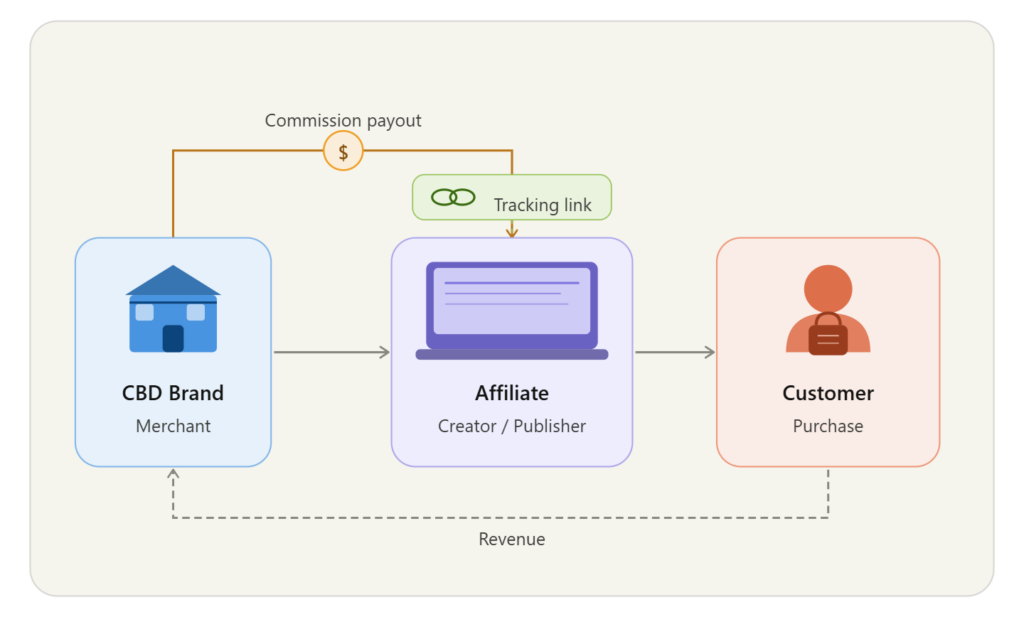
Each affiliate gets a unique link or promo code. This is what helps the system record the click and connect it to the final action.
Step 6: Create content and drive traffic
Once tracking is ready, the affiliate starts promoting the product through:
- Reviews, guides & comparison pages
- Email campaigns
- Social media content
Step 7: Measure and improve
After traffic starts coming in, the brand checks what is working and improves the campaign over time.
The Merchant, Affiliate, and Customer Relationship
✔️ The merchant creates the offer, sets the commission, and handles tracking and payouts.
✔️ The affiliate brings traffic by promoting the product to the right audience.
✔️ The customer clicks, explores the offer, and decides whether to convert.
Cookie Durations, Tracking, and Attribution
These three terms decide how credit is given.
Cookie duration (How long the system remembers a customer from an affiliate link)
Tracking (Using links, codes, or software to record clicks and results)
Attribution (The rule used to decide which affiliate gets credit for the sale)
👉🏻 Example: If a program has a 30-day cookie, and a buyer clicks today but purchases 10 days later, the affiliate can still get credit.
| A strong affiliate setup does not start with promotion alone. It starts with the goal, budget, payout model, and tracking system. Once those are clear, the rest becomes much easier to manage. |
CBD Affiliate Marketing Program Types
Not every CBD affiliate marketing program is built the same. The main differences usually come down to how the program is run, what it promotes, and how affiliates get paid.
1. Direct or In-House Programs
These are managed by the brand itself. The company handles affiliate approval, tracking, communication, and payouts directly. This route usually gives the brand more control, while the affiliate gets a more direct relationship with the merchant.
This type works best when:
- The brand wants to manage the program closely
- The team wants more control over promotions
- Direct communication with affiliates matters
2. Network-Based Programs
These run through a CBD affiliate network or platform that connects brands and affiliates in one place. This setup is usually easier to scale because the platform helps with recruitment, tracking, and payment management.
This type works best when:
- The brand wants to get started faster
- The business wants access to more affiliates
- The team prefers one dashboard for management
3. General CBD Programs
These programs promote a broader catalog rather than focusing on a single, narrow product line. They are usually a better fit for affiliates with a wider wellness or lifestyle audience.
This type works best when:
- The audience is interested in different CBD product types
- The content covers CBD more broadly
- The affiliate wants more than one product angle to promote
4. Niche-Specific CBD Programs
These focus on a narrower product segment or audience, such as pet products, skincare, or another use-focused category. They tend to work best when the affiliate already speaks to a clearly defined audience.
This type works best when:
- The affiliate has a focused niche
- The site or content serves one clear audience
- Buyers are looking for a specific kind of CBD product
5. Pay-Per-Sale
Under pay-per-sale, the affiliate gets paid only when a purchase is completed.
6. Pay-Per-Lead
With pay-per-lead, the affiliate earns when a visitor completes a lead action, such as signing up or submitting a form.
7. Revenue Share
A revenue share setup gives the affiliate a percentage of the order value rather than a fixed payout.
Which Type Is Best?
There is no one answer for every brand.
| ➤ For most CBD ecommerce brands: Pay-per-sale or revenue share➤ For list building or early-stage interest: Pay-per-lead➤ For more control: Go with in-house.➤ For easier scale: Go with network-based |
👉🏻 For CBD brands, the hard part is not opening an affiliate program but finding partners who can actually drive qualified traffic in a category where ad options are limited. That is where CBD Marketing Solutions can make a real difference.
| A CBD brand does not have to stick to just one structure. A business can use different commission models for different offers if that better suits its margins, sales cycle, or customer value. |
Average CBD Affiliate Commission Rates In 2026
CBD commission rates are usually higher than those in many standard e-commerce programs. In most cases, the workable range is 10% to 40%, but the sweet spot for many brands is 20% to 30%.
Decide Your Rate
Use this checklist as a starting point:
Established CBD brand: 15% to 20%
Better when the brand already has trust, repeat buyers, and a site that converts well.
Growing CBD brand: 20% to 25%
A balanced range for brands that want to stay competitive without squeezing margins too hard.
Newer CBD brand: 25% to 30%
Usually makes more sense when the brand still needs stronger affiliate interest and wider visibility.
Aggressive growth phase: 30%+
Useful when the goal is faster traction, but only if the numbers still work for the business.
| The ‘Number ’ Most Brands Can Anchor Around |
| If a brand wants one clean target, 25% is often the safest place to start. It is strong enough to get attention, but not so high that it becomes difficult to maintain over time. |
Payment Schedule
A good commission rate can still look weak if the payout timing feels slow or unclear.
Payment Timing Checklist:
✔️ Most preferred: Monthly payouts after 30 days.
⚠️ Still workable but less attractive: Monthly payouts after 45 to 60 days.
❌ Alarming factor: 90-day payouts or vague payment terms.
| Affiliate marketing has grown into a major digital sales channel, with the global affiliate platform space valued at $22.6 billion in 2025 by Grand View Research. |
How To Set Up A CBD Affiliate Marketing Program For Your Brand?
Setting up a CBD affiliate market program is not just about turning on tracking and waiting for sales. In this category, the better setup usually follows a clear order:
| Lock ‘rules’ → Choose the right ‘operating model’ → Recruit ‘partners’ carefully. |
This matters because the FTC expects clear disclosure of paid relationships, the FDA has taken action against CBD brands making disease-treatment claims, and Google still allows only limited CBD ads in narrow cases.
Setup checklist:
Before you recruit anyone, make sure these basics are in place:
✅ Clear commission structure
✅ Payout schedule
✅ Tracking setup
✅ Approved brand language
✅ Rules on what affiliates can and cannot say
✅ Creative assets they can use right away
| If affiliates have to guess your rules, they will either promote the brand poorly or avoid it altogether. |
Choosing a Platform
The right platform depends on how much control your team wants, how much support you need, and how hands-on you plan to be with recruitment. There are some platforms you can reach out to for assistance.
1. CBD Marketing Solutions
For CBD brands looking for more than software, CBD Marketing Solutions is the best place to start. Our CBD affiliate marketing services help brands reach new customers and increase sales through affiliate marketing, while also emphasizing industry knowledge and access to affiliate networks. That makes us a smart fit for brands that want strategy, partner recruitment, and CBD-specific guidance, not just a dashboard.
Best when:
- CBD brands like yours want expert help from day one.
- Your team does not want to build the program alone.
- Compliance, recruitment, and growth all need attention at the same time.
2. ShareASale / Awin route
If you are still considering ShareASale, the important update is that the platform officially closed in October 2025, and users were moved to Awin. So in practice, this is now an Awin-based network option, not a separate long-term platform choice.
Best when:
- The brand wants access to a larger network environment.
- The team prefers network-based partner discovery.
- One platform for tracking and payouts sounds easier than building everything from scratch.
3. Impact
Impact is a broader partnership platform built to manage affiliates, creators, and referrals in one place. It is a good fit for brands that want a more advanced setup and expect the program to grow into a larger partnership channel over time.
Best when:
- The brand wants room to scale.
- Affiliate and creator activity may sit under one system.
- Reporting, automation, and partner management matter more.
4. In-house
An in-house setup gives the brand the most direct control. The trade-off is simple: your team has to handle recruitment, approvals, communication, and ongoing management on its own.
Best when:
- The brand already has an internal team
- Direct control matters more than convenience
- The business wants closer day-to-day relationships with affiliates
| Newer CBD brands often do better with managed help or a network-led route, while more established brands can justify a stronger in-house setup. |
Recruiting and Vetting Affiliates
This is where many CBD brands either protect the program or weaken it. In this niche, quality matters more than volume.
Start with non-negotiables
Before approving anyone, define the rules clearly:
❌ No disease-treatment claims.
❌ No vague or misleading promises.
✔️ Proper disclosure of affiliate relationships.
✔️ Approved wording for offers and product descriptions.
| A good practice is to line up everything with FTC disclosure expectations and FDA enforcement around illegal CBD claims. |
Look past follower counts
A big audience is not enough. Check:
- Where does the traffic come from?
- Whether engagement looks real
- Whether the content matches your category
- Whether the site or creator feels trustworthy
A smaller wellness publisher with a loyal audience is often a better fit than a huge account with weak engagement.
Use an application filter
Do not auto-approve affiliates. Ask simple questions like:
- How will you promote the brand?
- What audience do you serve?
- Which channels do you use?
- Have you worked in wellness or supplements before?
Give approved partners a better chance to convert
Once someone is approved, make the job easier for them. Give them:
- High-resolution product images
- Ready-to-use copy
- Discount code details
- Landing pages links
- A properly defined Dos and Don’ts checklist
Keep checking after approval
Vetting does not stop once the link is issued. Review top partners regularly, watch for risky language, and reward the affiliates who bring the best-fit traffic.
CBD Affiliate Marketing Best Practices
A CBD affiliate marketing program performs better when the focus remains on safe promotion, clear content, and strong partner oversight. In this space, clean execution usually wins.
1️⃣ Keep compliance tight
The first rule is simple: do not let affiliates make medical or disease-treatment claims.
2️⃣ Educate before you sell
CBD buyers often want to read first and buy later. That is why reviews, comparisons, guides, and FAQs usually do better than pushy sales copy.
3️⃣ Work with better-fit affiliates
A smaller creator with the right audience is often more useful than a bigger account with weak relevance.
👉🏻 For brands that want this done with the right mix of affiliate strategy, SEO, and content support for a restricted niche, we deliver exactly that combination rather than treating CBD like a standard e-commerce category.
4️⃣ Send clicks to the right page
Most campaigns perform better when traffic lands on a product page, a collection page, or an offer-specific landing page rather than the homepage.
Affiliate management does not stop after signup. Review top partners regularly, check their messaging, and remove anyone who ignores the rules.
Remember that the best CBD affiliate programs usually grow through SEO content, niche creators, email, and careful compliance, not broad, aggressive promotion.
So, if you want one built for this niche and built to convert, give us a call!
FAQs
1. What is a CBD affiliate marketing program?
A CBD affiliate marketing program is a partnership in which affiliates promote a CBD brand through tracked links and earn a commission when their traffic results in a sale or another approved action.
2. How much commission should a CBD brand offer affiliates?
Most brands stay in the 20% to 30% range, while newer brands may offer more to attract stronger partners. The right rate should match the brand’s margins, goals, and growth stage.
3. What is the best payment model for a CBD affiliate program?
For most brands, pay-per-sale works best because the payout is tied directly to revenue. Pay-per-lead can also work when the goal is to build a list before driving sales.
4. How often should affiliates be paid in a CBD affiliate program?
The most preferred structure is monthly payouts after 30 days. It gives the brand time to account for returns while still keeping the program attractive for affiliates.
5. Should a CBD brand use an affiliate network or manage the program in-house?
An affiliate network offers faster setup and a wider reach, while an in-house CBD affiliate program gives the brand more control over partner selection, communication, and compliance.
6. What kind of affiliates are best for CBD brands?
The best affiliates are usually those with a relevant audience, genuine engagement, and content that fits well with the CBD space, such as wellness blogs, niche creators, review sites, and email publishers.
7. What should affiliates avoid when promoting CBD products?
Affiliates should avoid making medical claims, making misleading promises, and making vague disclosures. Clean, educational content usually performs better and keeps the CBD affiliate program safer in the long run.