
A strong Delta 8 content strategy helps hemp brands plan topics around what buyers actually search for before they decide what to buy. In 2026, random blog posts won’t be enough; users want clear answers on products, comparisons, legality, buying choices, and trust signals.
This blog will cover why Delta 8 brands need a content plan, the five key content pillars, blog topic ideas, a 90-day editorial framework, featured snippet tips, compliance checks, and ways to measure content performance.
Why Delta 8 Brands Need a Content Strategy in 2026?
A strong Delta 8 content strategy helps brands turn buyer questions into useful search content, especially in a market shaped by legal changes, product confusion, and limited ad options.
The points below explain why a planned content approach is essential for Delta 8 brands in 2026.
1. To build trust before buyers reach the product page.
Delta 8 shoppers often look for legality details, product comparisons, COAs, labels, and shipping information before they feel ready to buy.
2. To stay visible when paid ads are limited.
Cannabis and hemp brands cannot rely solely on ads, so Delta 8 SEO content helps capture users who are already searching for answers on Google.
👉🏻 For brands that need a search-first approach in this restricted market, CBD Marketing Solutions offers Delta 8 marketing services built around SEO, content planning, and visibility growth.
3. To keep up with changing state rules.
Delta 8 rules vary across the U.S., and research on U.S. Delta-8 law variation notes that adult sales remain unregulated or unclear in many states.
4. To separate the brand from low-quality competitors.
Helpful content around lab reports, ingredients, age rules, shipping limits, and transparency gives users more reasons to choose one brand over another.
5. To reduce packaging and marketing risks.
The FDA and FTC issued warning letters to companies selling Delta-8 THC food products that mimicked popular snacks, making responsible content and product positioning even more important.
Delta 8 Content Strategy for Search-Driven Hemp Buyers
Delta 8 shoppers rarely move from search to checkout in one step. They usually check legality, compare cannabinoids, review product formats, and look for trust signals first, so topic selection should follow that buying path.
Search intent keeps Delta 8 blog topics useful because each topic is tied to what the reader wants to learn, compare, verify, or buy. Once that intent is clear, the next step is to check whether Google is rewarding blogs, product pages, local pages, or comparison-style content for that keyword.
👉🏻 Start With Search Intent Before Choosing Delta 8 Blog Topics
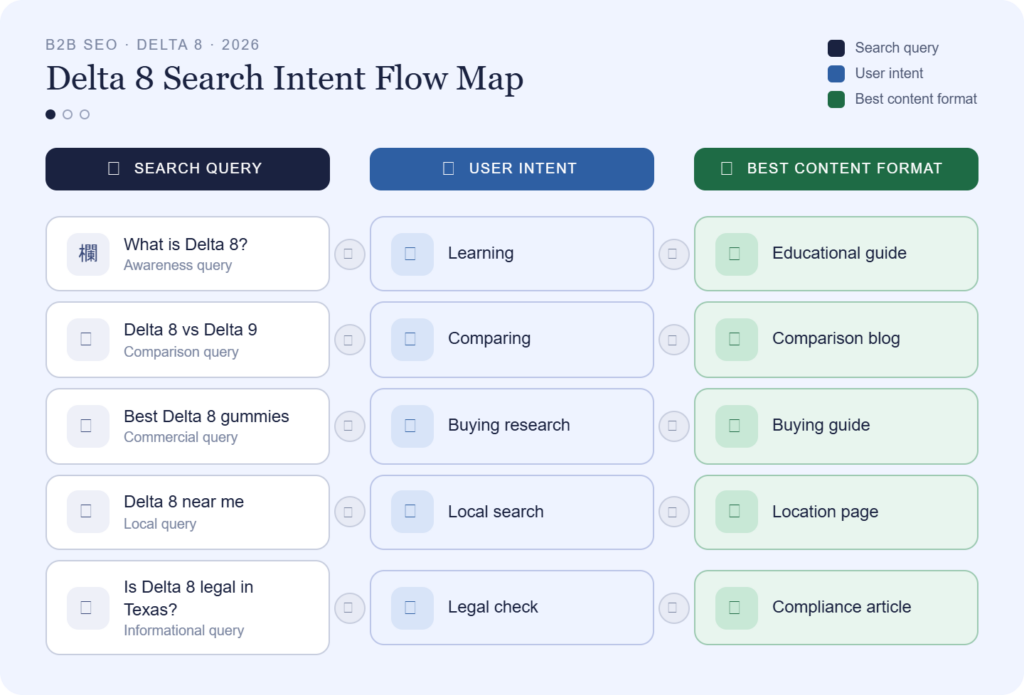
A strong Delta 8 SEO content plan starts by matching each keyword with the result type Google already rewards. Before creating the outline, use these quick checks to decide what the page should actually become.
1. Check the SERP before assigning the topic. If Google shows guides, write a guide. If it shows product pages, build a commercial page. If it shows local results, plan location-focused content.
2. Read keyword modifiers carefully. Words like “what,” “how,” and “legal” suggest learning intent, while “best,” “near me,” “buy,” and “coupon” show stronger buying intent.
3. Use keyword tools before finalizing topics. Platforms like Semrush, Ahrefs, and Google Keyword Planner can help check search volume, keyword difficulty, CPC, and SERP competition before adding a term to the calendar.
4. Prioritize keywords by ranking opportunity. A practical Delta 8 content plan should balance high-volume terms with easier long-tail searches before moving into the content pillars.
The 5 Content Pillars for Delta 8 Websites
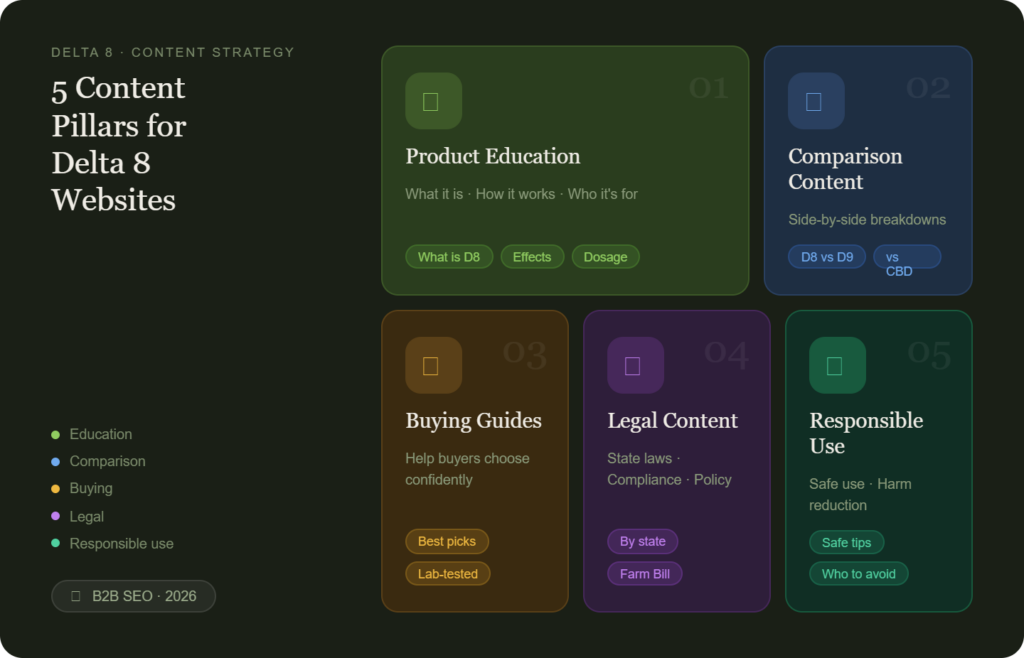
After the search intent is mapped, topics should be grouped into content pillars. This keeps the blog focused and makes sure each page supports a different stage of the buyer journey.
Use these pillars to determine which types of content belong in your Delta 8 content strategy.
1. Product Education: For First-Time Searchers
Cover the basics users need before they compare products. Use this pillar for:
- What is Delta 8?
- What are Delta 8 gummies?
- What does a COA show?
- How do product labels help buyers compare options?
2. Comparison Content: For Shoppers Weighing Options
These topics help users understand differences without pushing them straight to checkout. Best angles include:
- Delta 8 vs Delta 9
- Delta 8 vs CBD
- Gummies vs carts
- Edibles vs vapes
3. Buying Guides: For Decision-Stage Readers
This content should help users make cleaner purchase decisions. Focus on:
- Label checks
- COA checks
- Shipping policies
- Product format selection
- Brand comparison points
4. Legal and Compliance Content: For Risk-Aware Buyers
Delta 8 shoppers often want to know whether a product can be bought, shipped, or used in their state. Cover:
- State law updates
- Age requirements
- Shipping restrictions
- Product disclaimers
- Packaging and claim guidelines
5. Responsible Effects Education: For Sensitive Search Demand
Effects-related searches exist, but the content must stay careful. Keep the focus on general expectations, product clarity, and responsible wording instead of unsupported claims.
Many Delta 8 websites cover the right topics, but leave them disconnected. A stronger approach ties each pillar to search intent, internal links, and the next useful step, which is central to our Delta 8 marketing process.
Compliance Checks Before Publishing Delta 8 Content
Delta 8 content should pass a review before it goes live. This matters most for pages about effects, legality, shipping, and product claims.
Use this pre-publish checklist:
✔️ Remove medical claims that suggest Delta 8 treats, cures, or prevents a condition.
✔️ Avoid youth-focused wording, visuals, or examples.
✔️ Review state laws, shipping limits, and age-related details.
✔️ Add COAs, ingredient details, disclaimers, and product transparency where relevant.
✔️ Keep the ‘effects language’ educational rather than promise-driven.
✔️ Avoid copycat snack-style framing or casual language around restricted products.
| This step should not make the content boring. It should make it more dependable. |
30 Delta 8 Blog Topic Ideas That Rank
The best Delta 8 blog topics are easier to plan when they are grouped by intent. Use this table as a quick visual guide before building briefs.
| Search intent | What do the readers want? | Best topic examples | Format to target |
| Learning | Basic product clarity | 1. What Is Delta 8 THC?2. Delta 8 vs CBD3. What Are Delta 8 Gummies? | Beginner guide |
| Comparing | Help choosing between options | 1. Delta 8 vs Delta 92. Gummies vs Carts3. Delta 8 vs HHC | Comparison blog |
| Buying | Purchase support | 1. How to Choose Delta 8 Gummies2. What to Check Before Buying Delta 83. How to Read a COA | Buying guide |
| Legal | Rules and restrictions | 1. Is Delta 8 Legal in 2026?2. Delta 8 Laws by State3. Can Delta 8 Ship to My State? | Compliance article |
| Local | Nearby purchase research | 1. Delta 8 Near Me2. Where to Buy Delta 8 Locally3. Online vs Local Delta 8 Shopping | Local SEO page |
| Trust | Brand confidence | 1. Delta 8 Buying Mistakes2. How to Compare Delta 8 Brands3. Delta 8 Product Label Guide | Checklist or FAQ |
Your Delta 8 Editorial Plan: A Simple 90-Day Framework
A Delta 8 editorial plan gives the topic list a publishing order. The goal is to build from basic education to stronger commercial and authority-focused content.
| Month 1 should build the base. | Start with beginner topics, legality basics, Delta 8 vs Delta 9, Delta 8 vs CBD, and product format explainers. |
| Month 2 should support buying decisions. | Move into COA guides, product label explainers, format comparisons, buying checklists, and beginner-friendly product guides. |
| Month 3 should strengthen authority. | Add law updates, local SEO content, shipping guides, FAQs, and refreshes for older posts. |
👉🏻 A 90-day plan should not be treated solely as a posting schedule. It should include keyword priority, brief direction, internal links, publishing order, and update dates. That planning layer is built into our Delta 8 marketing services, so content supports rankings rather than just filling a calendar.
Use AI Carefully, Not Automatically
Many Delta 8 brands now rely on AI for every piece of THC content marketing, and that is where quality usually drops.
AI can help with outlines, topic clustering, keyword grouping, FAQ ideas, and first-draft structure. It should not replace legal review, product knowledge, brand judgment, or human editing.
So, the better approach for Delta 8 brands is to:
- Use AI to organize research, not to invent claims.
- Add human review for legality, product accuracy, and compliance.
- Include brand-specific examples, COA references, shipping policies, and real buyer questions.
- Edit every section for usefulness before optimizing for keywords.
- Remove generic lines that could appear on any hemp or CBD website.
| AI can speed up production, but it cannot create trust on its own. That still comes from accuracy, clarity, and editorial control. |
How to Optimize Delta 8 SEO Content for Featured Snippets?
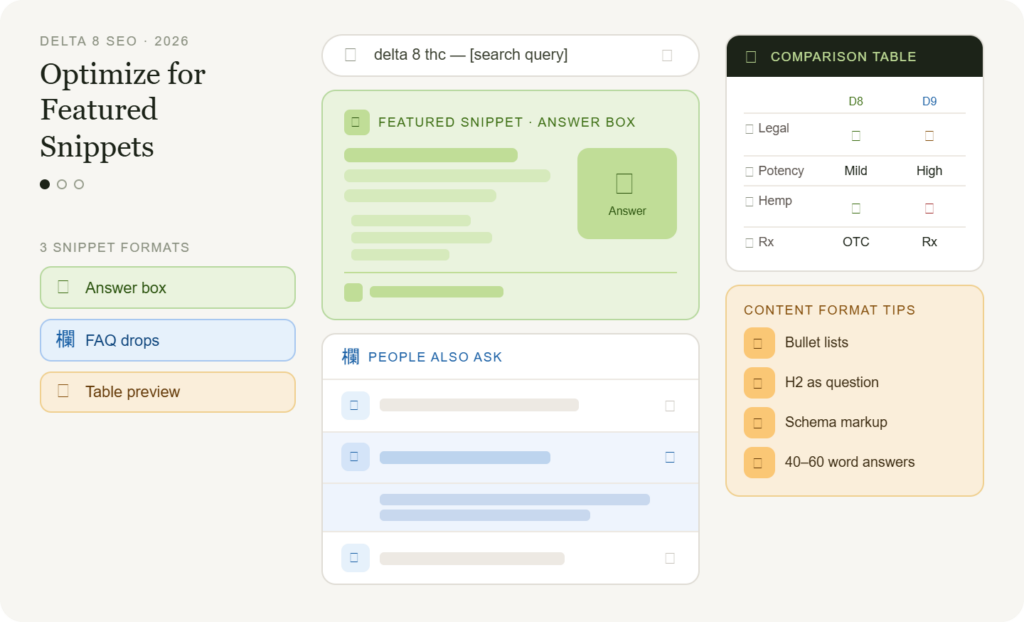
A strong Delta 8 content strategy should make answers easy for both readers and search engines to understand. Featured snippets usually favor pages that answer questions directly, so formatting matters as much as topic selection.
For Delta 8 SEO content, clarity should come before clever wording. Use this approach:
- Answer the main question within the first few lines.
- Use H2s and H3s that match real search phrasing.
- Add short definitions before detailed explanations.
- Use tables only when comparison is easier visually.
- Add FAQs for follow-up questions.
- Keep legal and effects-related wording careful.
- Remove long introductions that delay the answer.
Once the content base is strong, Delta 8 backlinks can help strengthen authority around the pages that matter most.
| Good snippet optimization is not about stuffing keywords. It is about making the answer simple, useful, and easy to pull into search results. |
How to Measure Whether Your Delta 8 Content Plan Is Working?
A Delta 8 content strategy should be measured by progress, not traffic alone. Start with a simple review every month so the team can see what is ranking, what needs refreshing, and which pages are helping users move forward.
⭐ Check visibility first.
Use Google Search Console to review impressions, clicks, CTR, and changes in ranking.
⭐ Review user behavior next.
Use GA4, Microsoft Clarity, or Hotjar to see scroll depth, page movement, drop-off points, and visits from blogs to product or contact pages.
⭐ Validate keyword direction.
Use Semrush, Ahrefs, or Google Keyword Planner to check keyword gaps, difficulty, and topic opportunities.
For a faster starting point, you can get a website audit report delivered in a day for just $11.95 and use it to spot content, technical, and SEO gaps before updating the plan.
Final Thoughts
A Delta 8 content strategy in 2026 should connect search intent, topic planning, compliance review, AI-assisted editing, and performance tracking. The strongest plans help buyers understand the category, compare options, verify trust signals, and move through the site with less confusion.
If your team already has topic ideas but needs a sharper SEO structure behind them, contact us to turn the plan into a working content roadmap.
FAQs
How long does Delta 8 SEO content take to rank?
It can vary. Some pages may start gaining impressions within weeks, but stronger ranking movement depends on site authority, keyword difficulty, content depth, internal links, backlinks, indexing, and SERP competition.
Should a Delta 8 content strategy include “near me” keywords?
Yes, of course, a Delta 8 content strategy should include “near me” keywords. “Near me” keywords matter when a Delta 8 company wants local visibility, store traffic, or location-based search demand.
How can Delta 8 brands build topical authority without keyword stuffing?
Build topic clusters instead of repeating the same keyword everywhere. Create a main Delta 8 hub, then support it with focused pages on legality, product formats, comparisons, COAs, shipping, effects education, and FAQs. EEAT also matters here: add expert review, transparent sourcing, updated legal details, COA references, and author/editor signals.
How can Delta 8 brands write SEO content without medical claims?
Focus on product education, labels, COAs, ingredients, legality, shipping rules, and comparison support. Avoid language that says Delta 8 treats, cures, prevents, or manages any condition. Keep effect-related content general, careful, and, where relevant, backed by product-specific details.
What should a Delta 8 blog content cluster look like?
Start with a single main hub, such as a Delta-8 beginner guide or a category guide. Then build supporting blogs around Delta 8 vs Delta 9, Delta 8 gummies, COA checks, legality by state, shipping rules, “near me” searches, and buyer FAQs. Each page should answer a separate intent and link back to the main hub.
What is the best content funnel for Delta 8 ecommerce?
A strong funnel usually starts with education, moves into comparisons, then supports buying decisions, and ends with trust-building content like COAs, shipping details, FAQs, and policy pages. It could still depend on the site’s product range, state restrictions, target locations, current authority, and whether the brand sells online, locally, or both.