Vape link building is not as simple as getting backlinks from any website that accepts guest posts. Vape brands often deal with stricter publishing rules, limited advertising options, and fewer websites willing to mention nicotine-related topics. That makes every backlink choice more important.
A strong strategy focuses on relevant websites, natural anchor text, useful content angles, and placements that make sense for both readers and search engines. The goal is not to collect random links, but to build authority through backlinks that support your niche, target pages, and long-term rankings.
In this guide, we’ll cover practical tactics, common risks, backlink checks, and link velocity for vape websites.
Why Link Building Is Especially Tricky For Vape Sites?
Vape websites do not get the same link-building freedom as regular e-commerce brands. The niche sits close to nicotine, age-restricted products, advertising limits, and changing product rules. That means outreach is slower, publisher approval is harder, and every backlink has to be chosen with more care.
FDA classifies vapes as electronic nicotine delivery systems, and Google Ads does not allow ads for tobacco products or products designed to simulate smoking. This makes organic visibility even more important for vape brands.
Why Generic Link Building Does Not Work?
Generic link building usually focuses on getting links from any website with decent authority. That approach can fall flat for vape brands.
A backlink from an unrelated blog may look good in a report, but it may not support topical relevance. For vape websites, the better route is selective vape link building i.e.
✔️ Relevant publishers ✔️ Natural anchor text ✔️ Useful content ✔️ Logical placements.
This is how vape backlinks build authority without looking forced.
Safe Link Building Practices For Vape Websites Without Triggering Penalties
A strong vape link building strategy is not about collecting links from every site that says yes. The goal is to earn placements from websites where the topic, audience, and backlink fit naturally.
Google’s spam policies warn against links created mainly to manipulate search rankings, so every backlink should have a real editorial reason behind it. That is especially important in a restricted niche like vaping.
Before choosing a tactic, ask one simple question:
‘ Would this link still make sense if rankings were not involved? ‘
If the answer is yes, the tactic is usually worth considering.
Here are the white-hat methods that make the most sense for vape websites without increasing the risk of penalties.
1. Niche Vape Guest Posting
Vape guest posts can work well when they are built around useful topics, not sales-heavy content. A publisher is more likely to accept an article that informs readers, explains a trend, or answers a specific question.
Good guest post angles include:
- Vape buying mistakes beginners should avoid
- Differences between vape product categories
- Retail trends in the vape industry
- Compliance-aware shopping tips
- Local vape store guides
- Wholesale vape market insights
This is how you can find sites:
👉🏻 Use Google searches like “write for us” + vape, review competitor backlinks in tools like Ahrefs or Semrush, and check vape forums or community sites that allow contributor content or resource links.
| Tip: Pitch the article idea first. The backlink should feel like a natural reference inside the content, not the whole reason the article exists. |
2. Content Assets That Can Attract Links Naturally
Some pages attract links because they are genuinely useful. Vape brands can create content assets that publishers may want to reference, such as:
- Vape glossary pages
- State-by-state legality guides
- Beginner buying guides
- Product comparison explainers
- Industry statistics pages
- Retailer checklists
These assets make outreach easier because you are not asking for a random mention. You are giving websites a helpful resource to cite.
3. PR And News-Based Link Acquisition
PR-based link building works when the brand has something newsworthy to share. This can include a store opening, product category expansion, event participation, a survey, an industry report, or expert commentary on vape regulations.
Google recommends creating helpful, people-first content rather than content made mainly for search engines. PR links fit that idea when the story is useful, timely, and relevant.
👉🏻 Use platforms like HARO (Help a Reporter Out) to respond to journalist queries in the health, lifestyle, or regulation space. Even indirect mentions in relevant articles can earn you strong backlinks.
4. Podcasts, Webinars, And Strategic Collaborations
Some backlinks come from participation, not traditional outreach. Vape brands can earn relevant mentions by joining podcast interviews, webinars, guest speaking sessions, expert roundups, or industry collaborations.
These opportunities can include:
- Podcast interviews: Show notes often include a link to the guest’s website.
- Webinar appearances: Speaker bios, registration pages, or recap posts can feature the brand.
- Expert roundups: Contributors usually get credited with a mention or backlink.
- Co-authored content: Joint guides, reports, or surveys can attract links from both sides.
- Industry partnerships: Campaign pages, resource pages, or announcement posts can create niche-relevant visibility.
These placements work because the mention is tied to a real contribution. Even without a direct backlink, brand mentions, and co-citations beside trusted vape or industry websites can still support topical authority.
5. Directory Submissions For Vape Brands
Directory submissions can help vape brands, especially local stores and wholesale suppliers. But the directory must serve an actual user need.
Look for directories such as:
- Vape-specific directories
- Local business directories
- Retail directories
- Chamber of commerce websites
- Trade-show or event directories
Avoid directories that accept every website without review. These usually create weak links and may not add meaningful vape SEO authority.
How To Evaluate A Backlink Before You Accept It?
A backlink should not be approved only because the website has a high DR. For vape websites, the better question is: does this link come from a relevant, active, and trustworthy page?
As per Semrush’s backlink value evaluation guide, relevance, authority, placement, link attributes, and anchor text all influence backlink quality. For vape DR building, this means DR should never be checked alone.
The easiest way to avoid weak placements is to review each backlink through a fixed quality filter. So before you accept any vape backlinks, refer to this table.
| Quality signal | How to judge it? |
| Topical relevance | ✔️ The site should connect to vaping, CBD, retail, smoking alternatives, or a related niche. |
| Authority | ✔️ A strong domain helps only when the site has real credibility. |
| Organic traffic | ✔️ Real visitors matter more than inflated metrics. |
| Content quality | ✔️ The page should be original, useful, and properly edited. |
| Link placement | ✔️ A link inside the article body is stronger than one in a footer or sidebar. |
| Anchor text | ✔️ The anchor should sound natural, not keyword-stuffed. |
| Link attributes | ✔️ Check if the link is dofollow, nofollow, sponsored, or UGC. |
| Outbound links | ✔️ Too many unrelated links can make the page look spam-heavy. |
What To Avoid — Tactics That Can Trigger A Penalty
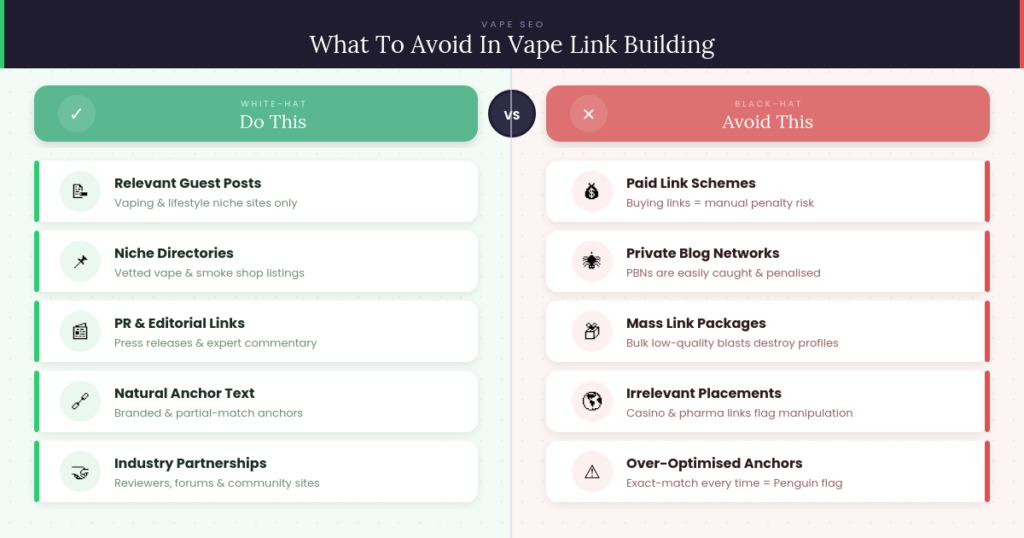
Black-hat vape link building usually shows up in the form of paid links, PBNs, mass link packages, irrelevant placements, copied guest posts, and over-optimized anchor text. These shortcuts may look useful when publisher options are limited, but they often create a backlink profile that feels forced instead of earned.
The risk is higher for vape websites because relevance already matters more in this niche. A backlink should support the topic, audience, and page it points to. When it does not, the link can undermine trust rather than build authority.
A Quora thread on paid backlinking has a similar take. One contributor says paid backlinks may help rankings “provided you don’t get caught,” while another warns that link spamming can hurt “online credibility.”
Paid Links, PBNs, And Irrelevant Placements
- Paid links become risky when they are bought mainly to pass ranking value.
- PBNs create a similar issue because these websites are often built to pass link equity, not to serve real readers.
- Irrelevant placements are also a problem. A vape link on a cooking blog, travel site, or random general website does little for vape SEO authority and can look manipulative at scale.
Use this table as a quick filter before accepting or building any backlinks:
| Avoid this tactic ⚠️ | What can it cost you? |
| Paid links without proper tags | They can look manipulative when built only for rankings. |
| PBN links | They usually exist for SEO, not real readers. |
| Mass link packages | Sudden links from random domains can look unnatural. |
| Irrelevant placements | They add little topical value to a vape website. |
| Low-quality directories | Thin pages with no review process rarely build authority. |
| Copied guest posts | Reused content makes the placement look low-effort. |
Placement quality is only one part of the risk. The words used to link back to your site can also make a backlink look natural or forced.
Over-Optimized Anchor Text
Even if the website looks relevant, anchor text can still make the backlink look unnatural. Repeating the same keyword-heavy anchor across multiple placements can make vape backlinks look forced.
A safer mix includes:
- Brand names
- Naked URLs
- Partial-match phrases
- Page-title anchors
- Natural contextual anchors
The backlink should read like a helpful reference, not an SEO insert.
👉🏻 Finding relevant publishers in the vape niche can be difficult when so many websites reject nicotine-related content. At CBD Marketing Solutions, we are one of the best vape link building services providers for brands that need niche-focused outreach, relevant placements, and stronger search visibility.
Link Velocity: How Fast Should You Build Links?
Link velocity is the pace at which a website earns new backlinks. In vape link building, this pace should look steady, relevant, and supported by real content activity.
A common benchmark is 3 to 5 high-quality backlinks per week for new websites. Established websites may build faster, often around 14 to 18 new referring domains per month, especially when backed by PR, content marketing, or trending topics.
Still, these numbers are not fixed rules. The right pace depends on website age, current backlink profile, competition, content quality, and brand activity.
A sudden spike from random websites can look unnatural in the vape niche. The safer approach is simple: build consistently, not aggressively. Quality and relevance should guide the pace, not just a monthly link target.
Why Many Websites Avoid Vape Content?
Many publishers do not reject vape content because the article is weak. They reject it because the category itself feels difficult to handle.
Common reasons include:
- Editorial risk: Some websites do not want nicotine-related links on their pages.
- Audience mismatch: Vape topics may not suit family, wellness, lifestyle, or general shopping blogs.
- Regulatory updates: Product rules, flavor restrictions, and compliance topics can change quickly.
- Reputation concerns: High-authority websites may avoid categories that feel controversial.
- Extra review work: Editors may need more checks before approving vape guest posts.
| Did you know? A strong domain rating alone does not make a backlink useful. Relevance matters more when the niche is sensitive. |
Which Platforms Take A Similar Approach?
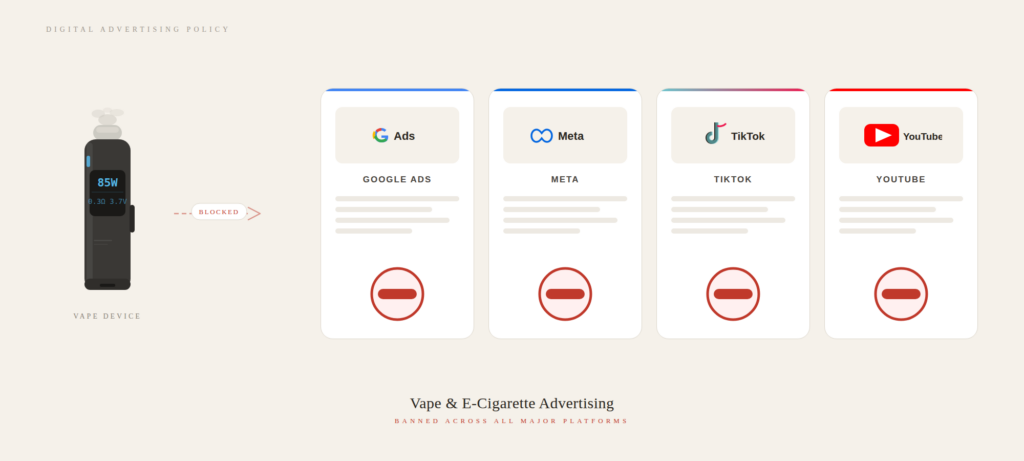
Major platforms also limit vape promotion, which shows why the niche needs a careful organic strategy.
- Google Ads: Does not allow ads for tobacco, tobacco components, or products designed to simulate smoking.
- Meta: Restricts ads that promote tobacco, nicotine products, and electronic nicotine delivery devices.
- TikTok Ads: Does not allow ad content or landing pages that show, promote, or sell tobacco, nicotine, or related products.
- YouTube: Does not allow content that directly sells, links to, or facilitates access to nicotine, including vaping products.
| Quick extra insight! Health sites, guest-post marketplaces, programmatic news sites, and moderated social platforms often keep vape content at a distance. |
The Takeaway
Vape link building needs a careful balance of relevance, quality, and patience. The best vape niche links come from publishers that understand the niche, pages that match the topic, and anchors that fit naturally inside the content.
Shortcuts like PBNs, paid links, mass packages, and irrelevant placements may look easy, but they rarely support long-term rankings. A safer strategy is to build links steadily, review every placement carefully, and focus on backlinks that make sense for both search engines and readers.
At CBD Marketing Solutions, link building is just one part of the broader vape marketing support we provide. Contact us to build a strategy that supports stronger visibility across the right channels.
FAQs
How long does vape link building take to show results?
Vape link building usually takes a few months to show clear movement. Results depend on the website’s current authority, competition, content quality, and the strength of the backlinks built. A steady campaign is more useful than expecting instant ranking jumps.
How much does vape link building cost?
The cost depends on publisher quality, niche relevance, content requirements, and the number of backlinks needed. Low-cost bulk packages may look tempting, but relevant placements from real websites usually require a higher budget and better outreach.
Where can I buy vape backlinks?
You can buy vape backlinks from niche SEO agencies, link building service providers, or publishers that accept vape-related content. The safer choice is to work with providers that focus on relevant websites, transparent placements, and natural anchors like us.
Is vape link building the same as vape affiliate marketing?
No. Vape link building focuses on earning backlinks from relevant websites to improve search authority and organic visibility. Vape affiliate marketing focuses on promoting vape products through partners who earn a commission from sales or leads. Both may involve links, but their purposes differ.
Can vape backlinks help local vape stores?
Yes, local vape stores can benefit from backlinks from local directories, community websites, event pages, business associations, and relevant niche blogs. These links can support both organic visibility and local search presence when they point to the right local landing pages.