
A strong Kratom digital marketing strategy needs more than basic e-commerce advice. Kratom brands have to think about search rankings, careful wording, buyer trust, and helpful product education at every step. Paid ads can be tricky, platform rules may change, and every piece of content needs to be written with the right level of care.
At CBD Marketing Solutions, we help brands in restricted spaces grow with smarter SEO, useful content, and practical marketing steps. This guide breaks down the major channels, tracking tools, and action points Kratom brands can follow in 2026.
The Kratom Market Landscape In 2026: Market Size, Regulation, And Rising Competition
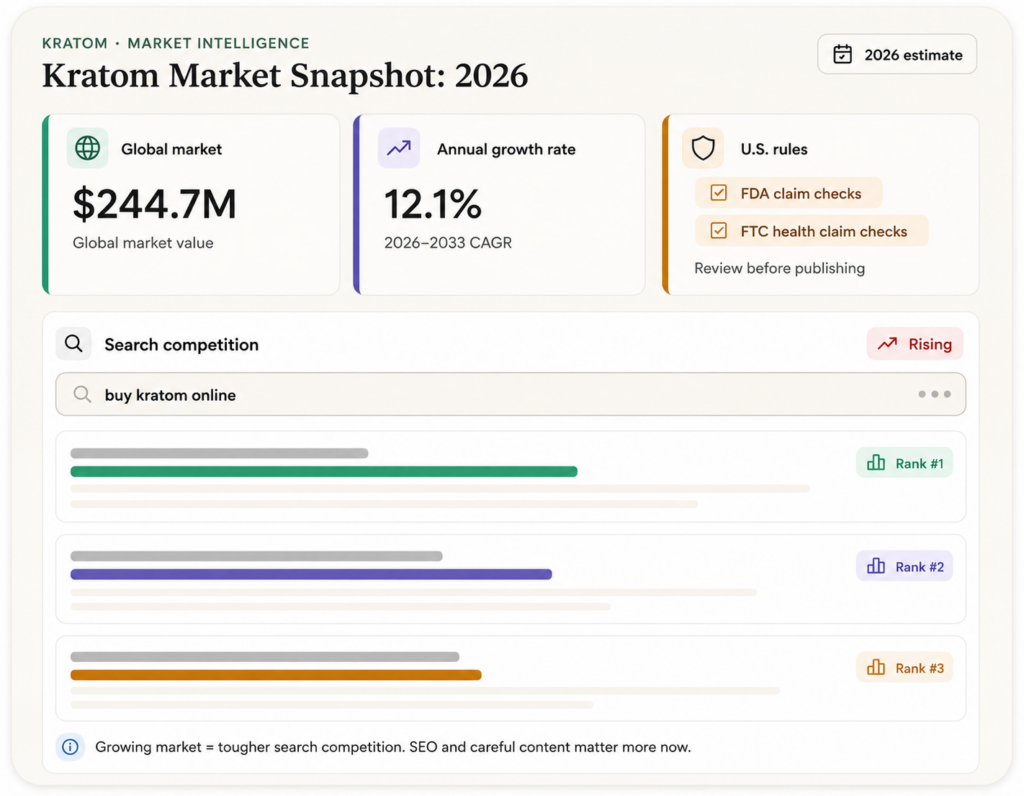
The Kratom market is growing, and brands can already feel that in search results. The global market is valued at $244.7 million, with a projected 12.1% yearly growth rate from 2026 to 2033. More sellers are trying to reach the same buyers, which means stronger competition for keywords, content topics, and buyer trust.
In the U.S., Kratom brands also have to work around strict federal attention. The FDA says Kratom is not lawfully marketed as a dietary supplement and cannot be added to regular foods. The FTC has also warned Kratom sellers about unsupported health claims, especially claims around treatment, withdrawal, pain, or disease-related concerns.
So the challenge is not just “how do we market Kratom?” It is “how do we get found, and avoid claims that can create trouble?”
Why Kratom Marketing Is Not Like Regular E-commerce?
Kratom brands deal with more limits than a regular online store. Ads, payments, laws, product claims, and email tools can affect traffic, orders, and buyer trust.
Ads are not the easy win here
Google, Meta, TikTok, and other major platforms can make it difficult for Kratom brands to run promotions. SEO and helpful content often work better because they reach people already searching.
Payment processors may reject Kratom stores
Stripe, PayPal, and similar payment processors may refuse to work with Kratom sellers. Without the right payment partner, checkout can slow down or fail.
Kratom laws change by location
Kratom rules vary across the U.S. Some states and cities do not allow sales, so shipping rules matter before orders come in.
Content cannot promise results
The FDA has not approved Kratom for medical use. Product pages, blogs, emails, and ads must avoid treatment or cure claims.
Some ’email tools’ may reject Kratom stores
Email platforms reject Kratom sellers, while others reduce inbox reach for product emails.
Because of these limits, it is high time brands should have a strong Kratom digital marketing strategy in place.
Main Promotion Channels For Kratom Brands
Kratom brands cannot afford to spend effort everywhere and hope something works. The better route is to focus on channels that bring the right traffic, answer buyer questions, support repeat orders, and make performance easier to track.
Major promotion channels for Kratom brands include:
- SEO for organic search visibility.
- Link building for stronger search authority.
- Content marketing for buyer education.
- Affiliate marketing for partner-led reach.
- Email marketing for repeat communication.
- Analytics for tracking what works.
| Paid traffic may still have a place in broader brand campaigns, but the core of a Kratom marketing strategy should usually be search-first. |
Kratom SEO Strategy
Since SEO is the first channel in this plan, start with search intent. Kratom buyers do not all search with the same goal.
👉🏻 Some want to buy, some want answers, and some want a nearby store.
A strong Kratom digital marketing strategy maps each keyword to the right page instead of pushing every term into one blog.
Use keyword research to decide what each page should do. Refer to the table below for that matter.
| Keyword type | Best page to target it | Examples |
| Buyer keywords | Product and category pages | ‘Buy kratom online’‘Kratom online for sale’ |
| Question keywords | Blogs, FAQs, and guides | ‘What is kratom?’‘Is kratom legal?’ |
| Local keywords | City pages or store locator pages | ‘Kratom near me’‘Kratom shop in Tampa’ |
| Comparison keywords | Blog posts or buying guides | ‘Kratom powder vs capsules’‘Red vs green kratom’ |
| Brand keywords | Review pages, homepage, and trust pages | ‘ABC brand review’ ‘best brands to buy kratom online’ |
| Want to find exact terms your store can target? Consider reading: Kratom Keyword Research: How to Find the Best Terms for Your Store? | ||
After that, tighten each page.
- Add the main keyword in the title, H1, intro, and meta details only where it fits.
- Use related terms.
- Add internal links from blogs to product, category, and service pages.
- Fix slow pages, broken links, messy URLs, duplicate content, and mobile layout issues.
- Add FAQs that help the buyer make sense of the topic.
Related Reading: 7 Kratom SEO Strategies That Actually Drive Organic Traffic
Want a niche marketing team to manage the strategy for you? Turn to us. We help Kratom brands bring SEO, keyword research, content optimization, blog management, affiliate marketing, and link building into one search-first growth plan.
Link Building & Authority Growth
Publishing strong content is only one part of Kratom SEO. Your website also needs mentions from relevant sites because those links help search engines see that your pages deserve attention.
Begin with these link opportunities:
- Pitch guest post ideas to wellness, botanical, hemp, or niche ecommerce blogs.
- Ask relevant resource pages to include your guide if it adds value to their readers.
- Create partner articles with retailers, distributors, suppliers, or industry publications.
- Share brand updates, educational resources, founder stories, or research-backed content with PR sites.
- Prioritize websites that already rank, get traffic, and cover topics close to your niche.
| Avoid cheap link packages and websites with no connection to Kratom. Those links may fill a report, but they rarely support long-term Kratom brand building. |
As outreach grows, a basic spreadsheet can become hard to manage. GrowLinks helps keep website research, quality checks, email outreach, pricing details, and approval steps in one place, so every link opportunity is easier to review before it goes live.
Kratom Content Marketing
SEO brings people to the website. Kratom content helps them understand the product, compare options, and check important details before they buy.
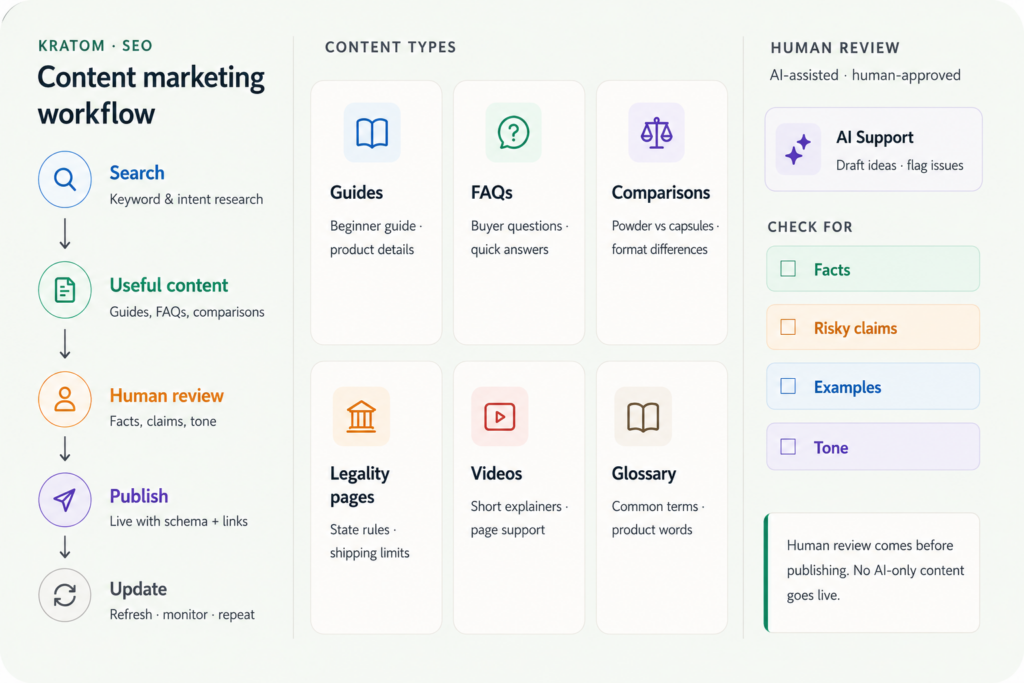
Every blog, guide, FAQ, or video should answer one useful question. Keep the wording simple. Talk about product details, buying factors, lab reports, shipping, legality, and brand information. Avoid treatment, cure, pain, withdrawal, or disease-related claims.
Useful content formats to target:
- Beginner guides
- State legality explainers
- Product comparison articles
- Buyer checklists
- FAQ pages
- Short educational videos
- Glossary style resources
- Blog updates based on changing search demand
Follow this checklist pre-publishing/uploading:
- Answer one main question per page.
- Add examples where the topic may confuse new buyers.
- Link blogs to related product, category, or service pages.
- Turn long blogs into short videos, email topics, and social posts.
- Update legality, shipping, and product-detail pages when information changes.
AI can help, but it cannot carry the content
Many brands now use AI to draft blogs faster. That is fine, but AI alone can make content sound like every other article online.
Google still wants content that helps real people. Its Google AI Search guidance says SEO still matters for AI search, but pages need useful details, a fresh point of view, and value beyond what anyone can repeat. A page made only to target keywords or copy common answers will not do much for a serious Kratom brand.
So, for Kratom-related content, use AI for support, not final judgment.
✔️ Check the facts.
✔️ Remove risky claims.
✔️ Add brand-specific examples.
✔️ Make the final piece sound like it came from someone who understands the niche.
Kratom Affiliate Marketing
Affiliate marketing can bring your Kratom brand in front of people who already follow niche blogs, review sites, product guides, and wellness-focused publishers. It works best when partners have the right rules in place before they start promoting.
Start with these basics:
- Choose affiliates who already speak to the right audience.
- Give partners approved product details and claim-safe talking points.
- Use trackable links or coupon codes for every partner.
- Review affiliate content before it goes live.
- Watch traffic quality, not just clicks.
- Check which partners bring sales, repeat buyers, and clean promotion.
- Share new product updates only with partners who follow the rules.
| The biggest mistake is treating affiliates like a quick sales shortcut. |
| A good Kratom affiliate program should protect your Kratom’s brand message first, then scale with the right partners. |
If you plan to add affiliates to your growth mix, read our Kratom Affiliate Marketing Guide. It walks through partner rules, tracking, promotion control, and setup steps in more detail.
Kratom Email Marketing
Email can help your Kratom store bring back past buyers, answer common questions, and share updates without waiting for ad approval.
This should be your plan: the list has to be clean, the platform you choose to forward emails has to allow the business, and the message has to avoid risky claims.
But first, get the basics right:
➙ Get a clear opt-in
Send emails only to people who signed up through the website, the checkout process, or a form. Skip rented lists, scraped contacts, and old contacts with no consent.
➙ Choose a Kratom-friendly email platform
Some popular tools, including Mailchimp and Klaviyo, have rules that can affect Kratom merchants, so check the policy before building email flows.
➙ Keep claims out of every email
Do not say Kratom can treat, cure, prevent, or manage any disease.
➙ Send useful content, not only offers
Share strain or format explainers, COA updates, lab-testing notes, shipping updates, and Kratom Consumer Protection Act news.
➙ Watch list quality
High spam complaints can quickly damage the sending domain, so remove inactive contacts and keep the unsubscribe option easy to find.
Analytics & Tracking For Kratom Brands
Tracking helps Kratom brands see where marketing is working and where money, content, or effort leaks out. A ranking drop, low click rate, slow page load, or poor email response can point to a bigger issue before it hurts sales.
Watch these metrics every month:
| Metric | Good sign | Bad sign |
| Impressions | More people see your pages in search. | Google is not showing your pages enough. |
| Clicks | Searchers choose your result. | Titles or topics may not match intent. |
| CTR | Your title gets attention. | Your meta title may feel weak or unclear. |
| Rankings | Important keywords move up. | Competitors may have stronger content or links. |
| Page actions | Visitors view products, forms, or carts. | The page may not guide buyers well. |
| Email complaints | Very low complaint rate. | The list may have poor opt-ins or weak content. |
Numbers usually tell a story.
- High impressions with low clicks often point to weak titles.
- Traffic with no product views may indicate the page attracts the wrong audience.
- Good rankings with poor sales may indicate that buyers need more trust signals, clearer product details, or smoother checkout steps.
GSC, GA4, & Ahrefs Setup
Use free and paid tools together. Google Search Console shows how people find the site in Google Search, while GA4 helps track what visitors do after they land on the website, as outlined by Google’s Search Console and Analytics guidance.
Free tools include Google Search Console, GA4, and Google PageSpeed Insights. Paid tools like Ahrefs, Semrush, and Screaming Frog help with keyword tracking, backlink analysis, competitor pages, and technical audits.
At CBD Marketing Solutions, we use these tools to find what went right, what went wrong, and what needs attention next. Along with building a strong Kratom digital marketing strategy, we also share a detailed website audit report for $11.95, delivered within 24 hours. Contact us and spot SEO, content, and website issues before spending more on marketing.
What Most Kratom Marketing Guides Miss: A 90-Day Action Plan
Implementing an effective Kratom digital marketing strategy becomes easier when the work follows a month-by-month plan.
Use the calendar below to see what to check first, what to improve next, and what to review before spending more time or money.
First 30 days: Check the website basics
Start with the parts that affect traffic, trust, and orders.
- Review the homepage, category pages, blogs, and checkout.
- Remove treatment, cure, pain, withdrawal, or disease-related claims.
- Set up Google Search Console and GA4.
- Write down the main keywords for products, blogs, and local pages.
- Find pages with thin, old, or repeated content.
- Check payment, shipping, and state sales tax rules.
- Note which pages already bring traffic.
Days 31 to 60: Improve pages & publish helpful blogs
Use the first month’s notes to clean up weak areas.
- Rewrite weak category pages.
- Publish four to six helpful blogs.
- Add links from blogs to related product or service pages.
- Add FAQs for common buyer questions.
- Improve pages about lab reports, shipping, legality, and product details.
- Shortlist websites that may accept a guest post or brand mention.
Days 61 to 90: Get ‘mentions’, send ’emails’, & review results
Check what is working and continue with the parts showing progress.
- Start link outreach.
- Set up basic email flows.
- Review affiliate partners.
- Update older blogs that still get traffic.
- Check clicks, rankings, sales actions, and email results.
- Pause work that brings no useful result.
- Spend more time on pages and channels showing steady progress.
If your Kratom brand wants such an action plan handled by a niche team, our Kratom marketing services have got you covered. It starts with one consultation.
Common Kratom Marketing Mistakes To Avoid: Big No No
Watch for these mistakes before they slow down the full plan.
❌ Writing for keywords but not buyers.
❌ Using the same angle across every blog. If every article repeats the same basic information, Google and readers have no strong reason to care.
❌ Ignoring internal links. Blogs, category pages, service pages, and guides should connect naturally.
❌ Letting old content sit for too long. Kratom laws, buyer questions, and search results can change. Review older blogs and update anything outdated, thin, or no longer useful.
❌ Checking rankings but not page actions. A keyword moving up is good, but the page also has to get clicks, send readers to the next step, or support sales.
❌ Using generic ecommerce advice. Kratom marketing has its own limits, so the plan has to match the niche rather than copying what works for regular online stores.
FAQs
Why has Kratom become so popular?
Kratom has gained attention because more people know about it now, more stores and online sellers offer it, and many buyers search for it because of its reported effects.
Can Kratom brands run paid ads?
No, not through most mainstream ad networks in the usual way. Kratom advertising is difficult because the FDA does not consider Kratom lawfully marketed as a dietary supplement, and Google Ads monitors unapproved pharmaceuticals and supplements under its healthcare policy. Meta also restricts ads for unsafe substances, products, or supplements.
What is the 70 20 10 rule in digital marketing?
The 70-20-10 rule helps brands allocate their marketing efforts. Spend 70% on proven channels that already work, 20% on improving or expanding those channels, and 10% on new ideas. For your Kratom brand, that could mean 70% in SEO and content, 20% in email and affiliate growth, and 10% in testing new content formats or AI SEO ideas.
What is the best Kratom digital marketing strategy in 2026?
The best strategy is a combined effort. Kratom brands usually need SEO, helpful content, link building, affiliate marketing, email, tracking, and careful claim review working together. AI SEO matters now, but AI-generated content still needs human editing & fact-checking.
How much will an agency charge to come up with a working Kratom digital marketing strategy?
The cost varies from agency to agency. It depends on the work required, the services you choose, the size of your business, the condition of your current website, and whether the agency needs to start from scratch or improve an existing plan.
How long does Kratom SEO take to work?
3 to 6 months to show early traction and 6 to 12 months to bring stronger, longer-lasting results. Established websites may see movement in 30 to 90 days. However, the exact timeline depends on content quality, competition, backlinks, technical SEO, and how often the site improves.
Don’t Market Kratom Blindly In 2026
A strong Kratom digital marketing strategy in 2026 starts with knowing where your website stands today. Check the pages that bring traffic, review the claims on your site, choose keywords that match buyer intent, and make sure your email, affiliate, and tracking systems are not working in separate directions.
From there, focus on the channels that matter most: SEO, useful content, trusted partners, and monthly performance checks. The market is growing, but so is the competition. The sooner you fix weak spots, the easier it becomes to earn better visibility.